
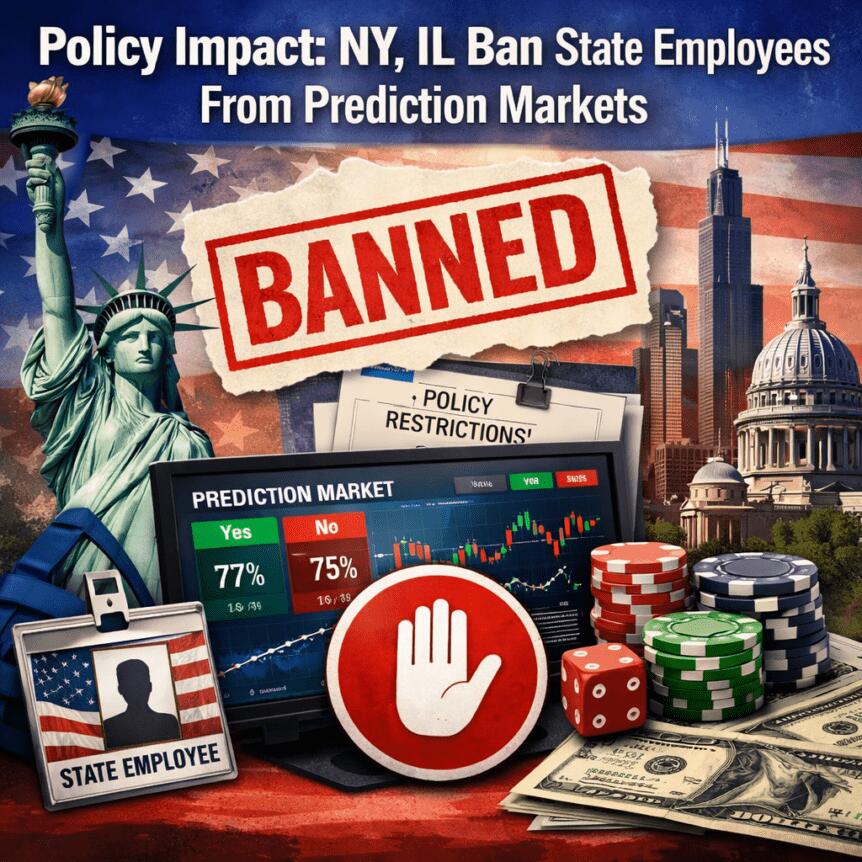
New York Governor Kathy Hochul signed an executive order barring state employees from participating in prediction-market betting, adding a formal layer of ethics rules to a sector that has seen rapid growth and rising scrutiny. The move follows a similar order issued by Illinois earlier in the week and underscores a broader policy shift as authorities weigh the implications of insider information and market manipulation in event-based markets.
Hochul framed the policy as a defense of public integrity, stating that “getting rich by betting on inside information is corruption, plain and simple.” The executive order also criticizes the federal policy environment for permitting an “ethical Wild West” around prediction markets without meaningful standards to curb insider trading. The directive makes clear that violations may lead to dismissal and could invite law enforcement action, while explicitly prohibiting state employees and officers from assisting others in profiting on confidential information through prediction markets.
Illinois moved in a parallel direction, with Governor JB Pritzker issuing an executive order that expands state ethics oversight in response to the rapid expansion of online prediction markets and event-based betting contracts. A formal statement from Illinois framed the action as a reinforcement of transparent governance and a preventative measure against insider trading as these platforms gain scale and reach across public life. The two states’ actions reflect a growing concern among policymakers that prediction markets, while useful for information aggregation, can become vectors for illicit trading if not properly restricted.
The movement comes amid mounting attention on how prediction markets operate when sensitive information may influence outcomes such as geopolitical events, military actions, or major policy decisions. Hochul cited specific cases that have drawn scrutiny over potential insider trades involving U.S. military action, pointing to instances where confidential information appeared to intersect with trading activity. These references illustrate why state-level ethics rules are becoming a focal point for both compliance programs in public administration and the private platforms that host these markets.
Key takeaways
- State-level ban on official participation: New York’s executive order prohibits state employees from engaging in prediction-market betting and signals a broader intent to curb conflicts of interest within public service.
- Parallel action in Illinois: Illinois issued a similar executive order, reinforcing ongoing regulatory attention to insider trading risks in prediction markets and setting a precedent for other states.
- Rapid market growth with regulatory risk: Prediction markets have seen sustained growth in volume, with March activity reaching a record level, highlighting the tension between information efficiency and insider-trading risk. According to Cointelegraph, monthly volumes climbed to $23.6 billion in March as markets expanded across sports, elections, and business outcomes.
- Notable enforcement activity: High-profile cases and platform actions illustrate tightening enforcement around insider trading, including actions involving traders and platform operators as scrutiny intensifies.
- Platform regulatory battles: Kalshi faces ongoing regulatory friction in multiple states, including cease-and-desist actions and court proceedings, with potential implications for how event-based contracts are treated under state gaming and wagering laws.
Insider trading concerns and enforcement dynamics in prediction markets
The discourse around prediction markets has increasingly moved from theoretical debates about market efficiency to concrete enforcement concerns. Hochul’s executive order anchors that shift in law, linking ethics violations with tangible consequences for public service employees. The references to suspected insider trading tied to U.S. military actions highlight the practical stakes when confidential information intersects with trading activity online. While platforms argue that they operate within a framework designed to protect against misuse, regulators have repeatedly signaled that gaps in oversight could undermine public trust and market integrity.
Market participants have noted that prediction markets often cover high-stakes events—ranging from geopolitical developments to corporate earnings—creating incentives for non-public information to leak into trading activity. In response, platform operators have pursued their own oversight measures. For example, reports on enforcement actions against participants who wager on personal candidacies or other sensitive events illustrate that private platforms are increasingly expected to police and sanction behavior that may hamper fair markets. The broader takeaway for analysts and compliance teams is that estimation of risk now must include a robust review of how information flows are managed and how enforcement mechanisms align with public ethics obligations.
Beyond individual cases, the regulatory zeitgeist is pressing for stronger framework alignment across jurisdictions. The mounting attention from state governments to predict-market governance dovetails with ongoing debates about how event-based derivatives should be regulated, including where they fit within general securities, gaming, or consumer-protection laws. While the federal approach to prediction markets remains unsettled, state-level actions are effectively shaping the practical operating environment for platforms and participants alike. For institutions, this translates into tighter internal controls, enhanced KYC/AML considerations, and a heightened focus on conflicts-of-interest policies when dealing with internal or confidential information that could influence trading decisions.
Kalshi, Nevada, and New York: regulatory friction products a broader compliance map
The regulatory landscape for prediction-market platforms has become a focal point in several states. The Kalshi platform, which operates on event-based contracts, has faced a series of regulatory challenges as states seek to determine whether such contracts constitute illegal gambling or require separate licensing regimes. In New York, the State Gaming Commission issued a cease-and-desist order related to Kalshi’s unlicensed mobile wagering activities within the state, highlighting the complexities of regulating digital prediction markets within traditional gaming frameworks. Separately, a lower court in Nevada temporarily blocked Kalshi from operating in the state, with regulators arguing that the contracts facilitated unlicensed gambling. The outcomes of these actions could have far-reaching implications for how prediction markets are treated under state licensing regimes and gaming laws.
Industry observers note that the regulatory tension surrounding Kalshi underscores a broader question about the status of prediction-market platforms in the U.S. If these platforms are deemed to operate as unlicensed gambling venues, they may face a cascade of licensing and enforcement actions across multiple states. Conversely, if authorities reconcile these products under a securities or commodity framework—or carve out a clear regulatory pathway—the sector could experience clearer compliance roadmaps. In public commentary, some industry participants have indicated that the regulatory question could eventually reach the Supreme Court, depending on how lower court rulings align with existing interpretations of gambling, securities, and commodities law. Such a development would carry implications for the permissible boundaries of event-based derivatives and the proper boundaries of government interference in private market activity.
For market participants and compliance teams, these regulatory dynamics call for heightened vigilance around platform governance, trade monitoring, and the handling of non-public information. As enforcement actions proliferate at the state level, firms must reassess internal controls, including the segregation of confidential information, conflict-of-interest disclosures, and the scope of permissible trading for employees and affiliated entities. The evolving precedent could also influence cross-border considerations, as global regulators evaluate whether similar governance models require standardized minimum standards or a more harmonized approach to event-based contracts and their financial or social risks.
Regulatory policy in a broader policy and market-structure context
While the U.S. state-level actions form a syndicate of ethics and compliance measures, observers are increasingly aligning these moves with broader policy debates. The rapid growth of prediction markets—driven by platforms that cover sports outcomes, elections, and business events—has intensified scrutiny of how these markets integrate with traditional financial and gaming regulatory regimes. In parallel, global policy evolution, including frameworks like the European Union’s MiCA, continues to shape how mainstream crypto-asset markets and related derivatives are governed. Although MiCA focuses primarily on crypto assets and their regulatory treatment, its approach to licensing, transparency, and cross-border activity offers a useful reference point for institutions navigating multi-jurisdictional compliance in rapidly evolving financial technologies. The comparative lens underscores the importance of robust, auditable governance structures, clear definitions of permissible activities, and consistent enforcement signals to support institutional adoption and compliance resilience.
For corporate counsel, risk managers, and financial investigators, the current trajectory suggests a dual emphasis: strengthening internal ethics regimes within public bodies and ensuring external platforms implement clear, enforceable standards that deter insider trading and manipulation. The thread tying these developments together is a clear move toward explicit governance of information flows, robust monitoring for suspicious activity, and a defined path for regulatory action when rules are bent or broken. This alignment is essential not only for market integrity but also for preserving trust among participants, investors, and the public sector that depends on orderly, predictable oversight of these innovative markets.
In sum, the surge in prediction-market activity is meeting a corresponding escalation in regulatory attention. State governments are taking concrete steps to limit conflicts of interest within public service, while enforcement against platform operators and traders intensifies the legal and regulatory risk landscape. As legal challenges unfold and potential Supreme Court consideration looms, market participants should expect continued clarity and continuity in compliance expectations, alongside ongoing innovations in platform governance and risk controls.
Closing perspective: the evolving regulatory framework for prediction markets will shape best practices across governance, monitoring, and cross-border operations. Institutions should monitor not just state actions but the legal ripples that may reach federal policy, court rulings, and potentially international standards as these markets mature.
https://www.cryptobreaking.com/policy-impact-ny-il-ban/?utm_source=blogger%20&utm_medium=social_auto&utm_campaign=Policy%20Impact:%20NY,%20IL%20Ban%20State%20Employees%20From%20Prediction%20Markets%20
Comments
Post a Comment