
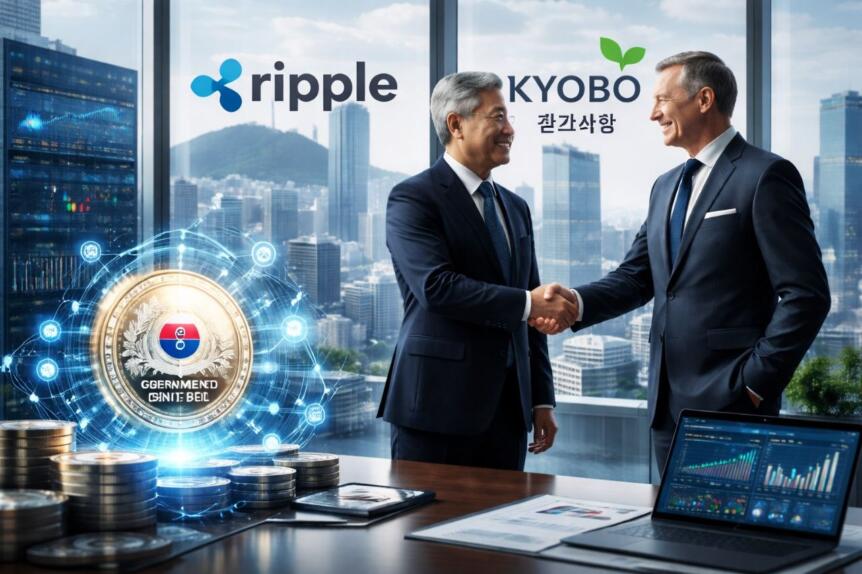
Ripple and Kyobo Life have teamed up to modernize Korean government bond settlement. The partners will test tokenized transactions through Ripple Custody in a regulated institutional setting. Kyobo is the first Tier 1 Korean insurer to take this step with Ripple. Ripple said the model could reduce settlement from two days to near real time.
Ripple and Kyobo Life Begin On-Chain Bond Settlement Work
Ripple announced the partnership in Seoul on April 15, 2026. It is Ripple’s first collaboration with a leading Korean insurance institution. The project centers on tokenized government bond settlement inside a regulated environment. Both companies released the announcement on Wednesday.
Kyobo Life is one of Korea’s largest and oldest life insurers. The company will use Ripple Custody to hold, transfer, and settle tokenized assets. That setup replaces fragmented and manual bond workflows with transparent on-chain execution. The work will start with custody-led settlement flows.
https://twitter.com/Ripple/status/2044219980602863659?s=20
Ripple said custody is the starting point for broader digital asset services. Those services may later include payments, liquidity, and treasury management. The company said the project offers a model for other regulated institutions. Ripple described that path as gradual and regulated.
Ripple Custody Targets Faster Trade Settlement
Government bond trades often settle two business days after execution. Ripple said on-chain settlement can move that timeline closer to real time. Faster settlement can lower counterparty risk and free up capital sooner. That could improve balance sheet use for institutions.
Ripple Custody is built for banks and other regulated financial firms. The platform supports secure movement, record keeping, and settlement activity. It also gives institutions one system for custody and transaction processing. The platform combines custody with settlement support.
Fiona Murray, Ripple’s managing director for Asia Pacific, described Korea as a key market. She said, "It is available, proven, and ready to deploy in Korea today." She added that Ripple sees a long-term role in Korea. Ripple said the company views this work as part of a broader market effort.
Kyobo Reviews Wider Payment and Market Use
The partners will also review stablecoin-based payment rails for institutional use. Those rails could support round-the-clock transactions within a compliant framework. The firms will also assess technical and regulatory feasibility in Korea. That review covers technology needs and compliance checks.
Jin Ho Park, a senior executive vice president at Kyobo Life, explained the aim. He said, "This is about validating how traditional financial instruments can operate securely on blockchain." Kyobo linked the work to its wider digital transformation plans. Kyobo said the effort goes beyond digital asset storage.
Ripple said the deal adds to its growth in Korea. The company noted that Korea began licensing remittance payment providers in 2017. The partnership shows how insurers can test digital asset infrastructure inside regulated markets. Ripple also said its Korean business activity has been growing.
https://www.cryptobreaking.com/ripple-and-kyobo-life-bring/?utm_source=blogger%20&utm_medium=social_auto&utm_campaign=Ripple%20and%20Kyobo%20Life%20Bring%20Korean%20Government%20Bond%20Settlement%20on%20Chain%20in%20Korea%20
Comments
Post a Comment