
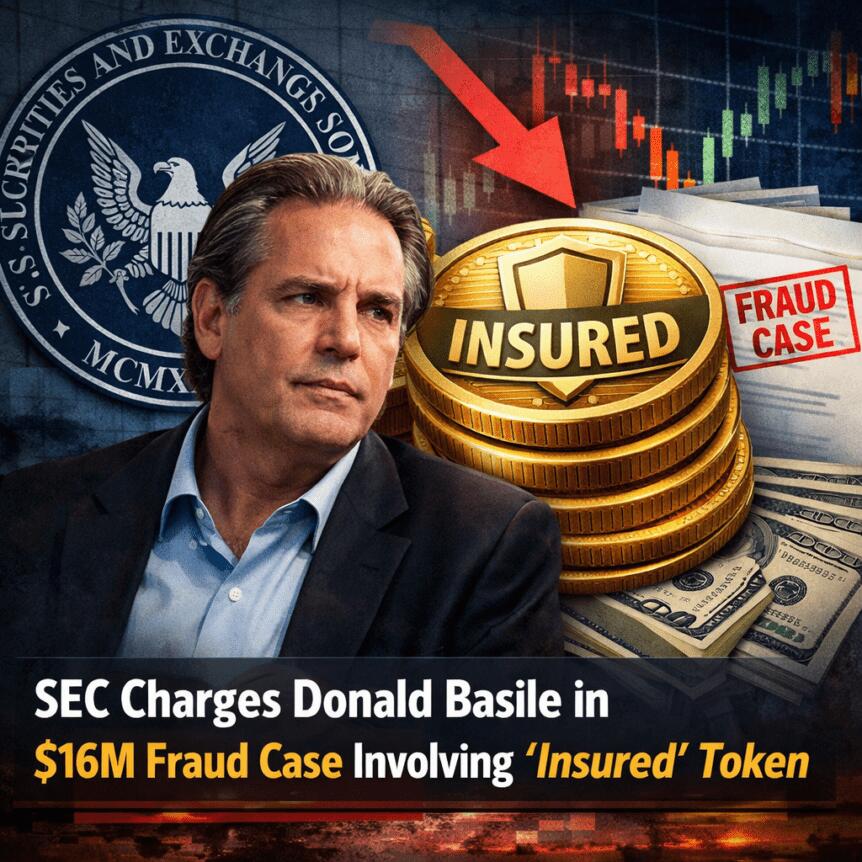
The U.S. Securities and Exchange Commission filed a civil complaint in the Eastern District of New York accusing crypto executive Donald Basile and two entities he controlled of raising about $16 million from investors through a scheme tied to a purportedly insured crypto token, Bitcoin Latinum. The regulator says Basile conducted the offering through Monsoon Blockchain Corp. and GIBF GP Inc. during 2021, using Simple Agreements for Future Tokens that promised future delivery of the token.
Regulators allege that hundreds of investors were told Bitcoin Latinum was insured and asset-backed. The complaint, supported by reporting from The Wall Street Journal, asserts no insurance carrier ever provided coverage or any proof of the claimed backing. The SEC has moved to unwind the transactions and hold Basile accountable for what it calls false representations about the asset and its security backing. According to The Wall Street Journal.
The case arrives amid ongoing questions about crypto enforcement priorities in a landscape where regulators have signaled a shift in approach. Cointelegraph notes that actions like this stand out as relatively few enforcement efforts under the Trump-era regulatory posture, which some observers described as more crypto-friendly compared with earlier administrations. The SEC has framed its current stance as a move away from “regulation by enforcement” toward targeting fraud, market manipulation and serious abuses of trust, even as it pursues specific securities-related allegations in the crypto space.
Key takeaways
- The SEC alleges Donald Basile and two affiliated entities raised about $16 million through SAFTs tied to Bitcoin Latinum, with the tokens promised to be delivered in the future.
- Investors were told the asset was insured and backed, but regulators say no insurance coverage or credible backing proof was ever provided.
- Funds reportedly flowed to personal use, including real estate purchases, credit-card payments and the acquisition of a $160,000 horse, according to the SEC’s allegations.
- The agency is seeking permanent injunctions, disgorgement with interest, civil penalties and an officer-and-director ban for Basile, while Bitcoin Latinum’s own site currently returns a 404 error.
Allegations and the mechanics of the offering
The SEC’s complaint details a scheme in which Basile, working through Monsoon Blockchain Corp. and GIBF GP Inc., marketed Bitcoin Latinum as a protected asset available through SAFTs. The agreements purported to secure future delivery of the token to investors who contributed capital in the belief that their investment would be backed by insurance and real-world value. The complaint implies that the core premise—that an insurer provided coverage or verifiable backing—was never realized, according to The Wall Street Journal’s reporting on the filings.
From 2021’s March to December window, the actions allegedly misrepresented the token’s risk profile and protection to investors. The SEC’s filing seeks to unwind the arrangements and recover alleged ill-gotten gains with interest, alongside civil penalties. The agency also seeks to bar Basile from participation in future securities offerings, underscoring its broader objective of deterring misrepresentation in crypto fundraising activities.
Regulatory posture and the broader backdrop
The SEC’s broader enforcement narrative has been evolving. In a week when the agency criticized past crypto cases for not delivering direct investor benefits, officials highlighted the importance of meaningful protections rather than simply expanding enforcement volume. Since fiscal 2022, the SEC has reported bringing 95 actions and collecting about $2.3 billion in penalties for “book-and-record” violations, even as it acknowledged that several cases involving crypto registration and dealer definitions did not clearly demonstrate investor harm.
Under Chair Paul Atkins, appointed in 2025, the SEC has signaled a reorientation toward prioritizing fraud, market manipulation and trust abuses over broad, volume-based enforcement. While the Bitcoin Latinum case is not framed as a back-to-basics reset, it sits within a climate in which the agency asserts it is focusing resources on cases with demonstrable harms to investors and systemic risk, rather than pursuing actions solely to expand case counts.
The status of Bitcoin Latinum itself adds another layer to the story. The project’s official site has since returned a 404 error, complicating attempts to verify project details or investor claims in real time. This confluence of regulatory action and an unclear project footprint underscores the attention regulators are paying to token projects that market themselves as insured or asset-backed, and the importance for investors to demand verifiable backing and regulatory clarity before participating in token offerings.
For readers watching the sector, the Basile case signals a continued emphasis on disclosure, truth-in-advertising and the risk of misrepresentation in crypto fundraising. It also highlights the tension between innovation in tokenized instruments and the safeguards required to protect retail investors, particularly in structures that resemble securities while operating in a largely decentralized, global market. The evolving stance toward enforcement, investor protection and the meaning of “insurance” or “backing” in crypto assets will likely shape the regulatory dialogue in the months ahead.
What remains uncertain is how aggressively the SEC will pursue similar claims involving SAFT-like structures and whether more details about Bitcoin Latinum’s purported insurer, if any existed, will surface through the litigation process. Investors and builders will be watching for how the court addresses disgorgement calculations, potential penalties, and any implications for future token offerings that blend securities-like promises with decentralized technology.
As the case progresses, market participants will be keenly watching for interim rulings on injunctive relief and any early signals about how the court may interpret the line between investment contracts and digital assets marketed as insured or asset-backed. The next chapter will likely test how regulators differentiate genuine investor protections from overbroad or misapplied securities theories in a rapidly evolving crypto landscape.
Readers should stay tuned for updates on the legal proceedings and any related statements from the SEC about its enforcement priorities, as well as for any new information regarding Bitcoin Latinum’s status, project disclosures, and potential investor recourse.
https://www.cryptobreaking.com/sec-charges-donald-basile-in/?utm_source=blogger%20&utm_medium=social_auto&utm_campaign=SEC%20Charges%20Donald%20Basile%20in%20$16M%20Fraud%20Case%20Involving%20'Insured'%20Token%20
Comments
Post a Comment