
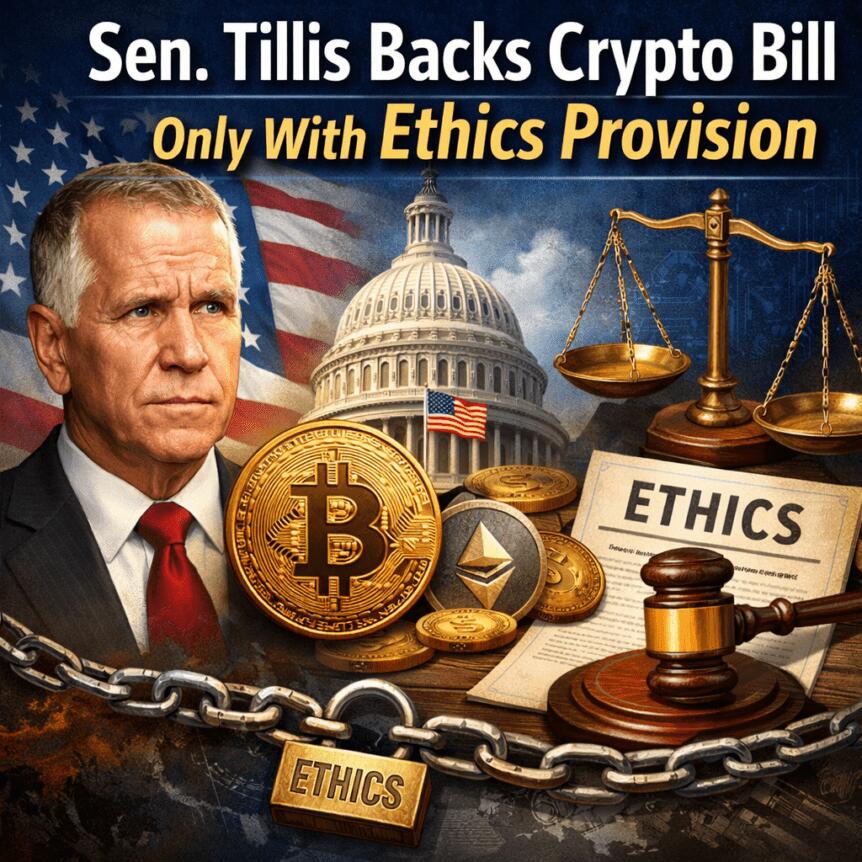
Senior Republican U.S. Senator Thom Tillis indicated that he will not support the Senate’s prospective crypto market structure legislation unless ethics provisions are included to constrain how White House officials may engage with digital assets. According to Politico, Tillis said there must be ethics language in the bill before it advances from the chamber, or he will oppose it.
Democratic Senator Ruben Gallego echoed the sentiment, stating that “there is no final bill — there is no final movement — unless there is a bipartisan agreement when it comes to the ethics provision.”
Tillis, who is slated to retire early next year, is a senior member of the Senate Banking Committee, the panel overseeing the legislation’s progress. The House of Representatives previously passed a version of the package, known as the CLARITY Act, in July. The Senate proposal would divide crypto regulatory responsibility between the Commodity Futures Trading Commission and the Securities and Exchange Commission and has faced protracted discussions, particularly on ethics language and questions surrounding stablecoin yield payments.
Lawmakers on both sides of the aisle have raised concerns about potential conflicts of interest tied to political figures and the crypto sector. Democratic lawmakers have criticized the activities of the Trump family’s crypto ventures and have sought to use the bill to address perceived conflicts of interest.
Talks on the ethics provisions are reportedly moving forward, though the exact language remains unsettled. “We’re making progress,” said Democratic Senator Adam Schiff to Politico. “We have been talking for a long time without making much progress, and now that other parts of the bill are starting to come together, we’re narrowing our differences.”
Schiff has previously signaled support for a comprehensive ethics framework that would constrain federal involvement with digital assets, including prohibitions on federal employees sponsoring, endorsing or issuing certain assets. He noted that such restrictions would apply broadly, potentially covering the president, who has publicly engaged with memecoins and NFT projects bearing his name.
As the policy process unfolds, the underlying regulatory architecture remains a central point of contention. The CLARITY Act’s approach to formally delineate jurisdiction between the CFTC and the SEC continues to be debated, with stakeholders concerned about gaps, preemption, and the treatment of complex instruments such as stablecoins. The negotiations also reflect a broader tension between enforcement aims and the creation of a clear, predictable regulatory framework for crypto markets.
Beyond the substantive regulatory mechanics, the discourse touches on how enforcement agencies—ranging from the SEC to the DOJ and the CFTC—will coordinate in policing digital-asset activities that intersect securities law, commodities rules, and anti-money-laundering standards. Compliance teams, exchanges, and financial institutions are watching closely for any shifts that could affect licensing, cross-border operations, and banking-crypto integration. The discussion also occurs within a wider international context, where peers in other jurisdictions are pursuing their own ethics and disclosure frameworks for political contributions and crypto-related sponsorships. For instance, Canada has moved to advance legislation addressing crypto political donations, illustrating how political finance considerations are converging with crypto regulation in multiple markets.
Industry participants are contending with a dynamic policy environment in which ethics provisions, if enacted, could shape how corporate actors interact with policymakers and legislators. The potential reach of a broad ethics regime—one that could apply to the president and other senior officials—would set a high compliance bar for political communications and asset endorsements, with implications for corporate governance, lobbying disclosures, and conflict-of-interest management.
In sum, the trajectory of the Senate’s crypto market structure bill remains contingent on the ethical guardrails inserted into the package. With the CLARITY Act already enacted in the House and ongoing negotiations in the Senate, the outcome will influence how regulators allocate oversight between the CFTC and SEC, how digital-asset products are treated under securities and commodities laws, and how public-private sector collaboration proceeds in a landscape marked by rapid innovation and heightened scrutiny.
Closing perspective: The next phase hinges on whether ethics provisions achieve bipartisan consensus. If such language is adopted, it could materially alter the policy trajectory, enforcement priorities, and compliance burdens for crypto firms and financial institutions operating in the United States.
https://www.cryptobreaking.com/sen-tillis-backs-crypto-bill/?utm_source=blogger%20&utm_medium=social_auto&utm_campaign=Sen.%20Tillis%20backs%20crypto%20bill%20only%20with%20ethics%20provision%20
Comments
Post a Comment