
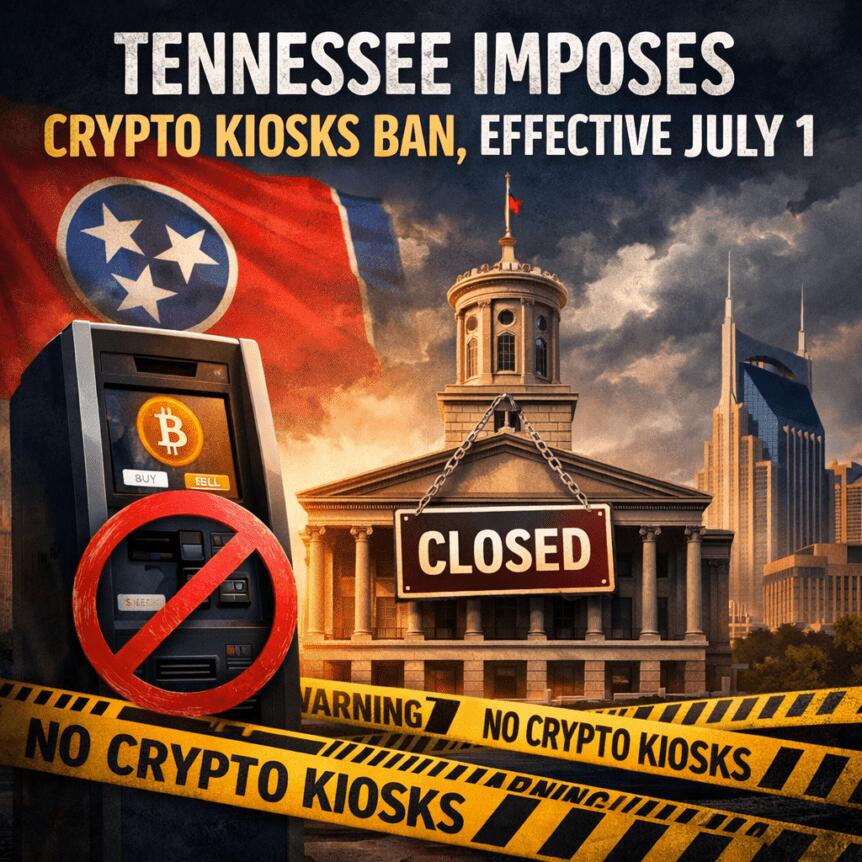
Tennessee Governor Bill Lee signed into law a bill that effectively curtails the deployment of cryptocurrency kiosks and ATMs in the state, setting a rapid compliance timeline for operators. House Bill 2505, enacted on April 13, reclassifies the installation of a crypto kiosk as a Class A misdemeanor beginning July 1, exposing operators and hosting venues to penalties of up to 11 months and 29 days in jail and a $2,500 fine for violations.
Industry data show Tennessee is home to more than 570 crypto kiosks and ATMs, with operators including Bitcoin Depot and CoinFlip active in the state. Market data reflected the regulatory development, as Bitcoin Depot’s Nasdaq-traded shares closed down roughly 6.9% on Monday, per Yahoo Finance, underscoring investor sensitivity to policy shifts affecting the on‑ramp sector.
The Tennessee measure sits within a broader pattern of state‑level actions aimed at crypto kiosks, particularly after episodes in which residents reported scams and other illicit activity linked to these machines. A Massachusetts town recently moved to ban the machines, and Minnesota’s State Senate advanced legislation that could extend a statewide prohibition.
“Virtual currency kiosks have become a gateway for scammers to exploit Tennesseans, especially our seniors, with little hope of recovering their money once it’s gone,” said Tennessee House Speaker Cameron Sexton, the sponsor of the bill.
Key takeaways
- HB 2505, signed by Governor Lee, bans the installation of cryptocurrency kiosks in Tennessee starting July 1, making violations a Class A misdemeanor with penalties up to 11 months and 29 days in prison and a $2,500 fine.
- Current data indicate Tennessee hosts more than 570 crypto kiosks and ATMs, operated by players such as Bitcoin Depot and CoinFlip.
- Bitcoin Depot’s stock performance reflected the regulatory environment, with shares down about 6.9% on the day of the law’s enactment.
- This move is part of a wider U.S. crackdown, with Massachusetts and Minnesota weighing or advancing restrictions on crypto kiosks in recent weeks.
- Federal data underline the risk environment: the FBI’s 2025 Internet Crime Report highlighted crypto and AI scams as costly, with more than 13,000 complaints about crypto ATMs and kiosks and losses topping $389 million.
Legislation tightens the screws on crypto on-ramps in Tennessee
The core of HB 2505 is a redefinition of what constitutes permissible activity around crypto-onramps within the state. By classifying the installation of a crypto kiosk as a Class A misdemeanor starting July 1, Tennessee suppliers and venues hosting these machines face meaningful criminal exposure for enabling such services. The policy rationale, as cited by supporters, centers on safeguarding residents—particularly seniors—from scams facilitated by kiosk-based crypto transfers. The bill’s sponsor, House Speaker Cameron Sexton, characterized the measure as a necessary response to escalating concerns about consumer protection in the digital currency space.
Industry landscape and market reaction
With more than 570 kiosks and ATMs reported in Tennessee, operators have built a sizable footprint in the state. The presence of major players like Bitcoin Depot and CoinFlip underscores the commercial importance of these machines even as regulators move to constrain their proliferation. The immediate market response—Bitcoin Depot’s stock decline on the day of the bill’s signing—illustrates the sensitivity of public markets to state regulatory shifts that could affect the economics of kiosk deployments, maintenance, and consumer trust.
Beyond Tennessee, the regulatory weather in the United States is increasingly heterogeneous. Massachusetts, for example, has seen local jurisdictions weigh bans on crypto kiosks, and Minnesota’s legislature has considered measures to ban or restrict the machines at the state level. Operators and investors alike are watching how these state-level actions might converge or diverge, potentially pushing the sector toward more centralized or alternative on-ramp channels.
Regulatory backdrop and the risk landscape for kiosk operators
The crackdown on crypto kiosks is taking place against a backdrop of rising enforcement activity in the broader crypto and digital‑asset sector. The FBI’s 2025 Internet Crime Report underscored that crypto and AI‑related scams were among the costliest threats to Americans online. The report documented more than 13,000 complaints tied to crypto ATMs and kiosks, resulting in losses of at least $389 million. Authorities point to scam modalities that exploit social engineering, including impersonation of family members or authorities to induce transfers to crypto wallets, highlighting why regulators view on‑ramp points as high-risk channels for illicit behavior.
The Tennessee measure also aligns with a broader policy trajectory that treats crypto kiosks as a potential vector for fraud, money laundering, and other illegal activities. As policymakers weigh additional restrictions, the on‑ramp sector could experience accelerated consolidation, relocation, or pivot toward regulated, compliant configurations that emphasize consumer protections and transparent fee structures. The coming weeks will likely determine which operators, if any, reconfigure their footprints in Tennessee and how other states respond to similar concerns.
For readers watching policy developments, the immediate question is how many more jurisdictions will introduce bans or tighter controls on crypto kiosks and what alternative on-ramps will emerge to serve users while balancing safety and innovation. The next regulatory moves in Minnesota, Massachusetts, and other states will be telling indicators of the sector’s trajectory in 2026.
https://www.cryptobreaking.com/tennessee-imposes-crypto-kiosks-ban/?utm_source=blogger%20&utm_medium=social_auto&utm_campaign=Tennessee%20Imposes%20Crypto%20Kiosks%20Ban,%20Effective%20July%201%20
Comments
Post a Comment