
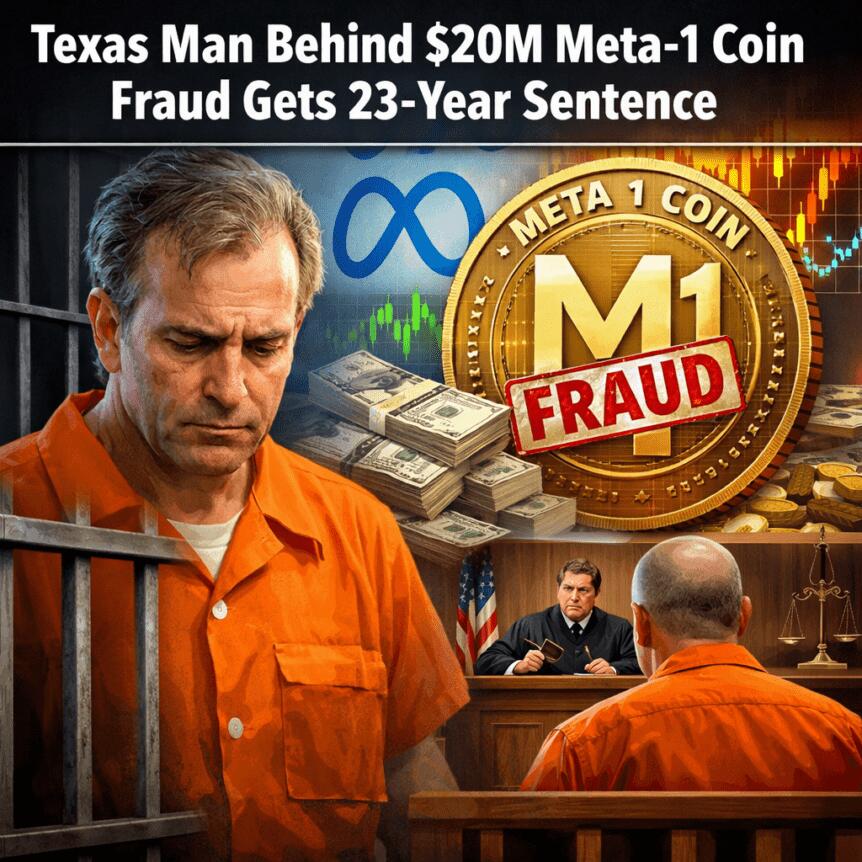
A Texas man who helped orchestrate a cryptocurrency scam that defrauded roughly $20 million from about 1,000 investors was sentenced to 23 years in federal prison on Tuesday. U.S. District Judge LaShonda Hunt handed down the sentence to Robert Dunlap, who served as a trustee for the Meta-1 Coin project and helped market the fictitious token.
According to the U.S. Attorney’s Office for the Northern District of Illinois, Dunlap and his co-conspirators used a self-created Meta Exchange to inflate the token’s market price and trading volume with automated trading bots, while presenting investors with misleading assurances about asset backing and potential returns. Prosecutors said the scheme relied on false statements and concealed expenses, with funds ultimately used for personal purchases, including luxury vehicles such as a Ferrari.
The defendant was convicted in November on two counts of mail fraud, each carrying a potential sentence of up to 20 years in federal prison. Prosecutors noted in the sentencing memorandum that Dunlap was “unrepentant” and that his misrepresentations escalated over time, underscoring the seriousness of the case as a warning to would-be crypto scammers.
The SEC has been active in pursuing similar schemes. In March 2020, the agency ordered an asset freeze and other emergency relief against Dunlap, an alleged accomplice, Nicole Bowdler, and former Washington state Senator David Schmidt to stop marketing and selling Meta-1 Coin. The SEC alleged that investors were told Meta-1 Coin was risk-free and could deliver enormous returns—claims that investors later learned were false. The agency noted that the coins were never distributed and that funds were diverted to personal use.
Token claims, market manipulation, and the broader crackdown
The case centers on Meta-1 Coin, a token that prosecutors said was touted as backed by a $1 billion art collection—including works by Picasso and van Gogh—and $44 billion in gold. Those asset-backed claims were part of the fraud profile presented by the government, which also described how Dunlap and associates marketed the token through a trust structure from 2018 to 2023. The government alleged investors were promised returns that would dwarf typical crypto gains, with figures that were manipulated to create an illusion of robust trading activity.
Beyond the Meta-1 case, regulators and authorities have signaled a broader push to curb crypto fraud and manipulation. In parallel reporting, authorities have pursued other crypto-related prosecutions, including charges related to hacking and DeFi-related exploits, underscoring a tightening stance as enforcement agencies increasingly scrutinize market misconduct in digital assets.
What this means for investors and the market
The Dunlap sentence highlights the risk profile of investment projects that promise outsized, rapid returns and rely on opaque asset claims. For investors, the case emphasizes the importance of due diligence, independent verification of asset backing, and a healthy skepticism toward platforms that blend trading activity with promises of instant wealth. For the crypto industry, the outcome signals regulators’ willingness to pursue not only misrepresentation but also the operational mechanics that enable such fraud, including automated market manipulation tied to self-hosted exchanges.
Looking ahead, readers should watch how the regulatory pendulum continues to swing on disclosure standards, enforcement actions, and the treatment of asset-backed crypto products. While the Meta-1 saga has reached a definitive sentencing point, the broader crackdown on crypto scams is far from over, with ongoing investigations and charges shaping market expectations for investor protection and compliance in the sector.
According to the U.S. Attorney’s Office in Illinois, the case serves as a stark reminder that alleged crypto fraud carries serious, long-lasting consequences. For further context, the original SEC filing and press release detailing the 2020 asset freeze are available through the agency’s public records.
https://www.cryptobreaking.com/texas-man-behind-20m-meta/?utm_source=blogger%20&utm_medium=social_auto&utm_campaign=Texas%20man%20behind%20$20M%20Meta-1%20Coin%20fraud%20gets%2023-year%20sentence%20
Comments
Post a Comment