
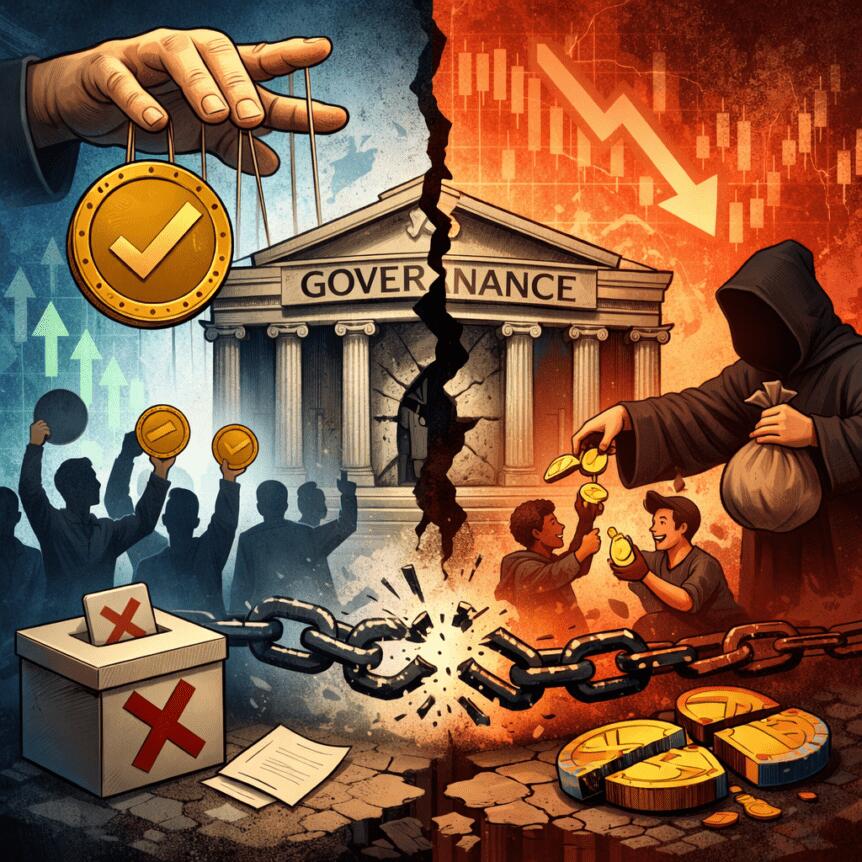
A crypto governance critique argues that token voting has not fulfilled its decentralized promise, and markets may offer a better coordination mechanism. In a perspective piece, Francesco Mosterts, co-founder of Umia, outlines why the early dream of “on-chain democracy” via token-weighted votes faces fundamental flaws—and how a market-based approach could reshape how on-chain organizations decide what to build and fund.
Mosterts emphasizes that crypto’s strength lies in markets: prices, incentives, and capital flows already coordinate almost every facet of the ecosystem, from token valuations to lending rates and blockspace demand. Yet when governance arrives, the system often abandons markets. He points to ongoing governance frictions across major protocols and a troubling pattern of participation and influence in DAOs. A recent study covering 50 DAOs found a persistent engagement gap: token holders vote inconsistently, and a single large voter can sway about 35% of outcomes, while four voters or fewer can influence two-thirds of decisions. In practice, this means governance power remains highly concentrated even as a decentralization narrative remains loud.
Key takeaways
- Token voting suffers from chronic underparticipation: most token holders abstain, leaving decisions to a small, active minority.
- Whales wield outsized influence, undermining the egalitarian premise of decentralized governance and risking outcomes dominated by a few large holders.
- There is no price signal attached to governance votes, creating misalignment between information, conviction, and action.
- Markets-based governance—where outcomes are priced and funded—could transform governance from expression of opinion into a mechanism of measurable conviction.
The promise and limits of token governance
The original vision of DAOs began with a simple idea: token holders would govern by voting on proposals, thereby aligning ownership with decision rights. The first wave of experiments—DAOs launched in 2016 and beyond—sought to replace centralized management with code-driven governance. Tokens, in theory, would symbolize both ownership and influence, enabling any participant to steer a protocol’s direction by casting a vote.
In practice, however, token voting has struggled to live up to that promise. Three core challenges repeatedly surface: participation, the dominance of whales, and incentive misalignment. Participation remains uneven, as many governance decisions require significant time and effort to review and analyze. The result is governance fatigue, with the majority of token holders remaining passive while a narrow cadre of participants makes the call on key proposals.
Whales compound the problem. Large holders can and do tilt outcomes, demoralizing ordinary voters who feel their input matters less than those with bigger balance sheets. This dynamic starkly contrasts with the ideal of a broad, democratic process where every tokenholder has a meaningful voice.
Then there’s the incentive issue. Governance voting lacks a direct economic signal—votes carry equal weight regardless of a voter’s information, due diligence, or risk tolerance. There is little price for being right or penalty for being wrong, which can encourage speculative or uninformed participation rather than careful, conviction-driven decision-making.
Why pricing decisions could fix governance
The argument pivots on a simple observation: crypto already uses markets to allocate capital, price risk, and signal conviction across a spectrum of activities. If governance can be integrated with pricing mechanisms, it could convert opinions into measurable expectations and align participation with real economic incentives. In other words, decision markets could monetize governance outcomes by letting participants buy and sell bets on proposed directions or policies, thereby revealing collective conviction through market activity.
Advocates of this approach point to several possible benefits. First, decision markets would incentivize participants to research proposals more thoroughly, because their capital at stake would fluctuate with the perceived success of a given outcome. Second, pricing governance outcomes would help surface true preferences and risk assessments, reducing the influence of uninformed voting and opportunistic behavior. Finally, markets could extend beyond mere protocol decisions to broader capital allocation—funding the most promising initiatives with transparent, incentive-aligned mechanisms from inception.
There is a growing sense in the ecosystem that the governance bottleneck—characterized by protracted debates, treasury disputes, and stalled proposals—is a symptom of the misalignment between how decisions are made and how value is created. If crypto wants governance to be a true coordination engine, it may need to borrow from markets more aggressively. Predictions markets, futures-like payoffs on governance outcomes, and futarchy-inspired mechanisms are increasingly revisited as potential pathways to price governance bets and coordinate action around credible forecasts.
What changes when governance is priced, not just voted on
Framing governance as a pricing problem could shift the dynamic from passive endorsement to active, informed risk assessment. By attaching economic signals to decisions, participants would be exposed to the consequences of their bets in real-time, incentivizing careful evaluation of proposals and potential trade-offs. The broader implication is a move from “vote for my preferred outcome” to “trade for the outcome you expect to materialize.”
Beyond improving participation and alignment, decision markets could influence how on-chain organizations allocate resources from day one. Startups and protocols might raise capital with built-in incentive structures for governance that reflect the true costs and benefits of proposed initiatives. In this view, token voting remains valuable for signaling preferences, but it becomes part of a wider system where markets determine which directions receive support and funding, and within what conditions.
As the ecosystem debates these ideas, it’s worth noting that some observers have already flagged governance tensions at prominent protocols. For example, coverage from Cointelegraph highlighted governance disputes around Aave’s exit from a DAO governance framework, underscoring the fragility of current models when high-stakes decisions collide with real-world incentives. The ongoing tug-of-war between governance control and treasury strategy illustrates how far the current approach is from a scalable, market-informed model.
What to watch next as markets reshape on-chain governance
The broader market is watching for experiments that meaningfully integrate pricing into governance. If decision markets can demonstrate durable improvements in decision quality and coordination speed without compromising decentralization, they could become a central feature of the next generation of on-chain organizations. The revival of discussions around futarchy, prediction markets, and other market-based coordination tools points to a phase of crypto where governance becomes less about voting rituals and more about economically rational decision-making under uncertainty.
Still, several questions remain unresolved. How would such markets be designed to prevent manipulation or collusion? What safeguards would ensure that price signals reflect diverse risk tolerances and long-term value creation rather than short-term speculation? And how would regulators treat on-chain decision markets that directly influence capital allocation and product strategy?
What’s clear is that token voting, while historically significant as crypto’s first big governance experiment, is unlikely to be the final answer to decentralized coordination. The next era could see governance complemented, or even superseded, by markets that price outcomes, align incentives, and actively guide what gets built with transparent, market-driven signals.
In the meantime, readers should monitor ongoing debates about how to harmonize decentralization with effective governance, particularly where treasury management, proposal execution, and cross-chain coordination are concerned. The direction crypto takes next—whether sticking with traditional voting or embracing a pricing-based framework—will shape how communities decide and fund the protocols they rely on every day.
https://www.cryptobreaking.com/token-voting-undermines-crypto-governance/?utm_source=blogger%20&utm_medium=social_auto&utm_campaign=Token%20Voting%20Undermines%20Crypto%20Governance%20and%20Incentive%20Alignment%20
Comments
Post a Comment