
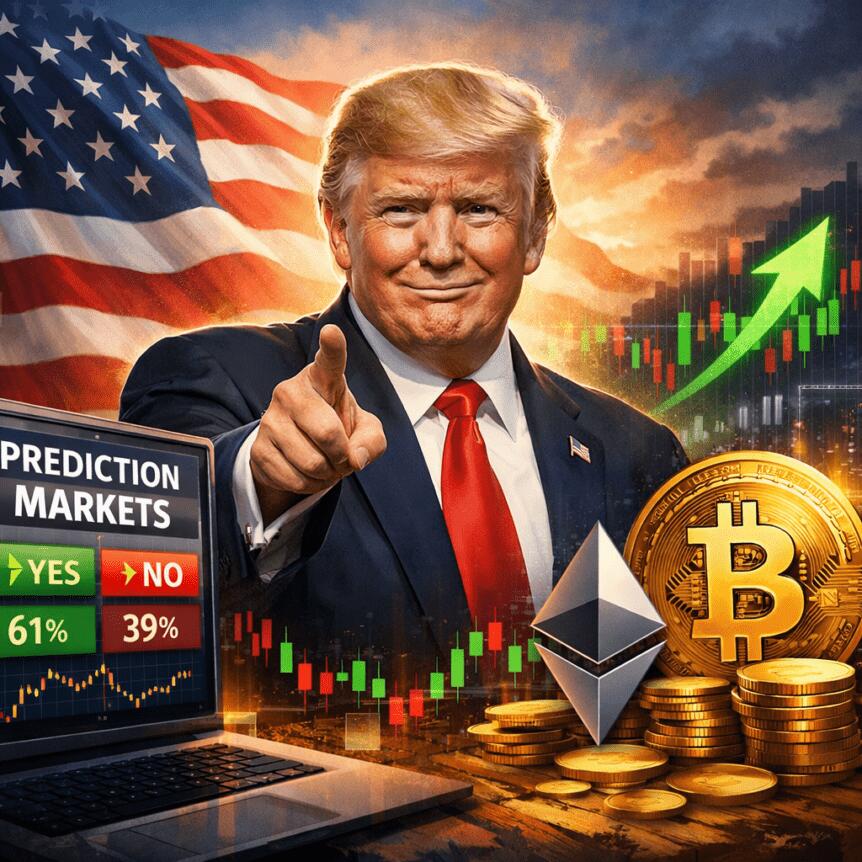
U.S. President Donald Trump has edged his position on prediction markets closer to cautious acceptance after a period of public skepticism, signaling that political and regulatory dynamics abroad are influencing his stance. Speaking to reporters in Florida, Trump acknowledged that while some critics remain unconvinced, “a lot of people who are very smart” support these markets, and he suggested the United States risks being left out if it doesn’t participate as other countries move forward.
That shift comes after a separate set of remarks in which Trump said he was not happy with prediction markets overall, describing the global landscape as increasingly “a casino” and noting the proliferation of betting platforms across the world. The remarks underscore a tension between domestic regulatory scrutiny and a rapidly expanding, data-driven sector that has drawn significant user and investor interest in recent months.
Key takeaways
- Prediction markets surged in popularity, with Polymarket and Kalshi reporting record activity; combined trading volumes reached $23.6 billion in March, per Token Terminal.
- Top political figures’ families and businesses are entwined with these platforms, complicating public perception and regulatory considerations.
- Trump’s anticipated involvement in tech-enabled markets extends to his business interests, including a planned Truth Social partnership with Crypto.com for prediction markets, and his family’s advisory roles in related ventures.
- The regulatory backdrop remains unsettled, with ongoing enforcement and legal debates about how gambling and prediction markets should be treated in the U.S. and abroad.
Prediction markets in the spotlight as usage climbs
Two of the most prominent prediction-market platforms—Polymarket and Kalshi—have together captured rising demand, attracting a broad user base seeking to hedge or speculate on real-world events. According to data cited by Token Terminal, the combined trading volume across these sites reached a record level in March, underscoring a sustained appetite for on-chain- or web-based event markets despite ongoing policy debates across jurisdictions.
The growth in activity arrives amid ongoing regulatory scrutiny in the United States and abroad. A recent wave of attention has focused on whether prediction markets should be treated as gambling or as legitimate information markets with potential applications for policymaking, risk assessment, and civic discourse. This tension is not new, but the pace and breadth of participation have intensified, driving investors and users to weigh both risk and opportunity in these platforms.
Family ties and corporate ambitions complicate the picture
The involvement of high-profile political figures and their families adds a layer of complexity to the trajectory of prediction markets. Donald Trump Jr. has been associated with Polymarket since August, joining the company’s advisory board. He also serves as an adviser to Kalshi, a role he took on in January 2025, highlighting how personal affiliations intersect with a rapidly evolving market landscape.
Beyond personal ties, Trump’s business ventures have signaled intended participation in the prediction-market space. In October, Trump Media announced plans to roll out prediction-market functionality on Truth Social, in partnership with Crypto.com. The arrangement would place market-tracking and betting capabilities on the platform, potentially broadening exposure to a U.S. audience for event-based markets. It’s worth noting that Trump divested his stake in Trump Media upon assuming office, transferring shares to a trust for which Trump Jr. is the sole trustee, a move that continues to shape the governance around any future initiatives tied to the brand.
These developments come against a backdrop of independent reporting and industry analysis that emphasize how the lines between technology platforms, political discourse, and regulatory oversight are increasingly intertwined. While executives and high-profile figures may help drive adoption, policymakers have signaled a readiness to scrutinize these markets more closely, particularly where foreign competition and cross-border liquidity intersect with U.S. consumer protection standards.
Regulatory context and what could come next
The broader regulatory environment remains unsettled. Earlier this year, concerns about applying traditional gambling laws to prediction markets drew attention from U.S. regulators, along with enforcement actions in other jurisdictions. In coverage linked to Cointelegraph, regulatory authorities have signaled a willingness to challenge or constrain certain market structures and operators, underscoring that user safety and compliance are likely to shape the pace of growth going forward.
Analysts note that the surge in volume and the involvement of prominent political figures could accelerate calls for clearer rules and standardized practices. This could include more explicit definitions of what constitutes a permissible prediction market, how customer funds are safeguarded, and what disclosures are required for operators and participants. In the near term, observers will be watching for how the U.S. approach evolves under current agencies and how international counterparts—where some countries have already embraced these markets—compare in terms of consumer protections, liquidity, and market integrity.
Recent coverage also points to ongoing discussions about the role these platforms might play in informing public policy or market risk assessment. Proponents argue that well-designed prediction markets aggregate information efficiently and can serve as useful tools for forecasting and governance. Critics, however, caution about moral hazard, manipulation risks, and the potential for inappropriate betting on sensitive or risky events.
For investors and builders, the main takeaway is that the sector’s momentum is unlikely to fade soon, but the road ahead hinges on regulatory clarity and credible risk controls. The next chapters will likely reveal how traditional financial oversight and innovative market design can converge to create sustainable ecosystems that are both compliant and genuinely useful to participants seeking to express hedges or opinions on real-world developments.
Meanwhile, observers should monitor both the policy discourse in Washington and the actions of foreign jurisdictions where prediction markets are already more mature. If the U.S. broadens access or introduces clearer guidelines, it could unlock a wave of new participants and capital. Conversely, tighter restrictions could reallocate activity to overseas platforms or compel operators to rethink product design to align with strict regulatory expectations.
As markets watch for signals from regulators and industry players, the coming quarters may reveal whether the recent rhetoric shift among political figures translates into practical policy or remains a cautious, interest-driven stance. The evolving dialogue between lawmakers, platform operators, and users will likely shape the pace of innovation in public-interest forecasting and its broader implications for governance and markets.
Readers should keep an eye on any formal regulatory updates from U.S. authorities, as well as announcements from platform operators about product changes, liquidity shifts, or new geographies of access. The balance between opportunity and oversight will determine how quickly prediction markets mature from fringe tools into mainstream, widely adopted instruments in the crypto and broader financial ecosystems.
https://www.cryptobreaking.com/trump-signals-easing-on-prediction/?utm_source=blogger%20&utm_medium=social_auto&utm_campaign=Trump%20Signals%20Easing%20on%20Prediction%20Markets,%20Crypto%20Markets%20React%20
Comments
Post a Comment