
Volo Exploit Raises Sui Ecosystem Concerns
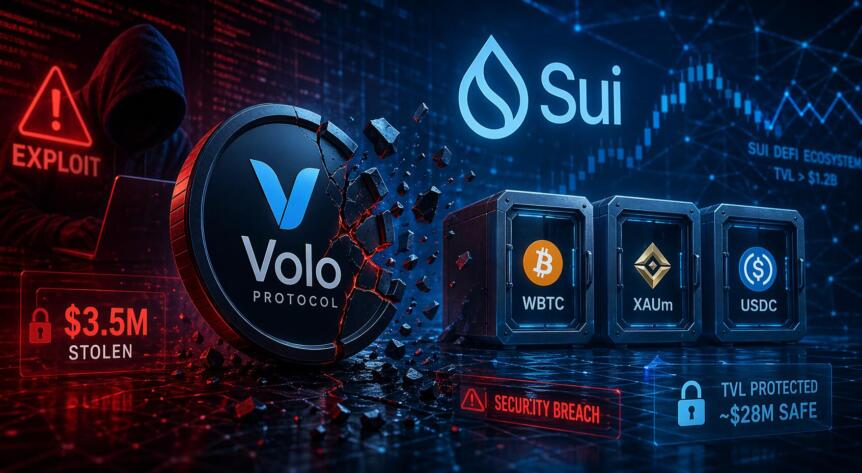
The first significant security breach of a liquid staking protocol occurred on April 22, 2026, when Volo Protocol was robbed of about $3.5 million across three vaults. The attack on WBTC, XAUm, and USDC pools has ignited broader discussion about the robustness of the fast-growing Sui DeFi ecosystem.
The exploit of Volo has quickly become a point of interest among analysts assessing risks in the fast-growing Sui ecosystem. Volo acted quickly to assure users that the breach had occurred and that it would cover all losses. Approximately $28 million TVL in unaffected vaults remained locked and safe after the team halted protocol activity within hours of learning about the exploit.
https://twitter.com/volo_sui/status/2046715584201511351
The most important question when it comes to ongoing research on the Volo exploit is whether it was an idiosyncratic flaw in the Volo vault design or a sign of systemic vulnerabilities in the Sui DeFi ecosystem. Early statements from the team suggest the issue was vault-specific rather than protocol-wide, meaning the Volo exploit was contained by design rather than by chance.
Volo Exploit Mechanism Still Under Investigation
However, uncertainty still surrounds the exact mechanism behind the Volo exploit. The attack mechanism remains not fully disclosed, and inquiries continue into the possibilities of the attack, flaws in the smart contracts, manipulation of oracles, or systemic vulnerabilities. A formal post-mortem should help clarify the root cause, and preliminary commentary suggests a possible network-level vulnerability.
Blockchain detective ZachXBT found that the funds associated with the Volo exploit, estimated to amount to about half a million dollars after the attack, were tracked to wallets controlled by attackers soon after the incident. The Sui Foundation has also joined recovery efforts and is organizing on-chain tracking.
The swiftness with which containment measures were implemented is one of the most remarkable features of the Volo exploit. The protocol was able to identify the breach, freeze all the vaults, and notify ecosystem partners within hours, which helped limit the loss to three impacted pools. This quick response served to avert what would have been a much greater loss across the platform’s $31.5 million TVL.
$1.2B Ecosystem Tested By Exploit Incident
Remarkably, vault isolation—intended to decrease systemic risk—proved a double-edged sword: it created a single point of failure yet helped avoid a complete protocol collapse. Whether such design decisions reduce or increase impact remains a hot topic among critics.
As the Sui DeFi ecosystem expands, with over $1.2 billion in TVL reported, the Volo exploit serves as a stress test of the network’s security assumptions. The event raises larger questions about whether the scaling of decentralized finance is being matched by mature risk controls.
In the meantime, the investigation continues, and the Volo exploit remains an important warning sign and an essential data point in understanding the evolving security landscape of next-generation DeFi systems.
Conclusion
Investigations into the Volo exploit are ongoing, with analysts seeking to determine whether the breach stemmed from an isolated vault flaw or deeper ecosystem risks. While funds were partially traced and losses contained, the incident has intensified scrutiny of security practices across Sui’s rapidly expanding DeFi infrastructure.
Summary
- Volo Protocol was hit by an exploit affecting vaults.
- Cause unclear: vault flaw versus Sui ecosystem risk.
- Incident raises concerns over Sui DeFi security.
Glossary of Key Terms
- Volo Exploit: Security breach that caused losses in Volo Protocol vaults.
- Volo Protocol: Liquid staking platform on the Sui blockchain.
- Liquid Staking: Using staked crypto while still earning rewards.
- Vaults: Smart contract pools holding user deposits.
- WBTC: Bitcoin represented as a token on Ethereum/Sui.
- XAUm: Tokenized asset used in Volo vaults.
- USDC: USD-pegged stablecoin used in DeFi.
- TVL: Total value locked in a DeFi protocol.
- Sui Ecosystem: DeFi network built on the Sui blockchain.
- On-chain Tracking: Tracing funds via blockchain data.
- Sui Foundation: Organization supporting Sui blockchain growth.
- DeFi: Decentralized finance without intermediaries.
FAQs
Q1: What is the Volo exploit?
A security breach on April 22, 2026, where about $3.5M was stolen from Volo vaults.
Q2: Were user funds recovered?
Volo pledged full reimbursement and froze operations, securing about $28M in unaffected vaults.
Q3: What caused the exploit?
The cause is still unknown, with probes into smart contract or oracle-related flaws.
Q4: What is the impact on Sui ecosystem?
It raised security concerns across Sui DeFi as the network continues to grow.
https://www.cryptobreaking.com/volo-exploit-raises-security-concerns/?utm_source=blogger%20&utm_medium=social_auto&utm_campaign=Volo%20Exploit%20Raises%20Security%20Concerns%20Across%20Sui%20DeFi%20Ecosystem%20
Comments
Post a Comment