
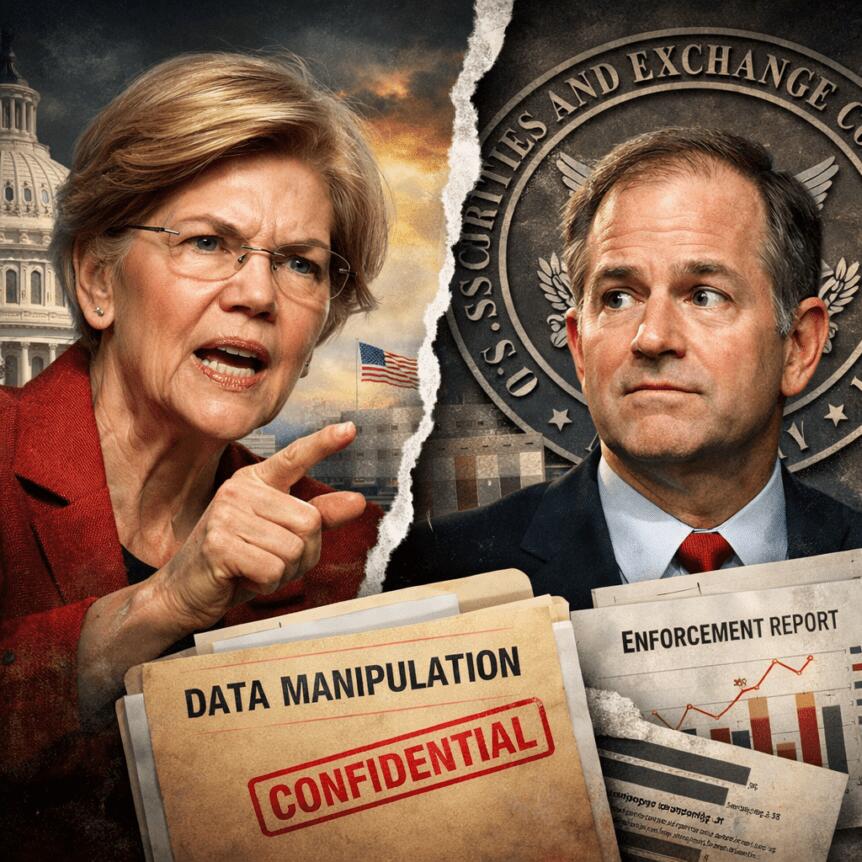
U.S. Senator Elizabeth Warren, the leading Democrat on the Senate Banking Committee, is escalating a dispute over the U.S. Securities and Exchange Commission’s enforcement posture. In a letter dated April 15, Warren accuses SEC Chair Paul Atkins of possibly misleading Congress about the agency’s enforcement numbers after the agency released its enforcement data for fiscal year 2025.
The data, released on April 7, show a marked drop in enforcement actions, prompting Warren to publicly challenge Atkins about his February 12 testimony at a congressional hearing. In her letter, she notes that she had asked him to comment on data showing a decline in enforcement activity; she says Atkins “demurred,” replying that he was “not sure what data” she was referring to. Warren contends that the latest figures vindicate her point that SEC enforcement actions have fallen significantly under Atkins’s watch.
Key takeaways
- The Senate Banking Committee's top Democrat questions SEC Chair Paul Atkins over whether he may have misled lawmakers about enforcement activity, citing FY2025 data released in April.
- Enforcement actions by the SEC reportedly declined to the lowest level seen in more than a decade, according to the agency’s own FY2025 data.
- Warren’s letter frames the data as evidence of a broader retreat in enforcement, raising concerns about the agency’s willingness to pursue cases, including crypto-related actions.
- As part of the controversy, Warren references a period in which the SEC reportedly rolled back enforcement against crypto firms, while other actions from the Biden administration were settled or dismissed, drawing bipartisan criticism.
- The SEC did not immediately respond to requests for comment on the letter or the underlying data.
Warren’s pivot: data as accountability and potential misdirection
The exchange between Warren and Atkins centers on a stark question: what is the true state of enforcement under the current leadership? In her letter, Warren emphasizes that the data released by the SEC last week show a run of more restrained activity, which she says contradicts Atkins’s earlier testimony that he could not comment on the data she referenced. She writes that the hearing occurred after the end of the 2025 fiscal year, and that Atkins’s later defenses appear “deeply misleading, potentially designed to cast doubt on the now obvious fact that enforcement activity has declined significantly.”
Warren’s letter to Atkins includes a request for detailed explanations about the agency’s enforcement trajectory and a confirmation of what Atkins knew about the data at the time of his testimony. Specifically, she asks for clarity on whether he was aware of the SEC’s enforcement efforts when he testified and seeks an explanation for the apparent decline. The committee gave Atkins a deadline of April 28 to respond.
At stake is not just a numeric trend but the agency’s posture toward enforcement in a landscape that includes crypto policy and investor protection. The April 7 data release has added fuel to a broader debate over whether the SEC is adequately policing markets that include digital assets, as lawmakers from across the spectrum weigh the agency’s tools and priorities.
Enforcement posture and crypto: a broader political debate
The discussion about enforcement numbers sits within a larger context of how the SEC has treated crypto-related actions across administrations. The article notes a shift in enforcement approach, with a period of retrenchment in crypto cases after the prior administration, contrasted with a higher number of crypto-related actions during the Biden era. Critics have argued that this shift represents a mismatch between the agency’s mission and the pace of market developments in digital assets.
Warren’s critique also flags a potentially wider concern: if enforcement slows while markets evolve, the regulatory framework may struggle to deter misconduct, protect investors, or establish regulatory clarity for innovators. The letter underscores the need to hold the agency accountable for its enforcement decisions, particularly in a sector that continues to draw the attention of policymakers, market participants, and builders seeking a stable, rules-based environment for digital assets.
In the background of these tensions, Atkins has faced questions about crypto-specific “safe harbor” considerations and the appropriateness of various enforcement strategies as the SEC negotiates its stance on digital assets. Earlier reporting highlighted debates over whether exemptions or more precise boundaries could help clarify where crypto activity falls within existing securities laws, a topic that continues to surface as officials examine the agency’s enforcement toolkit.
What comes next for oversight and crypto policy
The April 28 deadline for Atkins’s response to Warren’s questions sets the stage for a potential hinge point in congressional oversight of the SEC. While the agency did not provide an immediate comment on the letter, the exchange signals lawmakers’ intent to scrutinize how enforcement data is collected, interpreted, and communicated to the public—for better transparency and accountability.
For investors, traders, and builders in the crypto space, the evolving oversight narrative matters because it can influence regulatory certainty, risk assessment, and the appetite for enforcement risk in crypto ventures. If lawmakers perceive continued declines in aggressive action as a signal of lax oversight, that could shape debates on rulemaking, disclosure requirements, and potential new guardrails that affect how digital assets are treated in the U.S. market.
As the SEC weighs its enforcement posture, market participants will be watching not only for the numbers themselves but for how the regulator articulates its priorities and the conditions under which it pursues or retreats from enforcement actions—especially in areas where technology and markets are advancing rapidly.
For now, the key questions remain: Will Atkins clarify the data to reassure lawmakers about the agency’s intent and diligence? How will the SEC balance its enforcement priorities in crypto with ongoing demands for clearer regulatory guidance? And what signals will forthcoming actions, or the absence thereof, send to the broader crypto ecosystem?
The unfolding debate underscores a broader theme in crypto regulation: data, transparency, and accountability are increasingly central to investor confidence and the sector’s long-term trajectory. Keep an eye on any official responses, additional disclosures from the SEC, and subsequent remarks from lawmakers as the oversight process continues.
https://www.cryptobreaking.com/warren-secs-atkins-likely-misled/?utm_source=blogger%20&utm_medium=social_auto&utm_campaign=Warren:%20SEC's%20Atkins%20Likely%20Misled%20Congress%20on%20Enforcement%20Data%20
Comments
Post a Comment