
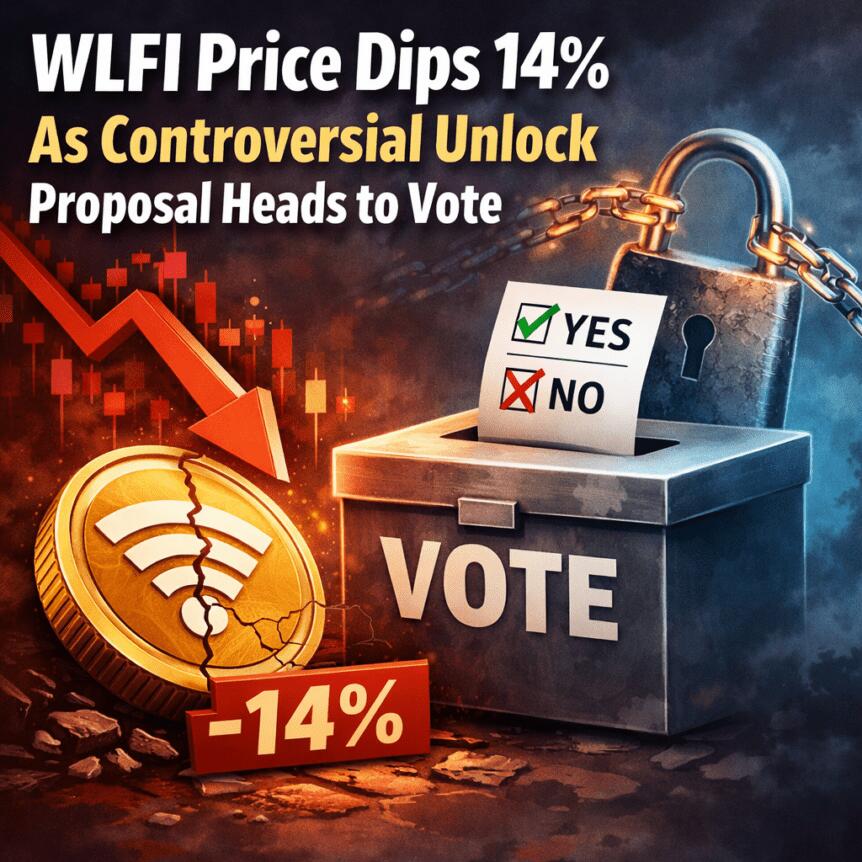
The governance proposal around World Liberty Financial (WLFI), a project linked to the Trump family, has moved into a formal community vote after triggering a visible crypto-market reaction. The measure would lock more than 62 billion WLFI tokens held by early investors and insiders for two years, followed by a staged release over a subsequent two to three years. The vote opened on Wednesday and is set to run through May 7, with early data showing overwhelming support but sparking a heated debate within the community about long-term tokenomics and governance control.
According to the proposal, 62,282,252,205 WLFI tokens would be subjected to a multi-year vesting schedule designed to keep a large portion of supply off the market for an extended period. The structure calls for a two-year cliff for early holders, after which a two-year linear vesting would release tokens gradually. For insiders such as founders, team members and advisers, the plan envisions a two-year cliff followed by a three-year linear vest. The intention, as described by World Liberty Financial, is to ensure token holders remain committed to the project’s long-term trajectory and to provide a more bounded picture of governance preferences.
As voting commenced, WLFI supporters appeared to outnumber critics by a wide margin. At the time of reporting, the tally showed about 6 billion votes in favor versus roughly 3.2 million against, with the voting quorum of 1 billion WLFI tokens already met. World Liberty Financial highlighted the governance move as a pivotal moment in the project’s history, asserting that none of the locked tokens would touch the market for at least two years if the proposal passes. The stance was echoed on the project’s official X (formerly Twitter) account.
Key takeaways
- Locking 62.28 billion WLFI tokens held by early investors and insiders under a two-year cliff, then releasing over two to three years.
- Insiders face a two-year cliff with a three-year linear vest; early investors face a two-year cliff with a two-year linear vest.
- The live vote shows overwhelming support (about 6 billion in favor vs. 3.2 million against) with the quorum already reached; voting continues through May 7.
- WLFI price activity reflects market skepticism around multi-year vesting, with the token trading around $0.06367 and showing a notable decline in recent days.
Governance mechanics and tokenomics at stake
The proposed schedule targets a gradualized unlock that shifts the token’s liquidity dynamic away from immediate market exposure. Proponents argue the structure helps align governance incentives with long-term project success, ensuring that those with a material stake remain vested in WLFI’s ongoing development. The two-year cliff for all participants, followed by staged releases, is meant to produce a predictable supply trajectory rather than the abrupt changes typical of abrupt unlock events.
Critics, however, have raised questions about both the underlying logic and practical effects. Observers have pointed to the length of the vesting windows and the potential for a prolonged liquidity constraint to distort price discovery or constrain market-making activity. The broader governance conversation also touches on whether the mechanism adequately captures the diverse interests of holders who may not participate in voting yet would be affected by the lockup.
The debate has been fueled by comments from notable crypto figures. Earlier coverage highlighted commentary from Moonrock Capital founder Simon Dedic, who described the proposal as akin to a rug pull and questioned the alignment of a two-year unlock with political timelines. Justin Sun, a WLFI stakeholder and founder of the Tron network, labeled the proposal among the most “absurd” he has seen. Those criticisms were echoed in the public replies to World Liberty Financial’s vote announcement, where many community members criticized the structure and its perceived centralization of control.
World Liberty Financial has defended the plan as a way to promote clear governance preferences and to keep token ownership among those genuinely committed to the project’s long-term success. In posts accompanying the vote launch, the team framed the mechanism as a deliberate attempt to reduce speculative activity and to anchor decision-making among core supporters rather than transient participants.
Market reception and investor considerations
Market reaction to the unfolding governance vote has been prominent. Data from CoinGecko at the time of writing places WLFI around $0.06367, reflecting a roughly 13.6% drop in the previous 24 hours and a broader decline of about 72.8% from its open-market level. The price action underscores the sensitivity of WLFI to news around tokenomics and governance, where a major change to supply and vesting can influence short-term sentiment as investors reassess risk and liquidity implications.
Those tracking WLFI’s trajectory will be watching how the market prices in the implications of a long-term token lock. If the proposal passes, the restricted supply could support a longer-duration price stabilization argument, though actual liquidity will depend on secondary-market dynamics, the pace of vesting, and how quickly counterbalancing investor activity returns to the market. If the proposal fails, WLFI could face renewed questions about governance efficacy and the distribution of control among early holders, insiders, and broader token holders.
Cointelegraph has reached out to World Liberty Financial for comment on the current vote and the broader governance framework. The initiative also reflects a wider conversation in the crypto space about how to balance founder and investor incentives with open, inclusive governance that can withstand scrutiny from a diverse set of stakeholders.
For readers seeking more context, related coverage has explored how other major industry players are navigating governance and token unlocks, and how these decisions impact investor confidence and platform adoption. The broader narrative around regulatory clarity, governance design, and long-horizon token economics continues to shape sentiment across communities tracking WLFI and similar projects.
As the vote unfolds, observers should monitor not only the final tally but also how the WLFI community discusses and interprets the proposed constraints on liquidity and the implications for future governance proposals. The outcome could influence how WLFI approaches future token economics and whether similar governance structures become a template for other projects seeking to anchor long-term commitment among core stakeholders.
Source: World Liberty Financial via its X post and the coverage from Cointelegraph. The live voting and related details are documented in the project’s governance portal and official communications noted in the cited coverage.
Readers are encouraged to verify developments as the May 7 voting deadline approaches and to consider how such governance models may shape investor risk, participation incentives, and the broader market’s appetite for long-term, locked-token strategies.
https://www.cryptobreaking.com/wlfi-price-dips-14-as/?utm_source=blogger%20&utm_medium=social_auto&utm_campaign=WLFI%20Price%20Dips%2014%%20as%20Controversial%20Unlock%20Proposal%20Heads%20to%20Vote%20
Comments
Post a Comment