
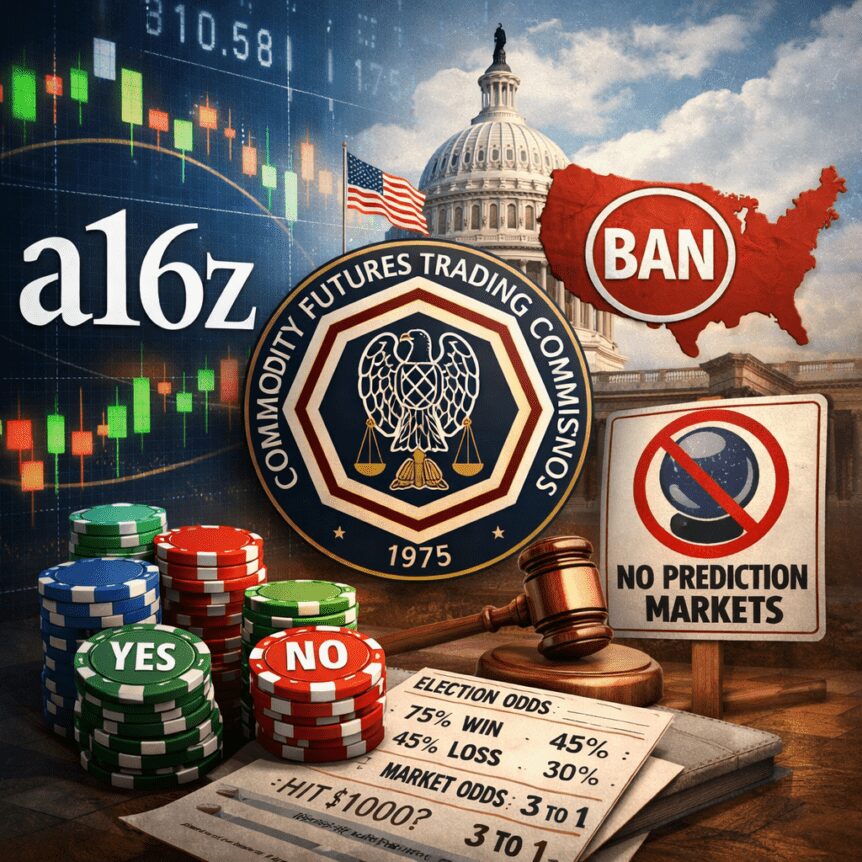
A16z has stepped into the federal-state clash over prediction markets by submitting a letter to the Commodity Futures Trading Commission (CFTC) that argues state-level crackdowns undercut the agency’s mandate to provide impartial access to its markets. The move comes as the CFTC advances its own rulemaking on how event contracts should be regulated and as enforcement actions against several states raise the stakes for platforms like Kalshi and Polymarket.
The venture-capital firm’s letter, filed on Thursday in response to the CFTC’s advance notice of proposed rulemaking, contends that a patchwork of state measures—ranging from cease-and-desist orders to criminal charges—creates barriers that hinder the federal framework designed to ensure open, unbiased access to prediction-market venues. A16z argues that such state interventions undermine the federal regulator’s ability to provide equal treatment for participants, liquidity, and predictable rules of engagement for operators and users alike.
Key takeaways
- A16z formally opposes state-level actions that restrict access to prediction-market platforms, urging the CFTC to preserve impartial access to markets and services.
- The CFTC has recently filed lawsuits against Illinois, Arizona, Connecticut, New York, and Wisconsin, accusing state authorities of overstepping by attempting to regulate markets that arguably fall under federal jurisdiction.
- A16z warns that forcing exchanges to block users based on state residency could severely limit liquidity, undermining the functionality and appeal of prediction markets.
- The letter argues that the CFTC—not state legislatures—should define what constitutes “gaming” under federal commodities law, citing decades of federal oversight over event contracts and market structures.
- Polymarket is seeking to regain access for U.S. users via discussions with the CFTC, following a 2022 settlement that barred the platform from serving U.S. customers for unregistered event contracts.
A16z’s intervention reframes the debate on access, liquidity, and regulatory authority
In its filing, A16z emphasizes a core tension in the current regulatory landscape: state authorities instinctively push back against online platforms that offer event-based contracts, while the CFTC contends it should oversee and harmonize these markets to protect consumers and preserve market integrity. The firm frames the issue as not merely a procedural mismatch but a question of market design and user access. “Being forced to deny impartial access to users in states that seek to license or prohibit certain event contracts will likely severely circumscribe available liquidity,” the letter states, underscoring a practical consequence of divergent regulatory approaches.
Beyond the legal arguments, A16z advances a broader case for prediction markets as legitimate price-discovery mechanisms. The firm argues that these platforms reveal crowd intelligence on uncertain outcomes and that their pricing processes contribute real-time information about how events are perceived to unfold. It also touts the potential for blockchain-based platforms to enhance regulatory oversight through on-chain auditability, which, in the firm’s view, can improve transparency and compliance without sacrificing access.
The stance aligns with a growing push from the crypto and digital-asset ecosystem to safeguard access to innovation even as regulators scrutinize risk. In the weeks surrounding the filing, enforcement activity has intensified on the state level, with governments pursuing action against platforms that operate in gray areas of state gambling or licensing regimes. The industry has watched closely for how federal authorities will balance consumer protection with the need for scalable, liquid markets that retail participants—often the majority in this niche—depend on for meaningful participation.
Regulatory framing and the ongoing jurisdictional contest
At the heart of the dispute is a question of jurisdiction: who gets to define what counts as “gaming” under federal commodities law—the CFTC or state attorneys general? State officials have argued that platforms offering bets on sports outcomes or political events are operating unlicensed gambling operations and should be regulated accordingly. A16z counters that only federal regulators have the authority to delineate the boundaries of gaming within the commodity-derivative regime, given the CFTC’s decades of oversight over event contracts and related markets.
The letter also foregrounds a social-value argument: prediction markets can surface price signals about uncertain futures, delivering a form of collective intelligence that complements traditional markets. A16z suggests that, when properly regulated, these markets can function as useful tools for information discovery and risk management. The firm highlights the potential benefits of on-chain transparency, arguing that blockchain-based platforms can render all transactions auditable in a way that may simplify regulatory oversight and reduce opportunity for malpractice.
As Cointelegraph has reported, prediction-market volumes have surged in recent months, underscoring the appeal of these venues to a broad spectrum of retail traders. March data showed roughly $25.7 billion in monthly trading volume, with more than four-fifths of participants categorized as retail traders by volume—an important signal of the democratization of access that regulators and policymakers are weighing in their own ways.
Polymarket’s US return and the broader market implications
Polymarket has become a focal point in the discussion about how US users might again participate in prediction markets. The platform is actively engaging with the CFTC to lift the ban that has barred American users from its main site since a 2022 settlement, in which Polymarket paid a $1.4 million penalty and agreed to block U.S. customers over unregistered event contracts. A successful return would require a formal vote by the commission, though the process could move more quickly if vacancies in four CFTC commissioner seats remain unfilled in the near term.
The potential re-entry of Polymarket would be a tangible test of whether the CFTC’s updated framework can accommodate a broader set of event contracts without compromising market safeguards. If the federal regulator clarifies or updates its stance on prediction-market governance, it could reduce the legal ambiguity that has spurred a patchwork of state actions. For investors and traders, such a shift would likely impact liquidity dynamics, geographic access, and the comparative attractiveness of multiple platforms that compete for user activity and capital flows.
What comes next for the prediction-market regime
The ongoing dialogue between A16z, the CFTC, and state regulators signals a broader trend: regulators are increasingly forced to reconcile a rapidly evolving technological landscape with established legal frameworks. While the current letter emphasizes preserving impartial access and clarifying regulatory authority, the outcome of the CFTC’s rulemaking will ultimately shape the architecture of prediction markets for years to come. Investors, traders, and builders should monitor how the agency weighs comments from major players, how it defines gaming and event contracts, and what safeguards—if any—will be codified to prevent abuses while preserving liquidity and access.
The fate of Polymarket’s U.S. participation remains a crucial live test. A federal path toward a clear, uniform regime could unlock a more robust, retail-friendly market structure, while a continued state-by-state approach might perpetuate fragmentation and liquidity fragmentation. In the near term, the next set of regulatory filings, court actions, and potentially new commission votes will help determine whether prediction markets can mature into a stable, compliant segment of the broader crypto-asset ecosystem.
Readers should stay attuned to updates from the CFTC’s rulemaking process and any new statements from A16z, Kalshi, and Polymarket as the regulatory framework for prediction markets continues to evolve—shaping both the opportunities and the risks for participants in this dynamic corner of the crypto economy.
https://www.cryptobreaking.com/a16z-backs-cftc-as-states/?utm_source=blogger%20&utm_medium=social_auto&utm_campaign=A16z%20backs%20CFTC%20as%20states%20seek%20to%20ban%20prediction%20markets%20
Comments
Post a Comment