
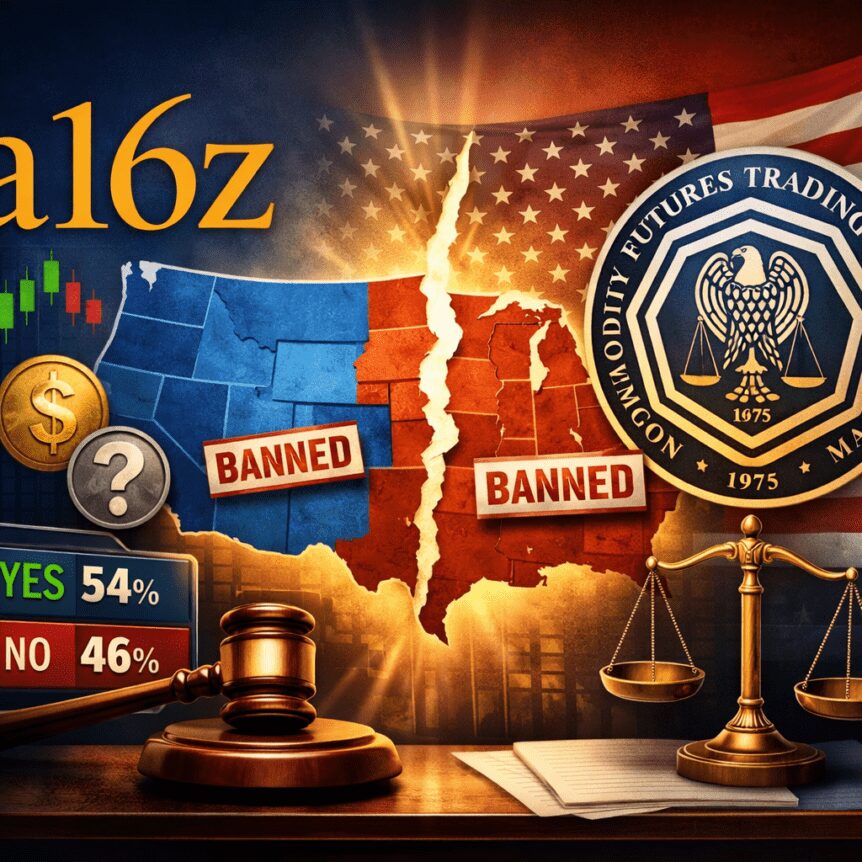
According to Cointelegraph, Andreessen Horowitz (A16z) has publicly aligned with the CFTC in a high-stakes federal-state dispute over prediction markets. In a letter filed on Thursday in response to the CFTC’s advance notice of proposed rulemaking on prediction markets, the venture capital firm urged that aggressive state enforcement—ranging from cease-and-desist letters to criminal charges—undermines the federal regulator’s mandate to provide impartial access to its markets and services.
The filing comes amid a broader push by the CFTC to assert federal oversight over event contracts while state attorneys general and regulators seek to apply their own licensing and gambling laws. In recent weeks, the CFTC has sued several states—Illinois, Arizona, Connecticut, New York, and Wisconsin—arguing that those jurisdictions overstep by attempting to regulate prediction markets that, the regulator says, fall under federal jurisdiction. A16z supported the position that forcing exchanges to block users based on state residency directly conflicts with the CFTC’s impartial access principles. The letter thus positions the debate as a core clash over jurisdiction, access, and the proper scope of regulatory authority for event- and outcome-related contracts.
“Being forced to deny impartial access to users in states that seek to license or prohibit certain event contracts will likely severely circumscribe available liquidity,” the firm wrote. The stance reinforces a broader debate about whether prediction-market platforms should be treated as regulated financial markets or as something else entirely, and it underscores the attention paid by major investors to the regulatory architecture around these platforms. The discussion surrounding the CFTC’s rulemaking follows a period of rapid growth for prediction markets, with platforms like Kalshi and Polymarket at the center of policy and compliance debates.
Key takeaways
- The A16z letter explicitly backs the CFTC’s pursuit of federal oversight and argues that state crackdowns undermine impartial access to prediction-market platforms.
- The CFTC has pursued lawsuits against Illinois, Arizona, Connecticut, New York, and Wisconsin, signaling a persistent federated-state conflict over how these markets should be regulated.
- A16z rejects narratives that characterize prediction-market platforms as unlicensed gambling, asserting that the CFTC—not state legislatures—defines what constitutes “gaming” under federal commodities law.
- The firm highlights on-chain transaction auditability as a potential contributor to more effective regulatory oversight and compliance controls.
- Polymarket seeks a path to reintroduce US users to its main platform; a full return would require a formal vote by the CFTC’s commissioners, a process potentially accelerated by vacant commissioner seats.
- Market activity in prediction markets remains substantial, with March monthly volume reported around $25.7 billion and a predominantly retail user base.
Federal-state clash over prediction markets and A16z’s stance
The core dispute centers on who should regulate event contracts and how their markets should be accessed by participants across state lines. A16z’s letter frames the issue as a test of whether federal authority, via the CFTC, should ensure uniform, impartial access to prediction-market platforms, or whether state authorities may condition access through licensing requirements or outright bans. By arguing that state-level restrictions impede liquidity and price discovery, the firm positions the CFTC’s access rules as essential to the health and integrity of the market ecosystem. The letter—submitted in the context of the CFTC’s advanced rulemaking process—asserts that federal oversight serves the public interest by maintaining open, fair, and auditable markets for uncertain outcomes.
Kalshi and Polymarket, as prominent platforms in this space, are frequently cited as case studies illustrating the tensions between state licensing approaches and federal market design. The stance taken by A16z aligns with a view that state remedies, when they seek to bar or restrict users based on residency, may undermine the cross-border liquidity and efficiency that federal markets are designed to sustain. The broader regulatory environment has underscored a growing expectation that the industry needs clear, stable federal guidelines to avoid a patchwork of state actions that could fragment liquidity and complicate compliance for operators and participants alike.
Jurisdiction: CFTC vs. state regulators on gaming and event contracts
A key dimension of the debate concerns how to classify and regulate event contracts. State attorneys general have argued that platforms offering bets on sports results or political events operate unlicensed gambling businesses. A16z countered by emphasizing the CFTC’s historical role in overseeing event contracts under federal commodities law, arguing that this authority should define what constitutes “gaming” for purposes of regulation. In this framing, the CFTC’s jurisdiction is not just a matter of policy preference but a statutory and regulatory reality that governs how these products can be offered and who can participate.
Beyond jurisdictional questions, A16z highlighted the social value of prediction markets as price-discovery mechanisms that aggregate crowd intelligence on uncertain outcomes. The firm also contended that blockchain-based platforms, with their on-chain transparency and auditability, offer regulatory oversight advantages that can enhance compliance and risk management for both operators and overseers. This angle ties regulatory considerations to the evolving infrastructure of the market—where on-chain records and verifiable transactions could support more robust enforcement and oversight mechanisms.
Policy implications, liquidity, and compliance considerations
The regulatory discourse surrounding prediction markets matters for a range of market participants, including exchanges, banks, investors, and technology providers. The federal-state friction affects licensing, access controls, and the ability of platforms to offer services across state lines. For operators, this translates into regulatory uncertainty, potential licensing costs, and the risk of abrupt changes in permissible activities. For regulators, the interplay between state-level attempts to regulate and federal authority raises questions about the optimal architecture for consumer protection, market integrity, and financial stability in markets that hinge on uncertain outcomes.
Market activity figures cited in industry coverage illustrate the scale of engagement in prediction markets. March data indicate monthly trading volumes in the tens of billions of dollars, with a majority of participants categorized as retail traders—defined as individuals trading smaller ticket sizes. This usage profile underscores the practical importance of predictable access and consistent regulatory treatment for liquidity provision, price discovery, and consumer protections. The onus is on policymakers to provide clarity that can support legitimate market activity while upholding compliance standards across jurisdictions.
Polymarket’s current status reflects the ongoing regulatory negotiation. After a 2022 settlement that included a $1.4 million penalty and a block on US customers for unregistered event contracts, Polymarket is engaging with the CFTC to explore a pathway for reinstating US access to its main platform. While a complete regulatory green light would require a formal commission vote, the context of several commission seats remaining vacant could accelerate consideration, depending on procedural timelines and regulatory priorities. This case illustrates how enforcement actions, settlements, and rulemaking interact to shape the practical feasibility of cross-border platform operations in the United States.
Closing perspective
The evolving policy framework for prediction markets sits at the intersection of federal oversight, state enforcement, and the assessment of how blockchain-enabled platforms can support compliant, transparent price discovery. As authorities refine rules and as large investors advocate for clear federal guidance, the coming months are likely to determine whether US-based prediction markets achieve broader access while maintaining robust governance and consumer protections. Observers should watch for CFTC rulemaking outcomes, any further regulatory actions, and the potential implications for Kalshi, Polymarket, and other platforms operating in this space.
https://www.cryptobreaking.com/a16z-backs-cftc-in-challenge/?utm_source=blogger%20&utm_medium=social_auto&utm_campaign=A16z%20Backs%20CFTC%20in%20Challenge%20to%20State%20Bans%20on%20Prediction%20Markets%20
Comments
Post a Comment