
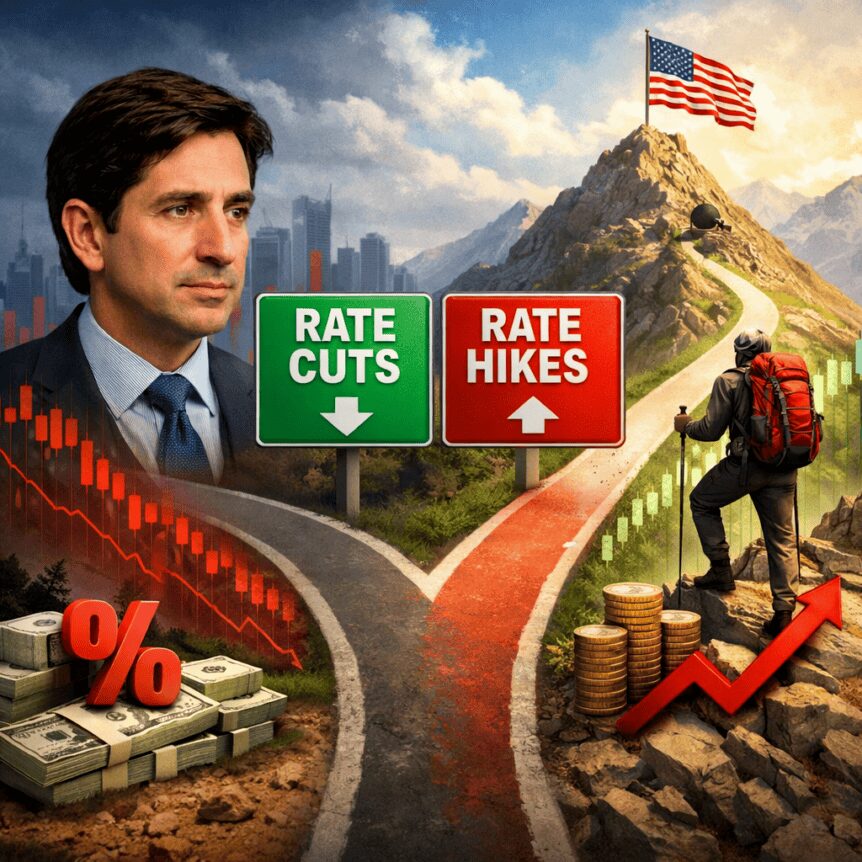
Kevin Warsh was sworn in as the chair of the United States Federal Reserve on Friday, launching a tenure that market participants are watching for signs of a policy tilt that could redefine the rate path for 2026. While a number of observers expect a traditional hawkish stance to persist, some prominent voices in the crypto and macro communities argue Warsh could pivot toward cuts as inflation cools and productivity advances via AI rhetoric take center stage.
Leading that line of thinking, Lawrence Lepard, a veteran Bitcoin investor and author, contends that Warsh’s leadership will eventually translate into rate reductions. In a post on X, Lepard noted that comments from other senior U.S. policymakers—specifically Kevin Hassett, former director of the White House National Economic Council, and Treasury Secretary Scott Bessent—support a shift toward lower rates in 2026. Lepard added that two data points highlighted in The Wall Street Journal are consistent with a narrative in which inflation proves more durable than initially assumed, yet ultimately transitory enough to justify rate cuts as productivity improves.
At Warsh’s swearing-in ceremony, President Donald Trump framed the debt challenge through a growth-centric lens, signaling an expansion of the monetary supply and a potentially looser regime on rates. His remarks fed a broader debate about whether the new Fed chair will resist executive-branch pressure to loosen policy, a topic that has also drawn scrutiny from lawmakers and market watchers.
Traders and analysts remain divided on Warsh’s likely impact on the trajectory of interest rates. While some anticipate a path that maintains or even tightens policy in the near term, others point to a longer horizon in which inflation cools more quickly than markets expect, inviting rate relief. The tension is part of a broader debate about how much independence the central bank can preserve as political and fiscal considerations interact with monetary policy.
For crypto markets, the policy question matters because a shift toward rate cuts could boost risk-on assets, including Bitcoin and a broader array of tokens. The degree to which Warsh’s tenure will align with or diverge from the prior Fed regime remains a live question for traders who have grown used to a complex, data-driven approach to inflation and growth signals.
Earlier coverage from Cointelegraph noted the nuance in expectations surrounding Warsh’s swearing-in and the challenges of predicting the policy path under a new chair. The discussion has repeatedly underscored that the path of rates in 2026 will depend heavily on evolving inflation data, labor market dynamics, and the administration’s broader fiscal stance.
Key takeaways
- Markets remain split on the Fed’s 2026 trajectory: a subset expect rate cuts, while others anticipate higher-for-longer policy depending on inflation and growth signals.
- The CME FedWatch tool estimated that roughly 68% of traders priced in a 25-basis-point or larger rate move by December 2026, underscoring persistent uncertainty in the policy outlook.
- Warsh’s appointment has intensified questions about Fed independence versus executive influence, a dynamic that lawmakers have highlighted during confirmation debates.
- Crypto markets are watching policy signals closely, as a lower-rate regime could provide a marginal tailwind for risk assets, though the magnitude of any impact remains uncertain.
Policy direction under a new Fed chair: what changes—and what stays the same
The central question surrounding Warsh’s tenure is whether the new chair will push for a more expansionary stance in the face of fiscal stimulus and a shifting inflation narrative. Lepard’s interpretation, rooted in public signals from other senior policymakers, suggests room for a future pivot toward easier policy, even as near-term rate hikes remain a plausible response to inflation pressures. The contrast between a long-run objective of price stability and the short-run demands of political leadership creates a delicate balance for the Fed, and one that markets will parse as more data arrive.
Lawmakers have not been silent on the issue. In April, U.S. lawmakers scrutinized Warsh’s commitment to preserving Fed independence, raising concerns about the potential for political interference to compromise the central bank’s mandate. Senator Elizabeth Warren highlighted the possibility of conflicts of interest that could arise if the administration’s policies intersect with business interests in the crypto space. This tension matters because it shapes perceptions of credibility and the speed with which policy signals translate into market moves.
Against this backdrop, investors should monitor how Warsh weighs inflation progress against growth momentum. If inflation cools and growth remains solid, the case for gradual normalization or even a measured easing could gain traction. Conversely, any persistent price pressures could push the Fed toward a more restrictive path. The debate hinges on a delicate mix of data points, expectations, and political signals that will evolve over the coming quarters.
Crypto markets and the policy environment: a potential ripple effect
Bitcoin and other digital assets have historically shown sensitivity to U.S. monetary policy expectations. A potential shift toward rate cuts could lift risk-on appetite, supporting higher valuations for crypto assets in the medium term. However, the fundamental drivers for crypto—decentralization, innovation, and use cases—remain distinct from traditional macro cycles. Traders will evaluate policy signals in conjunction with crypto-specific developments, such as liquidity conditions, on-chain activity, and regulatory clarity.
The broader macro narrative remains a mosaic of competing forces: inflation dynamics, productivity improvements tied to technology adoption, fiscal policy signals, and geopolitical considerations. The Fed’s path under Warsh will interact with these forces, influencing not only asset prices but the funding environment for blockchain projects, venture funding, and the pace of institutional participation in crypto markets.
As Warsh settles into the chair, market participants should watch a few key indicators: the inflation trajectory relative to expectations, the pace of wage growth and job openings, and the evolving view of 2026 rate moves reflected in futures markets. Additionally, how the administration and Congress frame growth and debt management will influence market sentiment and the degree to which policy signals translate into real-world macro effects.
The policy narrative also touches on the broader question of central-bank independence in a highly politicized environment. While the Fed’s mandate remains price stability and economic resilience, the perception of independence—and how it is tested by political and fiscal pressures—will continue to shape investor confidence in the central bank’s ability to navigate a complex economic landscape.
Alongside these considerations, investors should note the ongoing discourse about inflation as a "transitory" phenomenon, balanced against longer-term factors such as productivity and demographic trends. The balance of these forces will inform the ultimate stance Warsh adopts and how decisively the Fed communicates its future path to markets.
In the meantime, observers can look to official communications, minutes from meetings, and the evolving commentary from policymakers to gauge where rate expectations are headed. The next wave of data releases—starting with inflation reports, employment figures, and productivity metrics—will help clarify whether the 2026 trajectory tilts toward tighter policy, easier policy, or a more data-dependent stance that keeps traders in a state of cautious anticipation.
For readers tracking the crypto implications, the key takeaway is that any shift in the Fed’s stance—whether toward cuts or continued restraint—will likely influence risk tolerance in the near term. This environment could shape fundraising, liquidity, and price dynamics across digital assets as traders calibrate their positions to evolving macro signals. As always, the implicit takeaway is to balance macro expectations with the specific drivers of crypto adoption and innovation that continue to shape the sector’s long-run trajectory.
Specific references to Warsh’s ceremony and related debate can be found in contemporary coverage from Cointelegraph, including discussions on the odds of rate cuts and the political dynamics surrounding the appointment. For context on the broader public discourse, see the coverage of Warsh’s swearing-in and related policy debates as well as statements from lawmakers concerned with independence and potential conflicts of interest.
https://www.cryptobreaking.com/analyst-expects-warsh-to-cut/?utm_source=blogger%20&utm_medium=social_auto&utm_campaign=Analyst%20expects%20Warsh%20to%20cut%20rates%20even%20as%20consensus%20foresees%20hikes%20
Comments
Post a Comment