
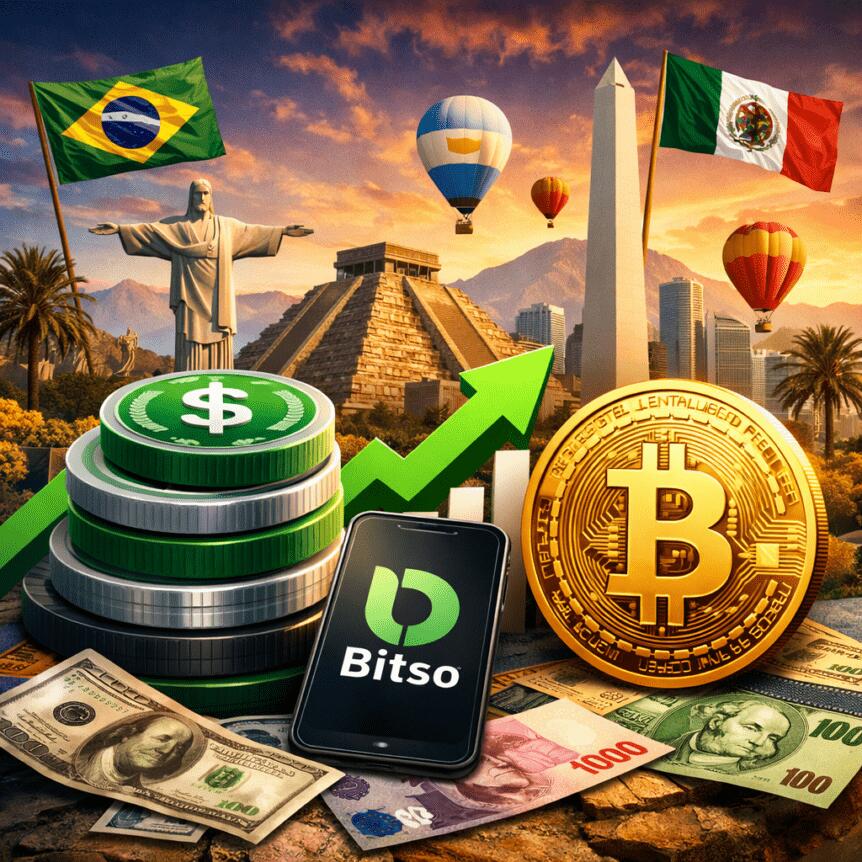
Latin America’s crypto adoption path is pivoting toward stablecoins in 2025, reflecting how local conditions—high inflation, currency depreciation, and uneven access to traditional banking—shape user behavior. Bitso’s 2025 crypto adoption report, drawn from nearly 10 million retail users on its exchange, shows stablecoins accounted for 40% of crypto purchases that year, while Bitcoin represented 18%. The shift marks the first time stablecoins outpaced Bitcoin in the region’s purchase mix.
The findings illuminate what Bitso calls a movement toward “digital dollarization.” In economies where local currencies struggle to preserve value, stablecoins pegged to the U.S. dollar offer a comparatively accessible way to store value and transact in dollar equivalents. As global payment rails expand, stablecoins appear increasingly practical for everyday savings, payments, and cross-border remittances across Latin America.
Key takeaways
- Stablecoins dominated Latin American crypto purchases in 2025 at 40%, versus 18% for Bitcoin.
- Bitcoin remains a core long-term store of value, present in 52% of regional crypto portfolios in 2025, a slight dip from 53% the prior year.
- The region’s stablecoin momentum feeds into a broader global trend, with the sector near $320 billion in market capitalization and growing use as a financial tool beyond investing.
- Local use-cases are expanding, notably Mercado Libre’s cross-border remittance product using the Meli dollar stablecoin for Brazil, Mexico and Chile, following the earlier discontinuation of its Mercado Coin offering.
Stablecoins reshape Latin American on-ramps
Bitso’s data underscore a practical shift in how individuals interact with crypto: stablecoins are increasingly used as a first point of entry and a medium of daily value transfer. In economies facing persistent inflation and currency volatility, stablecoins provide a more predictable unit of account than many local currencies, alongside faster settlement and lower friction for cross-border payments.
Beyond on-ramps, stablecoins are gaining traction as a component of regional financial infrastructure. The Bitso study situates stablecoins not merely as speculative assets but as tools that empower savers and small businesses to navigate volatility, access dollar-denominated payment rails, and send remittances with lower costs than traditional channels.
Bitcoin endures as a regional store of value
While the share of crypto activity tied to Bitcoin has declined slightly as stablecoins gain ground, the asset continues to anchor Latin American portfolios. The Bitso report notes that Bitcoin remains the primary long-term digital store of value, held in 52% of crypto portfolios in 2025, down marginally from 53% in 2024.
Industry observers have long framed Bitcoin as a scarce, decentralized store of value akin to gold. New analyses, including research from MarketVector, broaden that lens by highlighting common traits—scarcity, decentralization, and resistance to supply expansion—that underpin Bitcoin’s narrative as a durable store of value, even amid price volatility.
Local innovations push adoption forward
Regional deployments illustrate how stablecoins are moving beyond speculation toward practical use cases. In early April, Mercado Libre reported the launch of a cross-border remittance product using its Meli dollar stablecoin for users in Brazil, Mexico and Chile. The rollout followed the company’s earlier decision to discontinue issuing its own stablecoin, Mercado Coin, earlier this year. The move signals a shift toward dollar-linked digital currencies as a backbone for cross-border commerce within Latin America.
These developments sit within a broader ecosystem trend: the global stablecoin market has grown to roughly $320 billion, with adoption expanding across both developed and emerging economies. The Latin American experience demonstrates how stablecoins can function as a bridging technology—supporting savings, domestic payments, and regional remittances in an increasingly interconnected digital economy.
Broader market backdrop and policy signals
The Latin American story unfolds against a global backdrop where stablecoins are increasingly integrated into payments and settlement rails. For example, larger payment networks have begun to explore or implement stablecoin settlements, a trend that could accelerate liquidity and adoption in regions with imperfect traditional banking access. In related Asia-Pacific and European developments, industry participants emphasize that stablecoins offer efficiency gains for merchants and users alike, while regulators weigh consumer protections and systemic risk considerations.
US dollar dynamics also matter in this narrative. While the dollar itself faces inflationary headwinds, it historically retains greater stability relative to many local currencies, reinforcing the appeal of dollar-pegged digital assets for regional users seeking to preserve purchasing power.
What comes next for Latin America’s crypto landscape
Looking ahead, readers should watch how LATAM regulators balance innovation with safeguards as stablecoins scale in everyday use. The region’s mix of high inflation in some economies, ongoing currency depreciation, and evolving fintech ecosystems creates both opportunity and risk for stablecoins, Bitcoin, and related services. Investor and user interest may hinge on liquidity, on-ramps for new users, and the development of compliant custody and payment rails that can support cross-border activity at scale.
As Bitso’s findings illustrate, stablecoins have moved from niche instruments to practical components of everyday financial life in Latin America. The coming year will reveal whether this digital dollarization trend broadens beyond pockets of inflationary stress to become a pervasive feature of the region’s financial infrastructure.
https://www.cryptobreaking.com/bitso-stablecoins-top-bitcoin-for/?utm_source=blogger%20&utm_medium=social_auto&utm_campaign=Bitso:%20Stablecoins%20top%20Bitcoin%20for%20Latin%20America%20crypto%20purchases%20
Comments
Post a Comment