
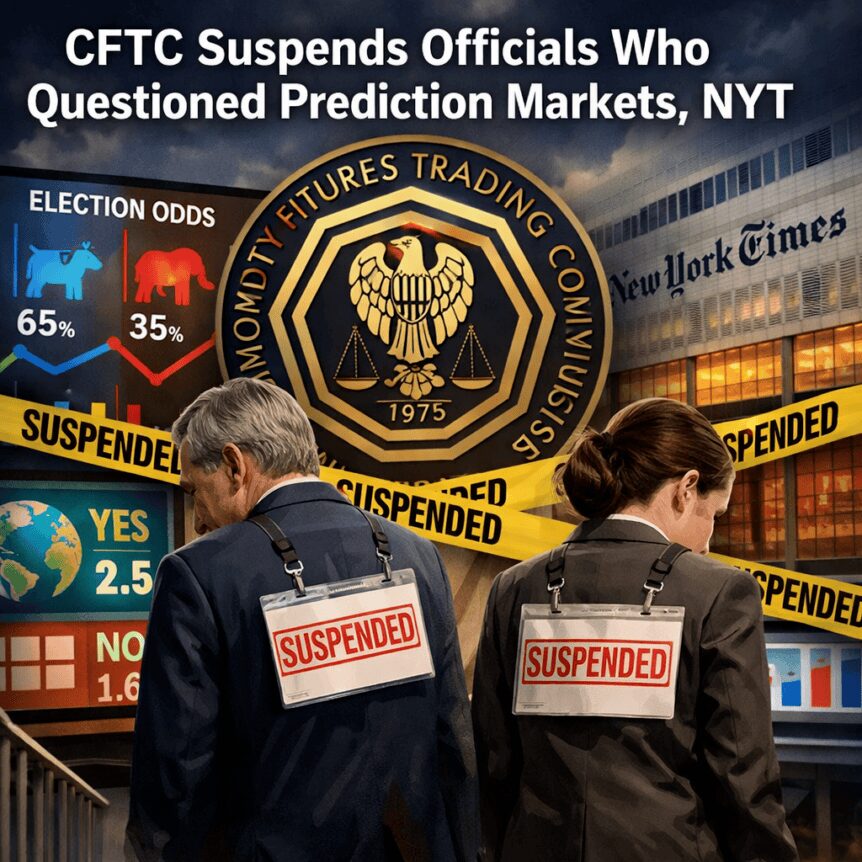
A New York Times investigation published this week paints a portrait of regulatory pushback that collided with a rising crypto and prediction-market ecosystem at the U.S. Commodity Futures Trading Commission (CFTC). The piece details how senior officials who raised concerns about certain prediction-market operators—Polymarket, Crypto.com and a Gemini affiliate—were sidelined, investigated, and ultimately removed from the agency. The report raises questions about whether regulatory independence was compromised as political and industry interests intersected with enforcement decisions.
According to the Times, concerns flagged by career staff included fair treatment of small bettors, insufficient fraud protections at Polymarket, and an incomplete regulatory review for a Gemini affiliate. Yet, the article contends that acting CFTC chair Caroline Pham and a senior counsel intervened to help these firms advance their objectives. By the end of 2025, two officials who had raised questions were placed on administrative leave and investigated, and three others involved in crypto enforcement faced similar fates. Those involved told the Times they were not informed what specific actions prompted the sanctions. The report quotes current and former agency staffers who described a broader message that emerged within the CFTC: avoid provoking the emerging crypto and prediction-market industries.
Key takeaways
- Internal concerns over major prediction-market platforms: Career staff warned about Polymarket’s fraud protections, Crypto.com’s treatment of small bettors, and Gemini’s affiliate not completing regulatory review.
- Enforcement posture shifts under the agency’s leadership: The Times notes a reduced crypto-enforcement footprint, with several investigations dropped and a move away from broad cases toward individual operators.
- Leadership and potential conflicts of interest: Caroline Pham left the CFTC for MoonPay; a key official who helped approve Gemini Titan’s application later moved to a Gemini unit, raising questions about regulatory capture or influence.
- Industry ties and political milieu: The report highlights business relationships tying the involved firms to political figures and entities, including Trump-associated ventures and investors.
- Regulatory and legislative context expanding pressure: The story aligns with ongoing calls in Congress to bolster the CFTC’s capacity as it faces a rapidly evolving crypto landscape.
Regulatory posture and the enforcement arc
The Times’ account portrays a CFTC that, in its handling of crypto and prediction-market firms, appears to have shifted away from aggressive enforcement. The article notes a contrast between the Biden era’s broader enforcement push and the current period, which it characterizes as more restrained. Specifically, the agency reportedly dropped at least five crypto investigations, and the number of crypto-enforcement actions fell from more than 80 under the Biden administration to only a couple during the period described by the report, with those recent cases aimed at individual operators rather than large firms.
The piece points to a leadership dynamic at the top of the agency. Caroline Pham, who helped steer policy before departing for MoonPay—an entity tied to Polymarket—left a vacancy in the chair role, with Michael Selig serving as the agency’s sole commissioner and acting chair. The report notes that Selig previously represented crypto firms as a corporate lawyer, underscoring concerns about potential conflicts of interest within the agency’s upper ranks. In parallel, Brigitte Weyls, who was the senior counsel referenced in the Times’ reporting, became general counsel at Gemini Titan after assisting with Gemini Titan’s application.
Industry ties, approvals, and risk signals
The investigation maps several notable ties between the implicated platforms and political and financial actors. Crypto.com is described as a business partner of Trump Media. Polymarket attracted investment from 1789 Capital, a venture capital firm associated with Donald Trump Jr. Gemini’s founders have reportedly been backers of American Bitcoin Corp, a cryptocurrency firm co-founded by Eric Trump. The Times presents these connections as part of a broader mosaic of influence that could complicate regulatory decision-making or create perceptions of preferential treatment.
In response to questions about conflicts of interest, a White House spokesperson asserted that “President Trump only acts in the best interests of the American public” and denied conflicts, a claim that the Times cited in its coverage. As with all such allegations, Crypto industry participants and the agencies involved have not publicly contested every detail of the report in the same forum, and the agency did not immediately offer a formal response to the Times’ findings in print at publication.
Enforcement actions against states and the broader regulatory frontier
Beyond internal dynamics, the Times recounts the CFTC’s legal posture toward prediction-market regulation at the state level. Cointelegraph has reported on the CFTC’s lawsuits against state regulators seeking to apply or interpret restrictions on prediction markets in places such as Wisconsin, Minnesota, New York, Arizona, Connecticut and Illinois. The Times’ framing suggests that the federal agency’s stance toward state-level regulation has interacted with a patchwork of state approaches, potentially creating uneven enforcement and compliance pressures for platforms operating within multiple jurisdictions.
Meanwhile, momentum on Capitol Hill has signaled that lawmakers intend to strengthen the CFTC’s oversight capacity. The House Agriculture Committee recently urged President Trump to nominate multiple commissioners to fill the agency’s leadership ranks, arguing that the CFTC is ill-equipped to oversee a rapidly expanding crypto and commodities ecosystem with only one sitting member. The unfolding political dynamic adds a layer of uncertainty about how quickly and how robustly the agency will recalibrate its crypto enforcement posture in the coming months.
For readers seeking broader context, the New York Times’ investigation arrives amid ongoing coverage of regulatory developments and industry tensions that are shaping investor and operator expectations. The timing suggests that market participants are watching closely not only for concrete enforcement actions but for the signals that regulatory capture concerns may influence future policy and decision-making within the CFTC.
Related coverage from Cointelegraph has discussed how the CFTC’s stance on event-contract reporting and data requirements has evolved, offering additional background on how the agency has managed the reporting framework around prediction-market activity in recent years. These themes collectively illuminate the broader regulatory frontier that traders, platform operators, and developers must navigate as market structures and use cases continue to diversify.
As the debate over independence, accountability, and industry influence continues, investors and operators should monitor upcoming regulatory nominations, potential reforms to employees’ conflicts-of-interest rules, and any new enforcement guidelines that the CFTC may publish as part of its response to this evolving landscape.
Source: New York Times investigation, May 24, 2026. The Times report and linked material provide the central narrative about staff concerns, leadership changes, and the alleged influence of political and business ties on regulatory outcomes. Cointelegraph has previously reported on related state-level actions and enforcement activity that contextualize how prediction markets intersect with federal oversight.
https://www.cryptobreaking.com/cftc-suspends-officials-who-questioned/?utm_source=blogger%20&utm_medium=social_auto&utm_campaign=CFTC%20Suspends%20Officials%20Who%20Questioned%20Prediction%20Markets,%20NYT%20
Comments
Post a Comment