
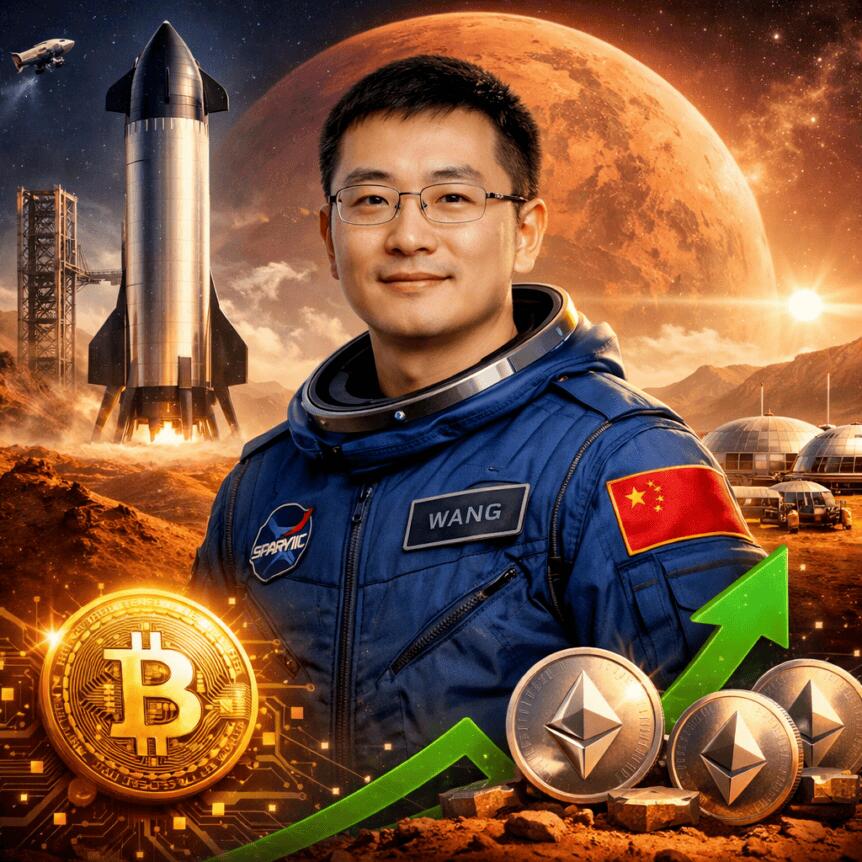
Chun Wang, the Chinese-born Maltese entrepreneur who founded the Bitcoin mining pool F2Pool, is stepping into a high-profile spaceflight role after reportedly purchasing a seat on SpaceX’s planned interplanetary mission to Mars. SpaceX announced the two-year mission will venture beyond the Moon, perform a Mars flyby, and return to Earth. Wang has also secured a ticket for a planned weeklong commercial lunar flyby that will launch before the Mars mission.
In a post on X, Wang framed his involvement within the wider trajectory of space exploration. He argued that even if lunar flights remain privately funded only to a point, activity on the Moon is likely to advance anyway as governments and private players push lunar bases into reality. Yet his expectation for Mars is more uncertain: “And I think I should do something about that. I hope that by purchasing a flyby mission to Mars, SpaceX will have another reason not to forget about Mars. Because we seriously shouldn’t defer Mars to our next generation.”
The development underscores a growing trend among tech executives funding or personally participating in spaceflight. Beyond SpaceX, figures such as Jeff Bezos, Richard Branson, and Jared Isaacman have publicly backed or spearheaded ambitious space ventures in recent years, highlighting a convergence of wealth, technology, and exploration as a new frontier for personal branding and strategic outreach.
SpaceX’s Mars ambition is not a distant dream. The company has signaled that Starship cargo flights to Mars for research, development, and exploratory purposes are unlikely to begin before 2028. The ultimate objective, SpaceX has explained, is to establish a self-sustaining city on Mars, a venture it estimates would require more than 1 million residents and millions of tons of cargo to support a permanent presence.
Wang’s personal motivation to press the timeline reflects a broader view that public imagination and private investment can sustain long-range space projects once they earn continuous visibility. He hopes his participation will keep Mars from receding from the public agenda, even as the Moon remains a more proximate and less controversial target for investment and experimentation.
Key takeaways
- SpaceX announced its first interplanetary mission to Mars, described as a two-year journey that will venture beyond Earth’s orbit, perform a Mars flyby, and return home.
- Chun Wang, founder of F2Pool, has purchased a seat on the Mars mission and also booked a weeklong commercial lunar flyby that precedes the Mars mission.
- F2Pool, one of the earliest Bitcoin mining pools in China and now Maltese-registered, remains among the largest, holding about 11.85% of the mining pool market share according to mempool.space.
- SpaceX projects that Mars missions will not begin before 2028, with the long-term vision of a self-sustaining Martian city requiring over 1 million people and vast cargo volumes.
- The Fram2 mission—another SpaceX venture Wang previously backed—flown earlier this year carried real-world experiments such as in-space X-ray imaging and mushroom cultivation by a four-person crew.
SpaceX’s interplanetary plan and Wang’s commitment
SpaceX’s forthcoming mission to Mars is described as a multi-year, interplanetary expedition designed to test systems, life support, and propulsion in an extended space environment. The company outlined that the mission will depart Earth, travel beyond the Moon, perform a Mars flyby, and return to Earth as part of a broader program to validate the feasibility of long-duration, crewed travel to and from the Red Planet. The mission is tied to the broader Starship development program, which SpaceX has positioned as the backbone of its Mars-at-scale ambitions.
Wang’s decision to purchase a seat aligns with a growing phenomenon of notable tech figures directly funding or stewarding spaceflight campaigns. By anchoring a high-profile participant to the mission, Wang adds a visible, crypto-centric investor to a roster that increasingly blurs the lines between fintech, crypto, and space exploration. He will also join a separate SpaceX flight—a planned weeklong lunar flyby—set to launch prior to the Mars mission, according to the company’s updates.
F2Pool’s profile in crypto mining and the broader signal for enthusiasts
F2Pool, established in 2013 by Wang, stands as one of the earliest mining pools to emerge from China. Today, it sits among the top players in the mining ecosystem, with its market share commonly tracked by industry trackers. As of the latest publicly cited data, F2Pool holds roughly 11.85% of the mining pool market share, placing it among the most influential pools globally. This profile gives Wang a noteworthy footprint in the crypto mining space even as he diversifies his public portfolio with spaceflight ambitions. The pool’s prominence is often cited in discussions about network security, hash rate distribution, and the evolving economics of mining operations in a shifting regulatory and environmental landscape.
Wang’s involvement at this intersection of crypto and spaceflight underscores a broader pattern: leaders who have built highly technical, capital-intensive enterprises are increasingly viewing space as a frontier with potential strategic and reputational value. The Fram2 mission—an earlier SpaceX venture Wang bankrolled—demonstrated his willingness to extend his influence beyond Earth’s orbit and into the testing ground for space technologies and protocols.
Fram2, a recent precursor to Mars ambitions
In a prior SpaceX-sponsored expedition nicknamed Fram2, a four-person crew traveled to perform experiments in Earth’s polar environment, including in-space X-ray imaging and mushroom cultivation experiments. The mission, which launched earlier this year, featured a multidisciplinary crew comprising a German polar scientist, a Norwegian cinematographer, and an Australian Arctic explorer. Fram2 served as a practical demonstration of SpaceX’s approach to micro-mad experiments and remote research while providing high-profile exposure to private funding and public interest in spaceflight.
Wang’s role in Fram2 and now his purchase of a Mars mission seat highlight a pattern: private actors are increasingly willing to fund not only research but also the symbolic, aspirational dimensions of space exploration. The intersection of crypto, venture funding, and spaceflight is becoming a recognizable trend as the industry tracks how long-haul missions move from concept to reality.
What to watch next for Mars and beyond
SpaceX’s Mars timeline remains contingent on technical milestones, regulatory considerations, and the gradual expansion of crewed spacecraft capabilities. The earliest cargo missions to Mars, and the eventual introduction of a self-sustaining Martian city, will unfold over years, if not decades. Investors and participants in related ecosystems will want to monitor the pace of Starship development, the outcomes of lunar flyby missions, and the geopolitical and regulatory signals around international space collaboration and private sector participation.
For crypto participants, Wang’s journey adds a narrative thread about how capital from crypto mining and fintech ecosystems might support or influence long-term space initiatives. It also raises questions about how such high-profile involvement could affect public perception, regulatory scrutiny, and the alignment of incentives as humanity pushes further into the solar system.
As the Mars mission moves from plan to practice, observers will be watching how SpaceX communicates progress, how participants like Wang frame their involvement, and how these ventures influence a broader cross-industry discourse about the role of private capital in space exploration.
https://www.cryptobreaking.com/chun-wang-joins-spacex-mars/?utm_source=blogger%20&utm_medium=social_auto&utm_campaign=Chun%20Wang%20Joins%20SpaceX%20Mars%20Mission,%20Signals%20Crypto%20Industry%20Shift%20
Comments
Post a Comment