
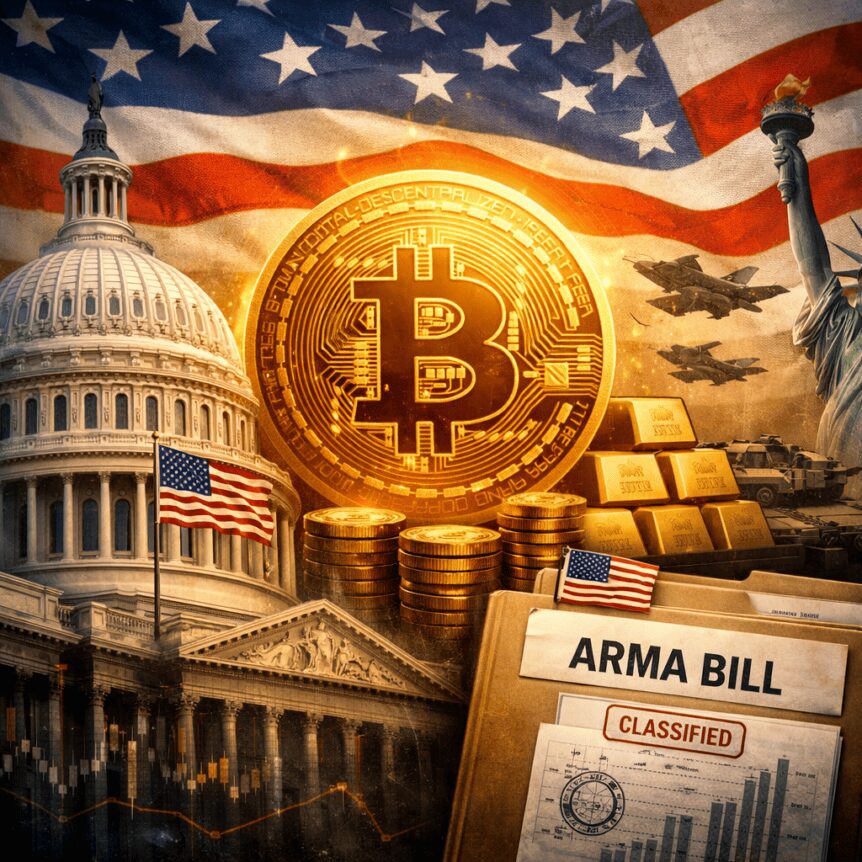
A renewed bipartisan push in Washington seeks to codify a strategic Bitcoin reserve, introducing the American Reserve Modernization Act of 2026 (ARMA). The legislation envisions creating a Strategic Bitcoin Reserve and a Digital Asset Stockpile for other federally held cryptocurrencies, with the assets managed by the U.S. Treasury. Sponsor Rep. Nick Begich and 16 co-sponsors say ARMA would target the accumulation of roughly 1 million Bitcoin over five years, using budget-neutral methods.
ARMA builds on the BITCOIN Act, first introduced in July 2024 and updated in March 2025. In a Sunday interview, Patrick Witt of the President’s Council of Advisors for Digital Assets described ARMA as “Version 2” of the BITCOIN Act, and noted the White House has spent considerable time examining the legal implications of a Bitcoin reserve.
“It's a breakthrough as far as getting everything in place, legally sound, properly safeguarding the assets.”
The United States currently holds 328,372 Bitcoin worth more than $25.5 billion — the most of any nation-state — though portions of those holdings have been sold in the past through court-ordered actions. “The US is already one of the largest holders of Bitcoin in the world. But Congress has never set a federal policy on what to do with that asset,” said Rep. Jared Golden, one of the 16 co-sponsors of the bill.
Under ARMA, Bitcoin would be held for a minimum of 20 years unless it is sold to reduce the national debt, which topped $39 trillion on Wednesday. Like the BITCOIN Act, ARMA would acquire up to 1 million Bitcoin over five years through budget-neutral strategies, meaning the program would avoid drawing from taxpayers’ funds. Proponents argue that a formal federal framework could anchor global competitiveness in digital assets and clarify ownership and custody rules for the government’s holdings.
As digital assets continue to rise in importance, lawmakers say a policy like ARMA could help set long-term strategic priorities. Rep. Mike Carey argued that a structured approach could strengthen the United States’ position on the world stage, ensuring the country remains competitive as digital assets expand in scope and significance.
Matt Cole, CEO and chairman of Strive, described ARMA as the “single most important crypto legislation” to emerge from Washington, signaling a potential turning point in how the U.S. treats digital assets at the federal level.
Key takeaways
- ARMA would establish a Strategic Bitcoin Reserve and a Digital Asset Stockpile to be held by the U.S. Treasury.
- The bill targets the acquisition of up to 1 million Bitcoin over five years using budget-neutral methods, without drawing from taxpayer funds.
- Bitcoin would be held for at least 20 years unless sold to reduce the national debt, which stands above $39 trillion.
- ARMA would implement enhanced transparency, including quarterly proof-of-reserve reporting and independent audits of the Bitcoin reserve.
- The legislation has 16 congressional sponsors and follows the earlier BITCOIN Act, signaling a renewed federal policy interest in digital assets.
A refreshed framework for a Bitcoin reserve
The essence of ARMA is to formalize how the government could own, manage, and disclose holdings of Bitcoin and other digital assets. By creating a dedicated reserve and a stockpile, the bill aims to provide a clear governance structure for federal holdings, reducing legal ambiguity and improving asset safeguarding. Proponents argue that a formal policy would help align the United States with evolving financial technologies and could offer a counterweight to geopolitical volatility in digital asset markets.
ARMA’s budget-neutral approach is a recurring theme, intended to avoid direct taxpayer outlays while still enabling the Treasury to amass a significant stake in Bitcoin. The policy design mirrors earlier proposals, such as the BITCOIN Act, but with added emphasis on legal clarity and asset protection. As the debate continues, negotiators will likely weigh how to balance custody responsibilities with the broader goals of national finance and security.
Policy implications and market signals
Considering the U.S. position as the world’s largest public holder of Bitcoin, ARMA could mark a meaningful shift in how the nation engages with digital assets. The current holdings, referenced as the largest among nation-states, have been subject to change through court-ordered actions over time. A formal federal framework could reduce ad hoc actions by courts or agencies and establish a consistent policy for both custody and disposition of assets in pursuit of debt reduction or other fiscal aims.
The bill’s supporters emphasize that codifying a reserve could help the U.S. remain competitive as digital assets mature. Rep. Carey highlighted the strategic importance of digital assets and suggested that such a framework could reinforce America’s long-term economic posture on the global stage. The White House has signaled ongoing consideration of the reserve’s legal architecture, a process Witt described as a necessary step to ensure constitutional and statutory alignment before any deployment of assets.
Transparency, audits, and digital property rights
A notable feature of ARMA is the push for enhanced transparency around the government’s digital asset holdings. Quarterly proof-of-reserve reports, along with independent third-party audits, would be published for the Bitcoin reserve, according to Begich. Beyond visibility, the bill also seeks to protect property rights by affirming that the federal government may not impair individuals’ rights to own or self-custody digital assets. Critics of government-held assets have long debated custody risk and the potential for political influence over the reserve; ARMA’s advocates frame transparency and clear custodial rules as essential for public trust.
The broader policy conversation around ARMA intersects with ongoing developments in the digital asset space, including battles over custody, reserve transparency, and the appropriate role of government in influencing financial markets through ownership of technology-enabled assets. As observers watch the legislative path, questions remain about implementation specifics, budget mechanics, and how the reserve would interact with existing monetary and fiscal authorities in times of stress.
Overall, ARMA signals a sharpening focus on strategic digital assets as a matter of national policy. If it progresses, the bill could redefine not only how the United States thinks about reserves and debt stewardship but also how investors and builders assess the credibility and stability of public-sector involvement in crypto markets.
Readers should watch for committee action and potential amendments that could shape the reserve’s size, governance, and interaction with other federal programs. The debate is far from settled, and the coming months will reveal how far lawmakers are prepared to go in formalizing a national digital-asset framework.
https://www.cryptobreaking.com/congress-renews-push-for-strategic/?utm_source=blogger%20&utm_medium=social_auto&utm_campaign=Congress%20renews%20push%20for%20strategic%20Bitcoin%20reserve%20under%20ARMA%20bill%20
Comments
Post a Comment