
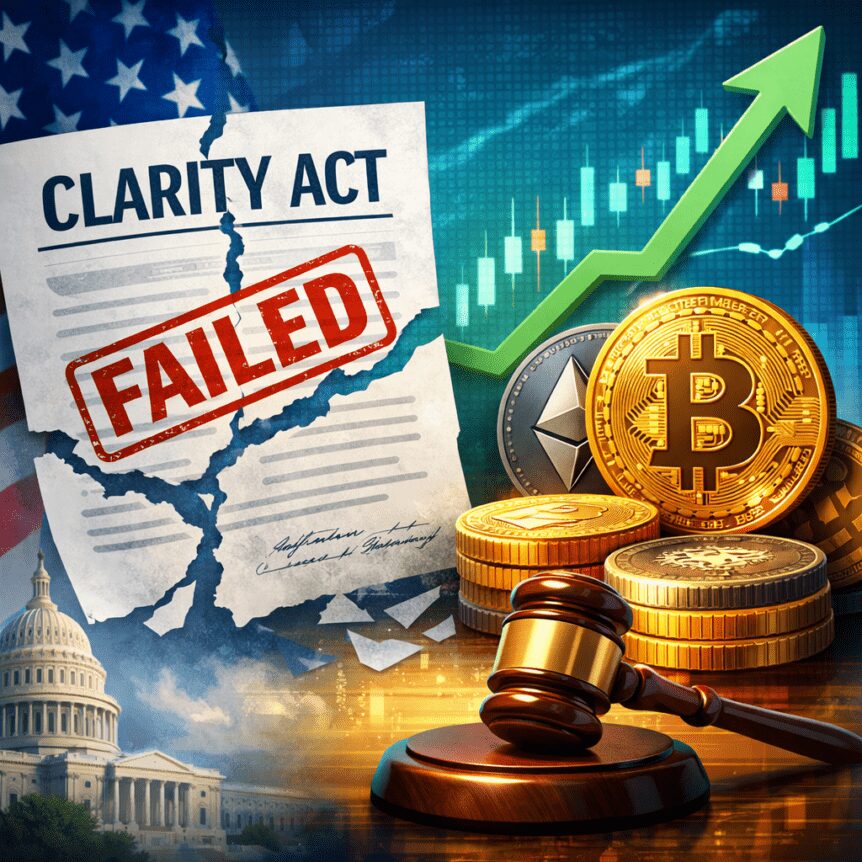
The U.S. crypto industry remains buoyant about its longer-term prospects, even as the fate of the CLARITY Act—an effort to codify regulatory clarity for tokens, stablecoins and crypto businesses—hangs in the balance in Congress. In a recent Chain Reaction episode, Chris Perkins, CEO of 250 Digital Asset Management, argued that the sector’s momentum would endure even if lawmakers don’t pass the bill this session.
Perkins pointed to ongoing policy work by the two main financial regulators as evidence the path to usable guidance is already being carved out. He cited the ongoing efforts of the US Securities and Exchange Commission (SEC) and the Commodity Futures Trading Commission (CFTC) under their chairs, following the agencies’ joint interpretation released in March on how federal securities laws apply to crypto assets.
“If not, we’re going to be just fine,” said Chris Perkins, CEO of 250 Digital Asset Management, on Cointelegraph’s Chain Reaction podcast, noting that the SEC and CFTC are already laying the groundwork for workable regulatory frameworks.
Key takeaways
- The crypto industry’s near-term momentum is not solely contingent on the CLARITY Act; regulators are actively shaping frameworks that could outlive any single piece of legislation.
- Regulatory policy work by the SEC and CFTC is creating a pathway that could bring much-needed certainty and a formal taxonomy for crypto assets, even absent a new law.
- Labeling tokens as securities is no longer an automatic death sentence; a clear, enduring framework could make the classification process more navigable for issuers, platforms, and investors.
- Passage of the CLARITY Act would entrench policy, making it harder for future administrations to roll back regulatory clarity and potentially reshaping the US crypto operating environment for years.
- A sense of urgency is growing around stablecoins and related yields, with lawmakers nudging toward a final text; several senators have offered optimistic timelines, signaling that energy around CLARITY is building.
Policy momentum in the making
The core premise of Perkins’s assessment is that policy isn’t waiting for a single bill to move forward. He highlighted that the SEC and CFTC have been actively developing frameworks and precedents that could guide token classifications, compliance pathways, and enforcement expectations regardless of CLARITY’s fate in Congress. The March joint interpretation, while not a CLARITY Act result, is cited by many industry observers as a signal that federal authorities are willing to articulate how securities laws apply to crypto assets in a concrete way.
Perkins emphasized that policy creation is a long-memory game: once a rule or taxonomy is established, it becomes a reference point that shapes future administration choices and regulatory posture. “There is a reason why we say it takes an act of Congress to do something,” he noted, but he also underscored that the current regulatory push is more than a momentary push for clarity—it’s the start of a framework that could endure beyond a single legislative cycle.
For investors and builders, the takeaway is that regulatory clarity may not depend entirely on a single bill. The ongoing work by the agencies could translate into a more predictable operating environment, with defined categories and compliance expectations that help reduce the mystery that has often surrounded crypto tokens and their regulatory status.
From “death sentence” to a regulated pathway
One recurring theme in Perkins’s discussion is the shift from the era when crypto assets labeled as securities faced existential risk to a landscape where a stable, enforceable framework could be leveraged by market participants. In the past, labeling a token as a security could trigger immediate enforcement action, delistings, and a lack of clear compliance pathways in the U.S. market. Perkins framed the current moment as a transition toward “certitude, stability, and ultimately, a taxonomy” that could harmonize regulatory expectations with practical business models.
That pivot matters because investors, exchanges, and developers often operate best when policy is predictable. If a robust taxonomy and enforcement approach emerge, projects may be better positioned to design compliant token structures, governance models, and disclosure norms that align with established regulatory expectations—reducing the risk of sudden policy shifts or unilateral enforcement actions that have in the past unsettled markets.
Still, Perkins cautioned that the absence of a final CLARITY Act passage would not automatically derail the industry's long-run prospects. The momentum generated by regulator-led policy development could keep the ecosystem on a constructive trajectory, even as lawmakers deliberate on a more formal framework.
CLARITY Act: timing, prospects, and what to watch
The debate around CLARITY has intensified as lawmakers emerged from ongoing negotiations on stablecoin provisions and related regulatory questions. The timing remains a focal point, with several public signals feeding into the market’s expectations. After the publication of a final text aimed at resolving stablecoin yield disagreements between the banking and crypto industries, industry participants voiced renewed optimism that a broader CLARITY package could advance in short order.
“It’s time to get CLARITY done,” said Coinbase chief legal officer Faryar Shirzad in a post on X after US Senator Thom Tillis and US Senator Angela Alsobrooks released the final text addressing the stablecoin yield dispute between banking and crypto sectors.
Political voices from both sides of the aisle have weighed in with their own stipulations about when a vote might occur. Senator Bernie Moreno suggested a May deadline for completion of the act, signaling that momentum could converge around a concrete resolution in the near term. Separately, Senator Cynthia Lummis remarked on April 11 that the moment might be now or never, underscoring the sense of urgency among proponents who view CLARITY as a critical step toward market legitimacy.
Should the CLARITY Act pass, supporters argue it would create a durable framework that would be harder to unwind in future administrations, offering a stable baseline for crypto regulation. Critics, meanwhile, warn of potential overreach or rigidity that could hamper innovation. The interplay between these perspectives will help determine not only the act’s fate but also how the broader market calibrates risk and investment decisions in the months ahead.
In the broader context, the ongoing regulatory dialogue touches on several practical implications for the market. Stablecoins, which have been a particular flashpoint in policy discussions, could see clearer rules around reserve accounting, yield generation, and permissible cash-management practices. As reforms take shape, exchanges and custodians may gain clearer disclosure norms, while token issuers could adopt standardized compliance programs that align with a codified taxonomy—reducing ambiguity and softening the shock of enforcement actions that have characterized recent years.
Industry participants are watching closely for two things: a finalized CLARITY Act with a coherent taxonomy and a trusted enforcement pathway that reduces the risk of sudden regulatory reversals. The interplay between rulemaking activity by the SEC and CFTC and the legislative process around CLARITY will likely define the competitiveness of the U.S. crypto landscape for the foreseeable future.
Cointelegraph’s reporting and interviews remain focused on translating these regulatory developments into practical implications for investors, traders, and builders—highlighting where clarity exists, where it is still evolving, and what signals might guide decision-making as the regulatory regime continues to mature.
As the legal and regulatory narrative evolves, market participants should stay attuned to the next moves from Congress and from the agencies. Even in the absence of a final CLARITY Act, the trajectory of regulatory policy in this period could set the tone for how crypto projects raise funds, launch products, and engage with users in a compliant and sustainable manner.
Readers should monitor tightening timelines on stablecoin provisions, any further joint statements from the SEC and CFTC, and potential floor votes or committee actions related to CLARITY. The balance between legislative efforts and regulator-driven policy will shape the quality and predictability of the U.S. crypto market going into the second half of the year and beyond.
Cointelegraph is committed to independent, transparent journalism. This coverage reflects the ongoing synthesis of policy discussions, industry perspectives, and regulatory developments shaping the crypto landscape.
https://www.cryptobreaking.com/crypto-sector-reassured-as-the/?utm_source=blogger%20&utm_medium=social_auto&utm_campaign=Crypto%20sector%20reassured%20as%20the%20CLARITY%20Act%20fails%20to%20pass,%20Perkins%20says%20
Comments
Post a Comment