
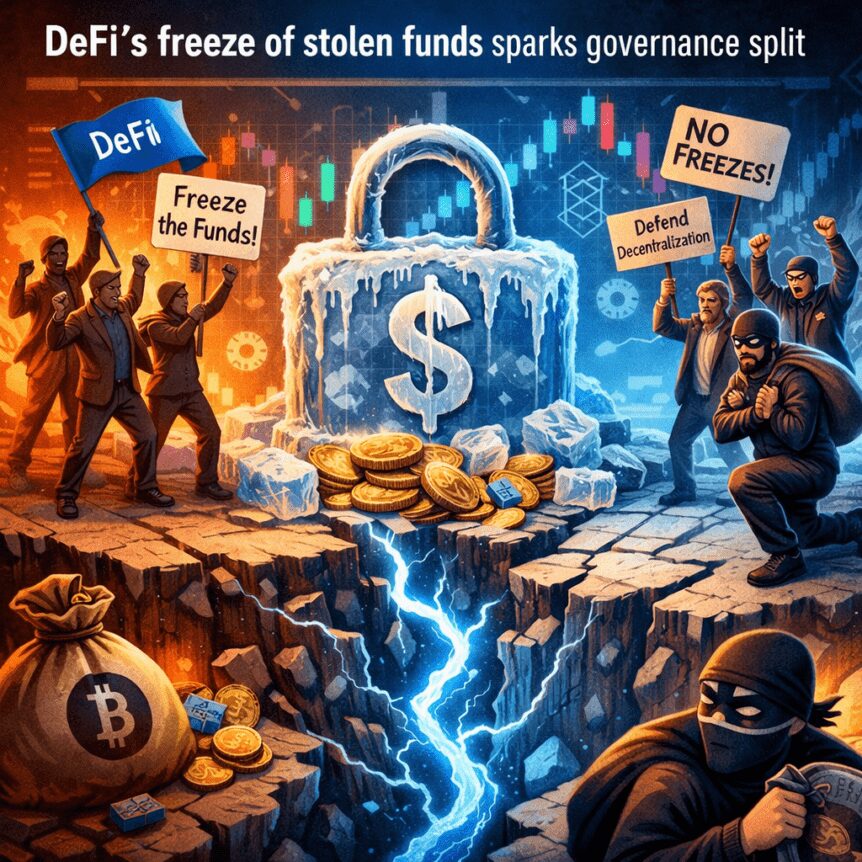
The debate over DeFi’s supposed “trustless” nature has been foregrounded again as a high-profile exploit tests the boundaries of on-chain governance and emergency intervention. After Arbitrum’s response to a major hack linked to the Kelp exploit, questions intensified about who gets to pause, seize, or redirect funds—and under what rules those powers should operate in a system that markets itself as decentralised.
The Arbitrum incident highlighted a practical tension: while protocol developers and decentralisation evangelists argue that permissionless, transparent governance should govern all action, emergency interventions by a security council or a group of trusted insiders can stop further damage at the cost of a purer reading of decentralisation. The core of the debate is not simply “decentralised vs centralised,” but over who holds the keys, how those keys are governed, and how quickly decisions can be made when funds are at risk.
Key takeaways
- Arbitrum relies on a 12-member security council that can enact changes in emergencies; nine signatures are required to authorize actions within a multisignature framework.
- During the Kelp DAO-related incident, Arbitrum froze some stolen funds linked to suspected North Korean actors, prompting renewed scrutiny of protocol-controlled intervention power.
- Centralised stablecoins like USDC and USDT can freeze funds under legally compelled processes, highlighting a governance gap between DeFi’s ethos and regulated fiat-backed issuers.
- THORChain Design: some DeFi projects insist they cannot freeze funds by design, a stance that contrasts with cases where intervention has occurred, raising questions about what “decentralised” really means in practice.
- Experts urge codifying pre-defined, transparent thresholds for intervention to avoid ad hoc governance decisions, balancing user protection with principled decentralisation.
Interventions in DeFi and the Arbitrum episode
The recent Arbitrum security gesture centered on freezing assets tied to an attack linked to the Kelp DAO incident. Arbitrum’s architecture allows a 12-person security council to oversee protocol changes, with emergency actions achievable through a nine-of-12 quorum in its multisig framework. This mechanism, voted on by the network’s decentralized autonomous organization, is designed to provide a rapid-response option when on-chain evidence signals malicious activity.
Connor Howe, CEO and co-founder of the cross-chain infrastructure project Enso, framed the tension plainly: “crypto protocols are not that different from centralized platforms or banks if a small group of people can freeze funds.” He stressed the need for transparency around who holds keys and the safeguards designed to prevent abuse. “There should be transparency in every protocol around who holds the keys, and the safeguards in place to prevent them from going rogue. If there’s no clear distinction, then it’s a vague claim of decentralization,” Howe said.
In discussing Arbitrum’s move, observers highlighted that the decision to intervene—especially in cases tied to North Korean-linked hackers—has become a focal point for broader questions about governance and responsibility in DeFi. The incident also revived scrutiny around the scope and limits of “emergency” powers in privacy-preserving, permissionless networks.
Who intervenes and what counts as “extreme” action?
On one side of the ledger are projects that argue for a hard line against any form of post-hoc intervention. THORChain, for example, has stated it cannot freeze funds by design, arguing that such action would undermine the very premise of non-custodial, cross-chain liquidity. Yet security researchers have pointed to past instances where interventions did occur, challenging the claim that decentralisation automatically prevents any form of takedown or fund seizure.
Bernardo Bilotta, CEO of stablecoin infrastructure platform Stables, argued that intervention can be appropriate but must be tightly scoped. “Freeze capabilities need to be narrowly scoped, time-limited and governed by transparent criteria that existed before the breach occurred,” he told Cointelegraph. “A protocol shouldn't be making up the rules while the house is on fire.” His stance frames the problem as one of responsible governance, not a philosophical struggle over decentralisation in the abstract.
The debate resurfaced amid the wider discourse triggered by the Drift protocol exploit, which involved a substantial loss and prompted questions about how best to respond when a protocol’s funds are compromised. The broader worry is that a few hands with “keys” can decide to intervene pre-emptively, potentially diverting funds away from legitimate user plans or liquidity strategies.
Wish Wu, CEO of institution-focused layer-1 Pharos, emphasized the need for pre-defined, codified conditions for intervention. “In practice, ‘extreme’ is too often defined after the fact by whoever holds the keys, which is exactly the failure mode decentralization was meant to avoid,” Wu said. He advocated for governance frameworks that set objective triggers—accepting that some edge cases may fall outside those rules—and insisted that a credible governance model must make it possible to distinguish between custodial and non-custodial operation in practice.
Centralised issuers and the mechanics of control
The debate cannot ignore the central role played by big centralized issuers in the crypto ecosystem. Centralised stablecoins such as Tether’s USDt and Circle’s USDC dominate the liquidity landscape, with a combined market cap well over $266 billion. The ability to freeze funds is a feature these issuers claim to exercise within the bounds of legal process rather than unilateral decision-making.
Circle’s position has been explicit: freezes occur as a compliance obligation, not as unilateral acts of asset seizure. Dante Disparte, Circle’s head of global policy, described the stance in a recent blog post: “When Circle freezes USDC, it is not because we have decided, unilaterally or arbitrarily, that someone’s assets should be taken from them. Our ability to freeze funds is a compliance obligation — exercised only when we are legally compelled by an appropriate authority, through lawful process.”
The drift toward centralized control has been sharpened by incidents such as the Solana-based Drift exploit, which reinforced concerns about regulatory and jurisdictional leverage over crypto assets in crisis moments. Critics argue that Circle’s approach—while more cautious—undermines the broader DeFi narrative by showcasing a different form of control, anchored in legal processes rather than on-chain governance alone.
Defining the edge: what counts as extreme intervention?
As the industry weighs the tradeoffs between speed, protection, and decentralisation, the question of who defines “extreme” intervention remains pivotal. Some proponents argue that protocols must embed decision rules into governance so that emergency actions occur within pre-agreed boundaries, preserving user trust while acknowledging the harsh realities of security incidents.
“That’s the key distinction between DeFi and traditional finance: there should be a transparent framework for intervention that’s pre-defined, not improvised,” Howe noted. “If the system can’t clearly articulate who holds the keys and under what circumstances they’ll act, it loses credibility as a genuine decentralised platform.”
Wu echoed the concern, warning that vague or discretionary powers could erode the very essence of decentralisation. “If there’s no clear distinction, then it’s a vague claim of decentralization,” he said, urging projects to articulate governance boundaries and escape hasty, ad hoc moves in crisis moments.
What’s at stake for users, investors, and builders
For users and investors, these debates shape risk profiles across DeFi and the broader crypto market. Quick, decisive interventions may curb losses in the near term but could also raise questions about future guarantees of fund accessibility and market integrity. For builders, the episode underscores the importance of designing governance that is both transparent and auditable, with clear criteria for emergency actions that preserve user protections without eroding the decentralised ethos.
Industry observers also note that the Arbitrum episode comes at a time when cross-chain infrastructure and Layer-2 security governance are increasingly in focus. If the industry can codify robust, pre-agreed governance thresholds, it may reconcile the imperative to stop damage quickly with the imperative to uphold a decentralized, user-centric ethos.
As markets digest these developments, the next phase will hinge on how governance structures evolve to balance action, transparency, and the protection of user funds. The essential question remains: can a DeFi ecosystem maintain its non-custodial promise while still defending users from sophisticated exploits through timely and accountable intervention?
Readers should watch forthcoming governance proposals, potential regulatory guidance, and any formal disclosures from major protocols about how they define and implement emergency intervention—especially when the stakes involve hundreds of millions of dollars in on-chain value.
https://www.cryptobreaking.com/defis-freeze-of-stolen-funds/?utm_source=blogger%20&utm_medium=social_auto&utm_campaign=DeFi’s%20freeze%20of%20stolen%20funds%20sparks%20governance%20split%20
Comments
Post a Comment