
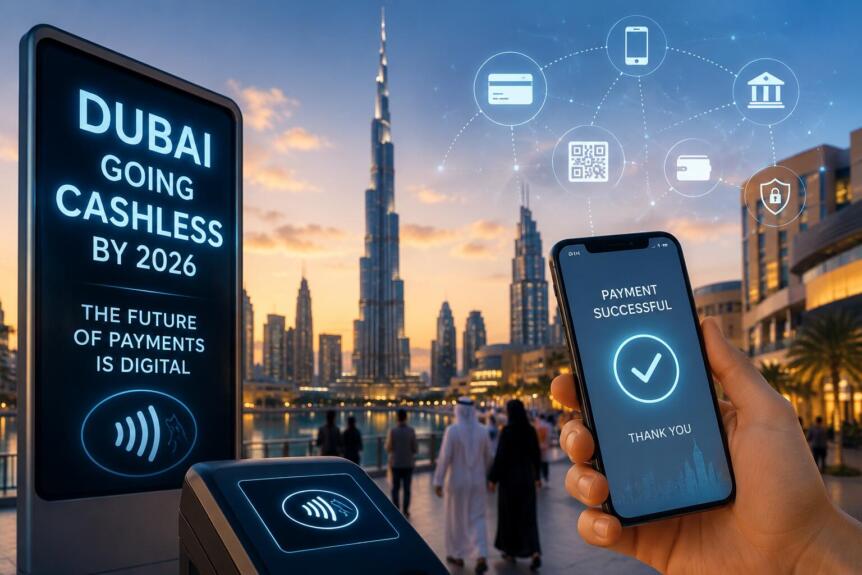
Dubai is rapidly accelerating its transformation into one of the world’s leading cashless economies, with authorities aiming for nearly 90 percent of all transactions across both public and private sectors to become fully digital by the end of 2026.
The initiative, known as the “Dubai Cashless Strategy,” was originally announced in October 2024 during a meeting of Dubai’s Executive Council chaired by Sheikh Hamdan bin Mohammed bin Rashid Al Maktoum. The long-term vision is ambitious: positioning Dubai among the top five cashless cities globally while strengthening its status as a global fintech and innovation hub.
Rather than eliminating money itself, the strategy focuses on replacing physical cash transactions with digital alternatives such as banking apps, contactless cards, QR payments, smart wallets, and AI-powered payment technologies.
According to Dubai Finance, the transition could contribute more than AED 8 billion annually to the emirate’s economy by improving efficiency, reducing operational costs, accelerating commerce, and increasing financial inclusion.
https://x.com/DXBMediaOffice/status/2008546514298359874
Why Dubai Is Moving Toward a Cashless Economy
Dubai’s push toward a digital-first financial ecosystem is part of a broader strategy to modernize infrastructure, support fintech innovation, and create a more connected economy.
Digital payments offer several advantages for governments, businesses, and consumers:
- Faster and more seamless transactions
- Reduced cash handling and operational costs
- Improved transparency and security
- Better integration with smart city infrastructure
- Enhanced financial tracking and analytics
- Greater convenience for residents and tourists
The strategy also aligns with the UAE’s wider ambitions around artificial intelligence, blockchain adoption, smart governance, and digital transformation.
For years, Dubai has positioned itself as a global testbed for emerging technologies. The move toward becoming a largely cashless society represents another major step in that direction.
Digital Payments Are Already Becoming the Standard
Recent developments show that the transition is already underway across multiple sectors.
One of the clearest examples came with the announcement from Parkin that cash payments at parking meters would begin to be phased out starting June 1, 2026. Drivers are now encouraged to pay using the Parkin app, SMS services, or nol cards instead of physical coins.
This may appear like a small operational change, but it reflects a much larger transformation happening throughout the emirate.
Consumers in Dubai are increasingly relying on:
- Apple Pay and Google Pay
- Contactless debit and credit cards
- Banking apps
- QR-based payment systems
- Instant transfer solutions
- Smart mobility payment integrations
The government is also encouraging businesses to modernize payment infrastructure through partnerships and fintech-focused initiatives.
In 2025, Dubai International Financial Centre (DIFC) and Dubai Finance launched workshops and programs designed to help businesses transition toward digital payment systems while introducing AI-driven financial technologies.
What This Means for Tourists Visiting Dubai
The cashless transition will not only impact residents and businesses, but also millions of tourists visiting Dubai every year.
The Central Bank of the UAE has already introduced initiatives aimed at simplifying digital payments for international visitors.
One of the most notable projects is the Tourist Identity initiative, which will allow tourists to instantly open digital bank accounts upon arrival in the UAE. Visitors will gain access to digital debit cards and essential banking services within minutes, significantly reducing the need to carry physical cash.
Tourists will also be able to access the UAE’s domestic card network, Jaywan, and use the Aani instant payment system for transfers and purchases.
Additionally, airlines including Emirates and flydubai have already partnered on initiatives encouraging digital payment adoption among international travelers.
The result is a smoother and more integrated payment experience across hotels, retail stores, transportation systems, restaurants, entertainment venues, and tourist attractions.
Potential Impact on Fintech, Crypto and Web3
While the Dubai Cashless Strategy itself is focused primarily on digital payments rather than cryptocurrencies, the initiative could indirectly accelerate growth across the broader fintech and Web3 ecosystem.
A population increasingly comfortable with digital wallets, instant payments, and app-based financial services creates an environment naturally more open to innovation in areas such as:
- Stablecoins
- Tokenized payments
- Digital identity systems
- Blockchain infrastructure
- Embedded finance
- AI-powered financial services
Dubai has already established itself as one of the world’s most crypto-friendly jurisdictions, attracting exchanges, blockchain startups, Web3 companies, and fintech entrepreneurs from around the globe.
As digital financial behavior becomes more deeply integrated into everyday life, the gap between traditional fintech and blockchain-based finance may continue to narrow.
A Glimpse Into Dubai’s Future
Dubai’s vision goes beyond simply reducing the use of physical cash.
The broader objective is to build a fully interconnected digital economy where payments, transportation, government services, tourism, commerce, and financial services operate seamlessly together.
If the strategy succeeds, paying with cash in Dubai could eventually become the exception rather than the norm.
From parking and public transport to restaurants, shopping malls, and government services, the emirate is steadily moving toward a future where nearly every transaction happens instantly through digital channels.
For residents, businesses, investors, and tourists alike, Dubai’s transition toward a cashless society may become one of the defining economic and technological shifts shaping the city over the coming decade.
https://www.cryptobreaking.com/dubai-pushes-toward-a-cashless/?utm_source=blogger%20&utm_medium=social_auto&utm_campaign=Dubai%20Pushes%20Toward%20a%20Cashless%20Future%20as%20Digital%20Payments%20Near%2090%%20of%20Transactions%20by%202026%20
Comments
Post a Comment