
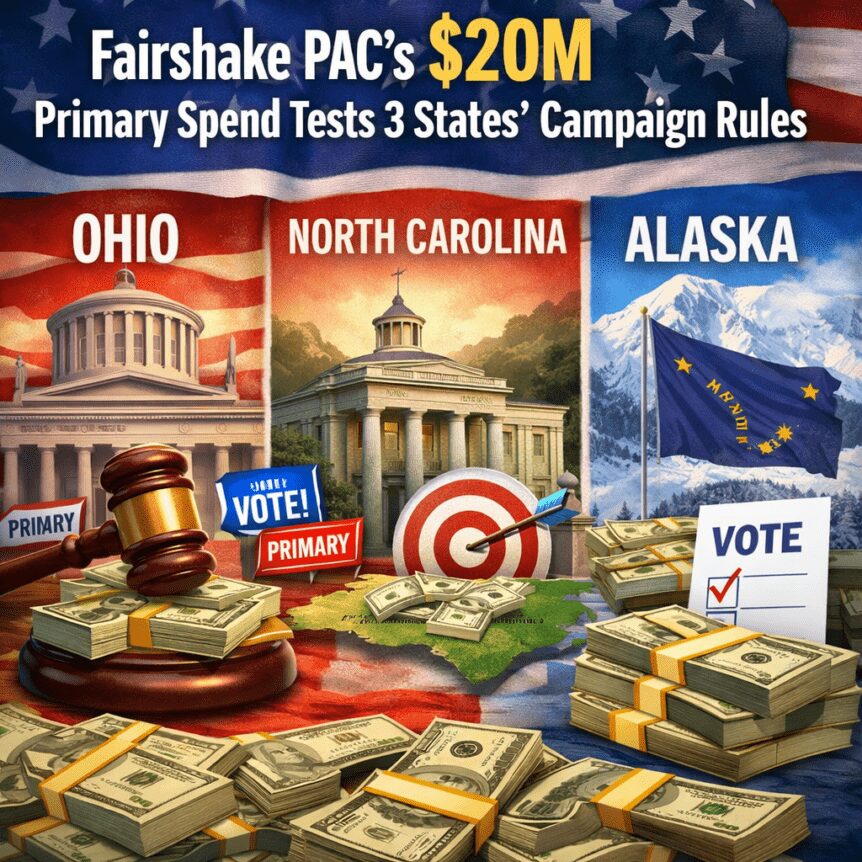
Crypto-aligned political action committees (PACs) backed by industry participants secured a string of wins in three U.S. state primaries on Tuesday, signaling a potential blueprint for crypto politics ahead of the 2026 midterms. The Fairshake network and its affiliates deployed sizable media spend to back a slate of candidates, with the funding stream largely anchored by Ripple Labs and Coinbase. The groups are coordinating through vehicles such as Defend American Jobs (supporting Republicans) and Protect Progress (for Democrats perceived as pro-crypto).
In Georgia and Kentucky, four Republican candidates and one Democrat won their respective primaries for U.S. Senate and House seats, while a Republican in Alabama advanced to a runoff. The successes underscore the willingness of crypto-affiliated committees to pursue both partisan angles in pursuit of policy-friendly outcomes.
“Fairshake’s 6-0 sweep tonight was a clear victory for pro-crypto leaders across the country,” Fairshake spokesperson Geoff Vetter told Cointelegraph. He added, “This powerful bipartisan mandate is being heard across America from Georgia to Alabama to Kentucky.”
According to Federal Election Commission filings, Protect Progress spent more than $4.2 million to back Jasmine Clark, who is running in Georgia’s 13th Congressional District. Defend American Jobs reported substantial media expenditures on Republican candidates: $455,000 for Clay Fuller in Georgia’s 14th district, $709,000 for Houston Gaines in Georgia’s 10th district, $431,000 for Jim Kingston in Georgia’s 1st district, and $7.2 million for Kentucky’s U.S. Senate seat. In Alabama, Barry Moore was backed with $7.4 million from Defend American Jobs in his run for the U.S. Senate, setting up a runoff against state Attorney General Steve Marshall and Republican candidate Jared Hudson after no candidate secured a majority in the primary.
Fairshake and its crypto industry backers are positioning their spending as a long-term strategy. A spokesperson indicated the aim is to mobilize support for pro-crypto leadership in 2026, with the group forecasting continued, substantial media expenditures to counter anti-crypto positions. The organization has reported a war chest of about $193 million, a figure far larger than its $130 million outlay in 2024 for media and advertising to influence congressional races. This scale reflects a broader strategy to shape policy conversations around regulation, taxation, and market structure in ways favorable to the industry.
Related reporting notes broader patterns in crypto PAC activity, including prior efforts that did not achieve expected influence. For example, Fairshake spent roughly $8 million opposing Illinois Lieutenant Governor Juliana Stratton in a U.S. Senate primary, yet Stratton won with more than 40% of the vote, illustrating the challenges of converting large media spend into decisive electoral outcomes.
Texas runoff tests crypto‑PAC influence
In Texas, Protect Progress has intensified its media investment to bolster Democratic candidate Christian Menefee in the race to unseat incumbent Al Green in Texas’ 18th Congressional District. Federal Election Commission filings indicate Protect Progress allocated more than $4.1 million to support Menefee and reported more than $2.8 million in media buys opposing Green, who has expressed anti-crypto views and supported votes against several crypto policy proposals, including the GENIUS Act (stablecoins) and the CLARITY Act (digital asset market structure).
Preliminary runoff dynamics in Texas reflect the complexity of crypto PAC strategy at the state level: Protect Progress previously spent more than $1.5 million opposing Green ahead of a March primary, but neither candidate secured a majority, triggering the upcoming runoff. The Texas contest adds to a broader narrative about crypto-aligned funding influencing candidate positioning on policy, regulatory oversight, and fintech innovation at the state level.
These developments appear within a wider regulatory frame. While the primary focus is electoral, the activity intersects with ongoing U.S. regulatory scrutiny of crypto markets—the SEC, CFTC, and DOJ remain central to enforcement and policy shaping. Observers note that such PAC activity can have implications for licensing, KYC/AML compliance, and cross-border policy alignment, particularly as U.S. states experiment with their own digital-asset frameworks while federal agencies assess uniform standards. In a comparative sense, regulatory trajectories abroad—such as the European Union’s MiCA framework—underscore a global significance to political economy decisions around crypto policy.
Historical context, risk considerations, and compliance implications
The crypto industry’s growing involvement in electoral politics reflects a strategic effort to influence policy direction in a landscape of evolving rules and enforcement priorities. The scale of spending—multimillion-dollar media buys and targeted district focus—highlights both opportunity and risk for participating firms. While such campaigns can advance policy priorities, they also elevate compliance considerations, including disclosure requirements, attribution practices, and the potential for heightened scrutiny from regulators and the public. Institutions engaging in or monitoring these activities should weigh the governance implications, including how such spending aligns with internal compliance frameworks and risk appetites in relation to regulatory expectations.
Looking ahead, the 2026 midterms loom as a critical inflection point. The continued deployment of pro-crypto messaging through PACs could influence candidate selection, committee assignments, and policy coalitions on issues such as stablecoin regulation, market structure, and the integration of crypto with traditional financial institutions. Analysts and compliance teams should monitor fundraising disclosures, media strategies, and endorsements to gauge how this activity may shape regulatory debates at both state and federal levels. The evolving policy environment will likely require ongoing assessment of political risk, licensing considerations, and cross-border regulatory alignment as the sector navigates a complex and rapidly changing framework.
Closing perspective: As crypto policy remains unsettled, the alignment of industry funding with specific candidates and district-level policy priorities will continue to draw attention from regulators, financial institutions, and legal professionals seeking to understand how electoral dynamics translate into practical regulatory outcomes and enforcement focus.
https://www.cryptobreaking.com/fairshake-pacs-20m-primary-spend/?utm_source=blogger%20&utm_medium=social_auto&utm_campaign=Fairshake%20PAC's%20$20M%20Primary%20Spend%20Tests%203%20States'%20Campaign%20Rules%20
Comments
Post a Comment