Grayscale Flags Six Protocols Leading Tokenization Growth Shift


Market Size Gap Signals Expansion Potential


Grayscale emphasized that US Treasuries lead tokenized assets with around $15 billion in value, followed by commodities at about $5 billion. Smaller segments include private credit, funds, and equities, which continue to develop gradually.

Zach Pandl and Will Ogden Moore stated that much of the global securities market could eventually shift to blockchain infrastructure. “Over time, we believe much of the $300 trillion securities market, along with assets like real estate, will migrate on-chain,” the report noted. Hence, the firm framed tokenization as a structural change in capital markets.

Canton Leads While Ethereum and Solana Scale


Grayscale identified Canton as the dominant network in tokenized assets, holding about $390 billion in value and capturing a large share of on-chain real world assets. Significantly, the report linked this lead to Canton’s institutional focus and built-in privacy features, which align with traditional finance requirements.

Ethereum followed with roughly $16 billion in tokenized assets and about $50 billion locked in decentralized finance. Moreover, the network maintains strong ecosystem activity, including developers and applications. Geoff Kendrick from Standard Chartered said Ethereum could lead near-term adoption driven by traditional finance participation.

Solana accounted for more than $2 billion in tokenized assets and offers high transaction throughput above 1,000 transactions per second. However, Grayscale noted that lower costs and faster processing could support wider retail access and specific use cases such as on-chain stock trading.

Infrastructure and Supporting Networks Gain Attention


Chainlink emerged as a key infrastructure provider within the tokenization ecosystem. The report described it as a “picks and shovels” opportunity because it supports data and connectivity across asset lifecycles. Additionally, Avalanche and BNB Chain also featured as networks expected to benefit from broader adoption trends.

Tokenized assets total about $30 billion, a small share of the roughly $300 trillion global securities market. Consequently, researchers described the gap as a large runway for future adoption. They added that only about 0.01 percent of equities and bonds currently exist on-chain.

Grayscale Research has named six blockchain protocols it expects to benefit most as tokenization expands across global markets. The firm pointed to Ethereum, Solana, Canton, Avalanche, BNB Chain, and Chainlink as key networks positioned to capture value from this shift. Moreover, the report highlighted rapid growth in tokenized assets, which rose 217 percent year over year.
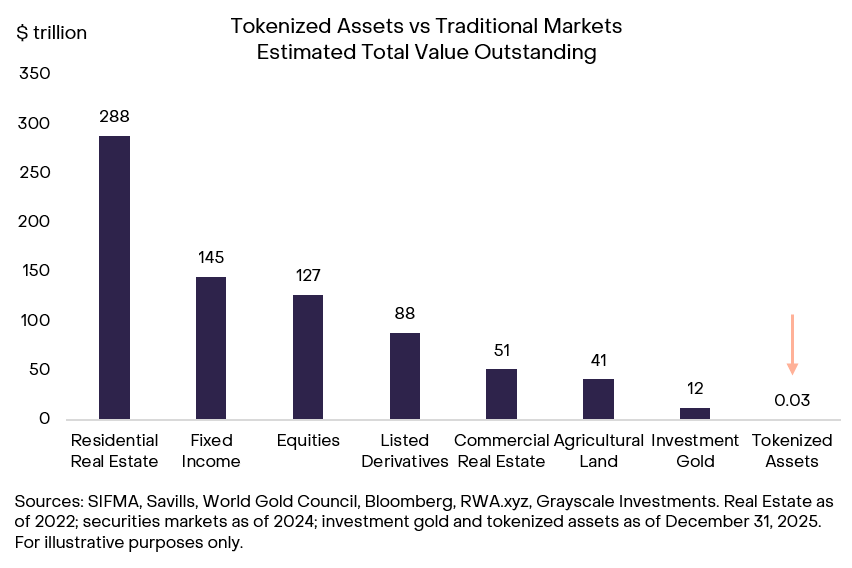
Tokenized Assets Vs Tokenized Markets
Tokenized Assets Vs Tokenized Markets. Source: Grayscale


https://www.cryptobreaking.com/grayscale-flags-six-protocols-leading/?utm_source=blogger%20&utm_medium=social_auto&utm_campaign=Grayscale%20Flags%20Six%20Protocols%20Leading%20Tokenization%20Growth%20Shift%20

Comments

Popular posts from this blog

Coinbase's x402 launches AI agents app store for payments

Coinbase-backed x402 has unveiled Agentic.market, a dedicated marketplace aimed at increasing the usefulness of AI agents by aggregating thousands of apps and services that agents can access without any API keys. The rollout positions the platform as a central hub for agents to discover, evaluate, and deploy capabilities across a standardized payments layer. Coinbase product lead Nick Prince described Agentic.market in a video posted on X as a storefront for discovering, comparing, and using x402 services. The marketplace is designed to give both humans and their AI agents access to a wide range of tools—from data feeds to consumer apps—without the friction of managing API credentials. A storefront for discovering, comparing, and using x402 services. Thousands of services. Zero API keys. Powered by x402. Prince added that the market offers a web interface for humans to browse and assess services, alongside a programming layer that lets AI agents autonomously search, filter, and integra...

Scaramucci Family Invests $100M in Trump-Backed Bitcoin Mining Firm

The recent investment in American Bitcoin highlights the growing interest and participation of prominent figures and families in the cryptocurrency mining sector, particularly in the United States. With over $100 million from the Scaramucci family’s Solari Capital and backing from notable entrepreneurs and investors, American Bitcoin is solidifying its position as a significant player in the evolving blockchain and crypto markets. This move underscores the increasing institutional and individual involvement in Bitcoin and related assets, shaping the future of the crypto industry amidst regulatory and market dynamics. The Scaramucci family’s private investment firm, Solari Capital, has committed over $100 million to American Bitcoin, a major U.S.-based mining company. American Bitcoin raised $220 million in a funding round before going public via reverse merger, with notable backers including Tony Robbins, Charles Hoskinson, Grant Cardone, and Peter Diamandis. The company ...

AML Fines Surpass SEC Cases, Elevating Crypto Regulatory Risk

Anti-money-laundering enforcement has overtaken securities violations as the principal regulatory threat facing crypto firms, according to CertiK’s State of Digital Asset Regulations report. The U.S. Department of Justice and the Financial Crimes Enforcement Network together imposed more than $1 billion in AML-related fines during the first half of 2025. The development signals a sharp regulatory pivot away from the Securities and Exchange Commission-led enforcement cycle that once dominated crypto compliance discourse. CertiK notes that SEC crypto-specific penalties collapsed in value, falling from $4.9 billion in 2024 to about $142 million in 2025, a trend the firm attributes to shifts in policy priorities and jurisdictional focus. According to CertiK’s findings, transaction-monitoring and licensing lapses are now generating penalties that rival or exceed many prior securities cases. High-profile settlements illustrate the trend: the Department of Justice’s February 2025 resolution w...