
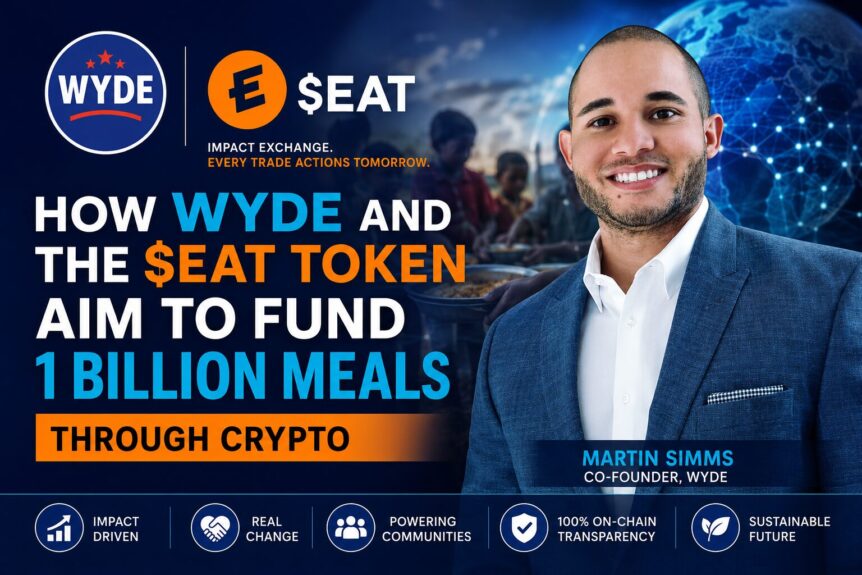
As blockchain projects increasingly search for real-world utility beyond speculation, WYDE is attempting to redefine what a crypto ecosystem can accomplish through a model it calls the “Impact Exchange.”
Built around its mission-driven $EAT token, the platform combines decentralized finance, on-chain transparency, and nonprofit funding infrastructure with a long-term goal of helping fund one billion meals globally. Unlike traditional crypto projects focused purely on financial returns, WYDE routes portions of trading activity directly toward verified hunger-relief organizations through automated smart contract infrastructure.
In this interview with Crypto Breaking News, WYDE Co-Founder Martin Simms discusses the origins of the Impact Exchange model, why he believes crypto and social impact can coexist sustainably, how the project’s legal structure could influence future decentralized organizations, and why infrastructure, rather than hype, is the real long-term product.
What inspired the “Impact Exchange” model, and how is it different from a traditional crypto exchange?
Martin Simms explained that the idea behind WYDE emerged from decades spent inside traditional finance and corporate treasury systems, where he observed a recurring pattern among the most successful long-term companies.
“I've been fascinated by finance since I was a kid,” Simms said. “The companies that consistently outperformed weren't the ones with the most aggressive extraction. They were the opposite. The traditional reading of fiduciary duty to the shareholder gets interpreted as a license to pull direct levers: layoffs, divestitures, cost-out. The companies that compound for twenty and thirty-year windows tend to invert that.”
According to Simms, companies such as Apple demonstrate how emotional alignment, community trust, and perceived societal value often generate stronger long-term market participation than purely financial optimization.
“When we built WYDE, the design question we kept asking was what that principle looks like applied to a market structure instead of a single company,” he said.
Simms describes the result as an entirely new type of exchange model:
“If the New York Stock Exchange is the for-profit stock exchange, WYDE is the stock market for nonprofits.”
Rather than treating charitable giving as a separate action outside the platform, the model integrates impact directly into the transaction layer itself.
“The direct trading of our vehicle adds value to every participant in the ecosystem,” Simms explained. “The community gets impact. The aligned organizations get sustainable funding. The holders get a token tied to a mission counter. Every transaction can fund impact. That's our North Star.”
How does the $EAT token fund hunger relief in practice?
According to Simms, the experience for users remains intentionally simple.
“A user buys $EAT the same way they'd buy any token on Base,” he explained. “They connect a wallet, swap ETH for $EAT through the Uniswap pool, done.”
Behind the scenes, however, the token’s smart contract infrastructure automatically allocates a percentage of each transaction toward hunger-relief initiatives.
“Their trade pays a dynamic fee between 1% and 5%,” Simms said. “The smart contract splits that fee four ways at the moment of execution.”
Part of that fee is routed directly toward:
- Feed the Children
- community-voted local food banks
- ecosystem infrastructure
- treasury functions
“Feed the Children gets half of the cause bucket. Local food banks get the other half,” he added.
Importantly, Simms emphasized that users are not required to make separate donations or manually select charities.
“The user's job ended at the swap. The mission infrastructure handled the rest.”
How does WYDE ensure transparency and accountability?
Simms outlined a three-layer accountability framework designed to ensure the funding flow remains publicly auditable and verifiable.
The first layer is blockchain transparency itself.
“Every fee distribution writes to Base,” Simms explained. “The cause-impact wallet, the partner wallets, the timestamps, the amounts — public record. You don't need our word. You can audit the chain.”
The second layer involves verified nonprofit reporting.
“Feed the Children operates as a verified 501(c)(3). They receive disbursements, they convert them into meals through their existing distribution network, and they report meals delivered on a regular cadence.”
Simms noted that WYDE intentionally uses conservative conversion metrics.
“The conservative aggregate we use is $1 equals 5 meals, which is below Feeding America's published figure. We'd rather under-promise on the conversion and over-deliver on the count.”
The third layer focuses on long-term partnership integrity.
“To qualify for token distributions at the milestone unlocks, a nonprofit partner has to remain active for at least 18 months,” he explained. “That gate exists specifically to prevent pop-up partners from extracting tokens and disappearing.”
“Real commitment, on-chain receipts, public reporting. That's the stack.”
Is the goal of funding one billion meals realistic?
While ambitious, Simms acknowledged the target is intentionally long term rather than short-term marketing rhetoric.
“One billion is the long-horizon mission, not the year-one target,” he said.
The project’s tokenomics roadmap is tied to progressive milestones:
- 100 million meals
- 250 million meals
- 500 million meals
- 750 million meals
- 1 billion meals
Importantly, treasury and team unlocks are linked to mission progress rather than dates.
“Nobody on our side gets paid until the meals show up,” Simms explained.
Since launch in December 2025, the platform has reportedly already funded more than 45,000 meals.
Simms also highlighted recent ecosystem growth catalysts, including:
- the BitMart listing
- the upcoming $EAT Card launch
- the “Impact Summer World Tour”
- the “Hunger Cup” competition initiative
Still, he remains realistic about execution risk.
“Will we hit 1 billion in the first year? No,” Simms said. “Will we hit the first milestone of 100M? That depends on how the card adoption curve plays out, how the CEX listings perform, and whether we can keep momentum past the summer competition window.”
“We have a credible path. We don't have a guarantee. Anyone who tells you a number this big has a guarantee is selling something.”
Why does the DUNA structure matter for decentralized organizations?
One of the more unique aspects of WYDE is its use of Wyoming’s DUNA structure, short for Decentralized Unincorporated Nonprofit Association.
According to Simms, the legal framework solves a major challenge facing decentralized mission-driven organizations.
“Before DUNA existed, you had two bad options,” he explained. “Option one: incorporate as a traditional 501(c)(3) and run the entire operation through a board, which kills the decentralization. Option two: stay structureless.”
Simms argues DUNA creates legal personhood without sacrificing decentralized governance.
“We can hold the treasury. We can sign the Feed the Children partnership agreement. We can be accountable in court.”
At the same time, governance decisions planned for 2026 can still maintain legal standing through community voting.
“DUNA gives them a real counterparty without forcing us to centralize the decision-making behind it,” he said.
Simms believes the structure may become increasingly important for future decentralized impact organizations operating at scale.
Can crypto and social impact actually coexist sustainably?
Simms acknowledged that skepticism toward “crypto philanthropy” is understandable.
“Most ‘crypto philanthropy’ is a founder writing a check after a token rally and posting the screenshot,” he said. “That's PR with extra steps.”
However, he argues WYDE’s model differs because impact is embedded directly into transaction mechanics rather than relying on optional goodwill.
“The fee distribution doesn't care whether a trader believes in the mission,” Simms explained.
“Whether someone is trading $EAT because they care about hunger or because they're trying to flip it for a profit, the cause-impact wallet gets paid.”
He believes sustainability ultimately comes from usage volume and infrastructure integration.
“We're building the volume through the card, the exchange listings, the Hunger Cup, the campus rollout,” he said. “Goodwill comes and goes. Card swipes happen every day.”
How will WYDE attract users beyond crypto-native audiences?
Simms believes the upcoming $EAT Card may become the ecosystem’s most important onboarding mechanism.
Launching June 1, 2026 through a banking partner, the card is designed to abstract away blockchain complexity entirely.
“From the user's perspective, it's a debit card,” Simms said.
“When they swipe it at a coffee shop, the interchange routes through our infrastructure, and a portion of that interchange buys $EAT from the pool, which triggers the same cause-impact split as any other trade.”
Users may never even realize blockchain infrastructure is operating underneath the experience.
“They never have to know what a wallet is. They never have to buy a token themselves.”
WYDE plans to initially target:
- college campuses
- ambassador programs
- Greek life competitions
- younger digitally native communities
“The blockchain runs underneath,” Simms added. “The user sees a website and a card.”
What comes next as governance launches in 2026?
According to Simms, the ecosystem’s next major evolution involves transitioning toward community governance.
“Year one was deliberately not democratic,” he said.
The decision was made intentionally to provide stability for nonprofit partnerships during the project’s early stages.
“No reputable 501(c)(3) is going to sign on if their funding can be voted away in week six.”
Following the initial 18-month stabilization period, $EAT token holders are expected to gain voting authority over:
- partner selection
- treasury deployment
- cause prioritization
- reward distribution
“The treasury holds 50 billion tokens, half the total supply, and every release is gated on meals-funded milestones rather than dates,” Simms explained.
Longer term, Simms believes the infrastructure itself may ultimately become WYDE’s most important product.
“The same fee-split contract works for healthcare, education, environment, any cause vertical with verified 501(c)(3) infrastructure to receive the funding.”
“Hunger is our proof of concept,” he concluded. “The infrastructure is the product.”
https://www.cryptobreaking.com/how-wyde-and-the-eat/?utm_source=blogger%20&utm_medium=social_auto&utm_campaign=How%20WYDE%20and%20the%20$EAT%20Token%20Aim%20to%20Fund%201%20Billion%20Meals%20Through%20Crypto%20
Comments
Post a Comment