
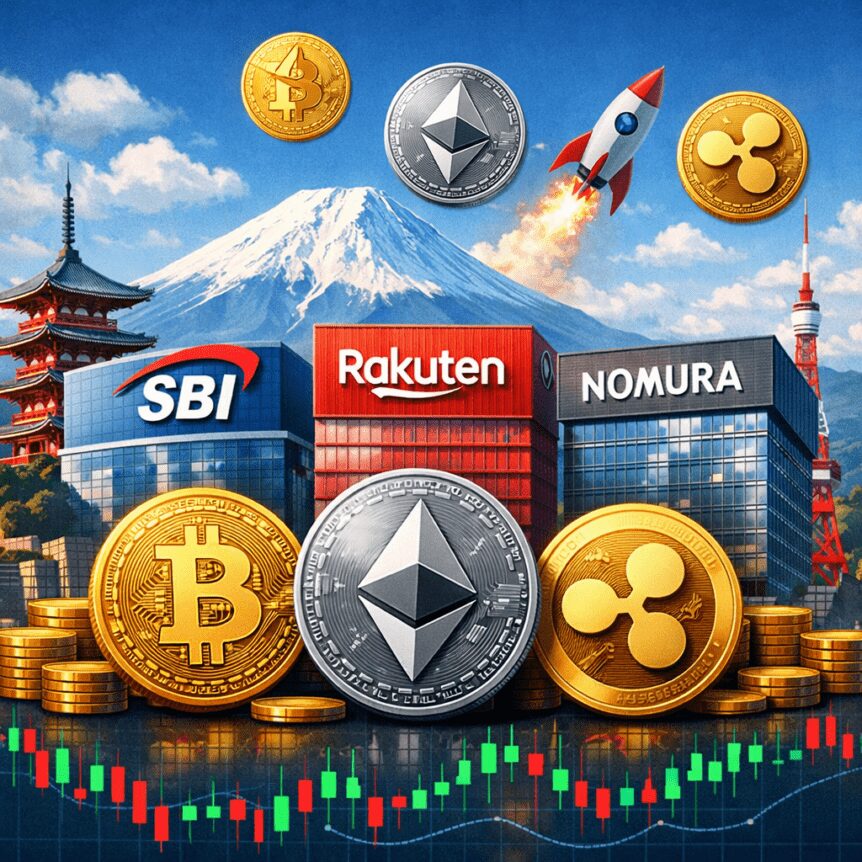
Japan’s largest brokerages are accelerating plans to give retail investors direct access to crypto through traditional investment channels. With SBI Securities and Rakuten Securities leading the way, in-house product development is underway for crypto-focused funds, including ETFs and investment trusts centered on liquid assets like Bitcoin and Ethereum. Major banks such as Nomura are expected to join once regulatory groundwork solidifies, signaling a potential sea change in how ordinary Japanese investors gain exposure to digital assets.
According to a Sunday report by Nikkei, SBI Securities plans to market funds developed by its group company SBI Global Asset Management, spanning both exchange-traded funds and investment trusts. The group aims to manage everything from product design to distribution in-house. Rakuten Securities is pursuing a similar path, pairing with Rakuten Investment Management to create products that can be traded directly from users’ smartphone apps. The overarching objective is to remove a key barrier—requiring dedicated crypto exchanges or wallets—by enabling crypto exposure through standard securities accounts.
Key takeaways
- Retail access to crypto via investment trusts and ETFs is moving from concept to potential rollout in Japan, led by SBI Securities and Rakuten Securities.
- Banks are pursuing crypto funds within existing corporate structures, with Nomura and Daiwa signaling intent to develop crypto investment trusts and SMBC exploring options through a cross-group task force.
- Regulatory momentum is building: the Financial Services Agency plans to revise the Enforcement Order of the Investment Trust Act by 2028 to formally include cryptocurrencies among permitted assets for investment trusts.
- Japan is eyeing the introduction of spot crypto ETFs as early as 2028, with major groups like Nomura and SBI expected to be early entrants, including SBI’s Bitcoin-XRP ETF and gold-crypto ETF plans.
Banks scaling crypto funds as regulation tightens
The Nikkei report underscores a broader industry shift as Japan’s financial giants position themselves for a crypto-enabled retail market. In addition to SBI and Rakuten, Nomura and Daiwa have publicly signaled plans to develop crypto investment trusts within their corporate groups. SMBC Group, including SMBC Nikko, has established a cross-group task force to evaluate options, while Asset Management One, under the Mizuho Financial Group umbrella, has begun preliminary exploration.
The regulatory backdrop is evolving in tandem with these plans. Japan’s Financial Services Agency is moving to revise the enforcement framework governing investment trusts by 2028, a change that would formally permit investment funds to hold cryptocurrencies. This aligns with a broader regulatory reorientation that has already seen crypto assets reclassified as financial instruments under an amended Financial Instruments and Exchange Act. If passed in the current parliamentary session, the amendments are expected to take effect in fiscal 2027, expanding the regulatory umbrella over crypto assets in securities markets. Cointelegraph reported on the reclassification, which marks a pivotal shift for product developers and distribution channels alike.
That regulatory trajectory is feeding into corporate strategy. The Nikkei coverage notes that several banks view crypto investment trusts not as a niche product, but as a strategic channel to deepen client engagement and broaden asset offerings in an era of digitization. For those institutions, the path from pilot programs to fully fungible products hinges on clear rules around custody, liquidity, and investor protections—areas that regulators are actively addressing as part of the 2028 timetable.
From trusts to potential ETFs: a broader roadmap for Japan
Beyond investment trusts, Japan is weighing more direct exposures to crypto through spot ETFs. Reports indicate that rule changes could permit crypto ETFs as early as 2028, with Nomura Holdings and SBI Holdings among the first to consider launching such products. The strategic logic is straightforward: ETFs offer a familiar, scalable channel for retail portfolios to gain crypto exposure without needing to navigate separate crypto exchanges or wallets. SBI, in particular, has publicly outlined plans for a Bitcoin-XRP dual ETF and a gold-crypto ETF, contingent on regulatory approvals.
The shift toward ETF-like structures complements the ongoing work on trusts. Investment trusts provide a framework widely used in Japan for packaged assets and can offer daily liquidity in some forms, while spot ETFs would provide a more direct, exchange-traded crypto vehicle. Both avenues reflect a broader move by Japan’s financial system to integrate crypto assets into mainstream investment products, signaling growing institutional comfort with digital assets as part of diversified portfolios.
As these developments unfold, observers will watch how the interplay between product design, custody solutions, liquidity management, and consumer protections shapes retail adoption. The convergence of in-house product development from major banks and a clear regulatory roadmap could shorten the timeline for broad-based crypto participation in Japan’s securities markets. The next milestones will hinge on regulatory milestones—such as the formal inclusion of crypto assets under the Investment Trust Act—and the timetable for implementing the 2027–2028 reforms that would unlock a wider range of crypto investment vehicles for everyday investors.
For readers tracking the practical implications, the core takeaway is clear: Japan is methodically moving crypto out of the isolated exchange world and into the fabric of mainstream financial services. If approved, spot crypto ETFs and regulated investment trusts could become routine components of retail portfolios within the next few years, reshaping the terrain for crypto investment in one of Asia’s largest markets. Watch the regulatory calendar in 2027 and 2028, as well as any product launches from SBI, Rakuten, Nomura, and their peers, to gauge how quickly this shift gains momentum.
https://www.cryptobreaking.com/japans-sbi-rakuten-nomura-set/?utm_source=blogger%20&utm_medium=social_auto&utm_campaign=Japan's%20SBI,%20Rakuten,%20Nomura%20set%20to%20launch%20crypto%20investment%20trusts%20
Comments
Post a Comment