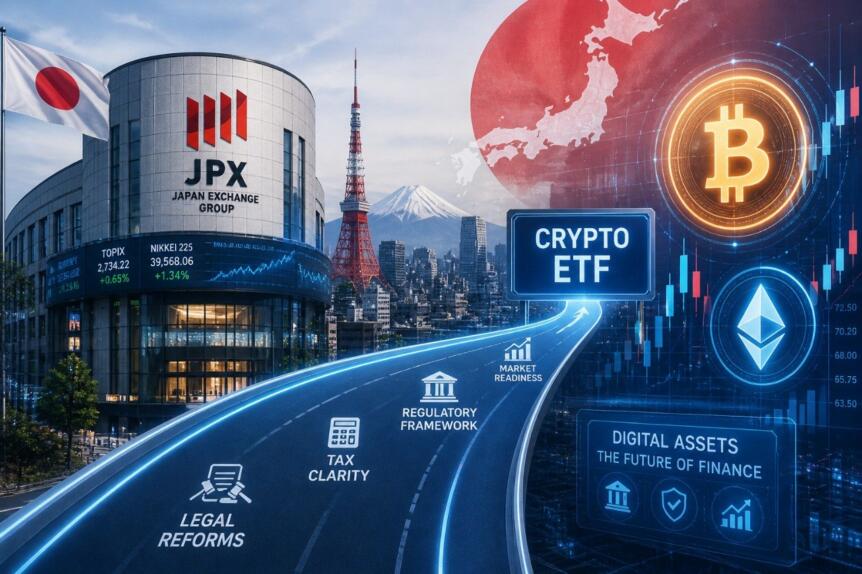
JPX Plans Crypto ETF Listing Path as Japan Reviews Digital Asset Law


JPX is moving closer to a possible crypto ETF launch in Japan, with 2027 seen as the earliest target. CEO Hiromi Yamaji said preparations can begin once legal reforms and tax rules become clear.

The move comes as Japan reviews how crypto assets are classified and taxed, while asset managers show growing interest in regulated crypto investment products.

Jpx Waits for Legal Clarity Before Etf Launch


Japan Exchange Group may move ahead with crypto ETFs once the legal process is complete. The company operates Japan’s main securities markets. So, its role could shape future crypto investment products.

Yamaji told Bloomberg that JPX is ready to prepare when laws and taxes are clear. He said, 'If the legal framework is in place and tax treatment is clear, it can be done anytime.'

The earliest listing could happen in 2027. However, the timing may shift to 2028 if law changes take longer.

https://twitter.com/WuBlockchain/status/2050084597648724273?s=20

Japan has not yet approved spot crypto ETFs in the same way as some other markets. For that reason, market operators are waiting for clear rules before listing such products.

Japan Reviews Crypto Tax Treatment


Japan is also reviewing how crypto gains should be taxed. Current rules treat many crypto gains as miscellaneous income. That can lead to tax rates as high as 55%.

A new tax proposal may place some crypto assets under financial product rules. If passed, certain gains could face a flat 20% tax rate. This would be closer to the system used for stocks.

The proposal may also allow losses to be carried forward for up to three years. That rule already applies to some financial products in Japan. It could help investors manage losses from market swings.

However, the plan may not cover every crypto activity. Staking, lending rewards, and NFTs may still need separate treatment. Final details will depend on future legislation.

Asset Managers Show Interest in Crypto ETFs


Yamaji said many asset managers have shown interest in crypto ETFs. These funds could give investors exposure to crypto through regulated markets. They may also offer a familiar structure for retail and institutional buyers.

Japan’s Financial Services Agency has supported wider debate on crypto reclassification. The move could bring crypto closer to traditional financial products. It may also support rules on market abuse and investor protection.

Still, the process remains unfinished. Lawmakers must decide how crypto assets should be defined and taxed. Regulators must also decide which assets can qualify for ETF products.

JPX is now watching the pace of reform. A 2027 launch remains possible, but the schedule depends on final rules. The next stage will decide how Japan opens its listed market to crypto ETFs.

https://www.cryptobreaking.com/jpx-plans-crypto-etf-listing/?utm_source=blogger%20&utm_medium=social_auto&utm_campaign=JPX%20Plans%20Crypto%20ETF%20Listing%20Path%20as%20Japan%20Reviews%20Digital%20Asset%20Law%20

Comments

Popular posts from this blog

Coinbase's x402 launches AI agents app store for payments

Coinbase-backed x402 has unveiled Agentic.market, a dedicated marketplace aimed at increasing the usefulness of AI agents by aggregating thousands of apps and services that agents can access without any API keys. The rollout positions the platform as a central hub for agents to discover, evaluate, and deploy capabilities across a standardized payments layer. Coinbase product lead Nick Prince described Agentic.market in a video posted on X as a storefront for discovering, comparing, and using x402 services. The marketplace is designed to give both humans and their AI agents access to a wide range of tools—from data feeds to consumer apps—without the friction of managing API credentials. A storefront for discovering, comparing, and using x402 services. Thousands of services. Zero API keys. Powered by x402. Prince added that the market offers a web interface for humans to browse and assess services, alongside a programming layer that lets AI agents autonomously search, filter, and integra...

Scaramucci Family Invests $100M in Trump-Backed Bitcoin Mining Firm

The recent investment in American Bitcoin highlights the growing interest and participation of prominent figures and families in the cryptocurrency mining sector, particularly in the United States. With over $100 million from the Scaramucci family’s Solari Capital and backing from notable entrepreneurs and investors, American Bitcoin is solidifying its position as a significant player in the evolving blockchain and crypto markets. This move underscores the increasing institutional and individual involvement in Bitcoin and related assets, shaping the future of the crypto industry amidst regulatory and market dynamics. The Scaramucci family’s private investment firm, Solari Capital, has committed over $100 million to American Bitcoin, a major U.S.-based mining company. American Bitcoin raised $220 million in a funding round before going public via reverse merger, with notable backers including Tony Robbins, Charles Hoskinson, Grant Cardone, and Peter Diamandis. The company ...

AML Fines Surpass SEC Cases, Elevating Crypto Regulatory Risk

Anti-money-laundering enforcement has overtaken securities violations as the principal regulatory threat facing crypto firms, according to CertiK’s State of Digital Asset Regulations report. The U.S. Department of Justice and the Financial Crimes Enforcement Network together imposed more than $1 billion in AML-related fines during the first half of 2025. The development signals a sharp regulatory pivot away from the Securities and Exchange Commission-led enforcement cycle that once dominated crypto compliance discourse. CertiK notes that SEC crypto-specific penalties collapsed in value, falling from $4.9 billion in 2024 to about $142 million in 2025, a trend the firm attributes to shifts in policy priorities and jurisdictional focus. According to CertiK’s findings, transaction-monitoring and licensing lapses are now generating penalties that rival or exceed many prior securities cases. High-profile settlements illustrate the trend: the Department of Justice’s February 2025 resolution w...