
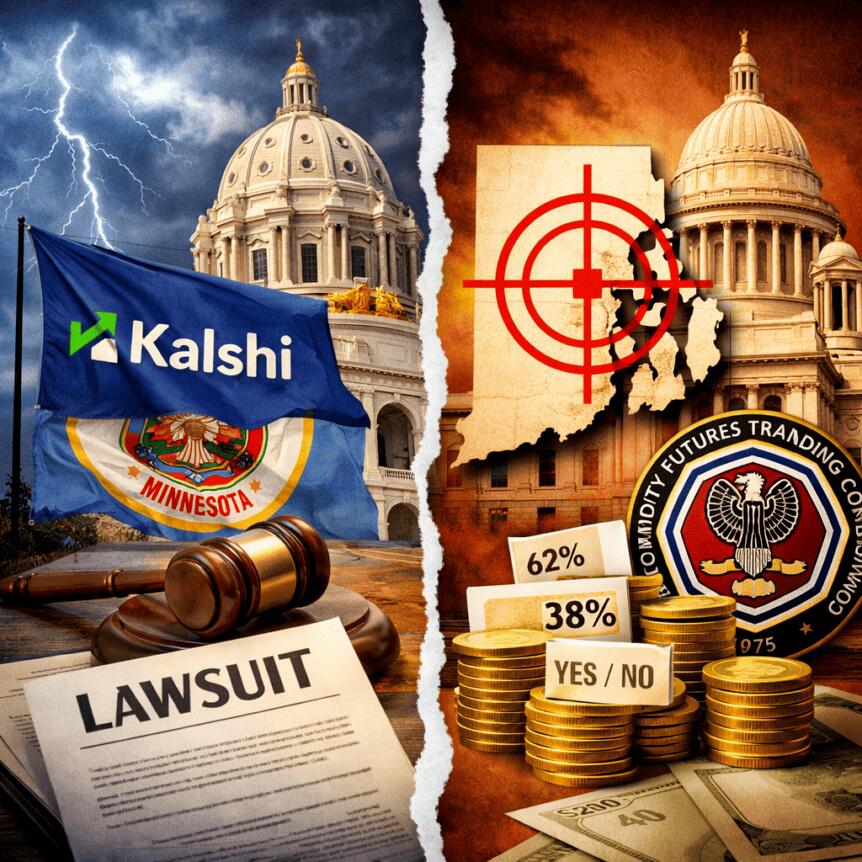
The U.S. regulatory battle over prediction markets is intensifying as federal and state authorities square off in high-stakes litigation. The latest developments center on actions in Minnesota and Rhode Island, underscoring a broader clash over whether event-based contracts offered on platforms like Kalshi and Polymarket fall under federal CFTC jurisdiction or state authority. For institutional readers, the episodes illuminate not only jurisdictional questions but also the compliance and licensing implications for crypto firms operating prediction-market-style products.
According to Cointelegraph, Minnesota Governor Tim Walz signed legislation amending state statutes to prohibit the advertising, creation, operation, or facilitation of prediction market platforms. Within a day of the bill’s enactment, the CFTC filed in federal court, asserting that Minnesota’s measure constitutes an “outright ban” on prediction markets and challenging the state’s authority to regulate such markets. The rapid federal move signals the agency’s willingness to pursue preemption arguments when state measures appear to encroach on federally designated activities. Kalshi subsequently pressed a constitutional challenge in Minnesota, arguing that the Commodity Exchange Act grants the CFTC exclusive authority over prediction markets and that federal law supersedes conflicting state statutes under the Supremacy Clause.
Underpinning these disputes is a dispute over how prediction-market contracts are classified. Kalshi and its allies contend that event contracts traded on federally registered markets should be treated as swaps and, as such, come under CFTC oversight rather than state policing. Jurisprudence in this area is unsettled: some courts have rejected federal preemption arguments, while others have sided with Kalshi and the CFTC, setting the stage for potential Supreme Court consideration in the longer term. The evolving case law has meaningful consequences for platform operators, financial institutions, and any entity contemplating state-by-state deployment of prediction-market-like products.
On the regulatory front, the CFTC reiterated its position in a joint filing with Kalshi against Rhode Island officials. The motion to intervene reinforced the agency’s view that the platforms’ sports-related “event contracts” amount to bets within the CFTC’s remit, echoing Rhode Island Attorney General Peter Neronha’s prior action against Kalshi and Polymarket. The Rhode Island cases illustrate a pattern: state actions targeting platform operators are increasingly met with federal counterclaims, creating a dense litigation corridor that could influence licensing, enforcement priorities, and the permissible scope of state restrictions on derivative-like products tied to real-world events.
Key takeaways
- Minnesota enacted a law prohibiting prediction-market activities, prompting a federal challenge from the CFTC within 24 hours and a constitutional-facing challenge from Kalshi.
- The CFTC argues for exclusive federal authority over prediction markets under the Commodity Exchange Act, with the Supremacy Clause cited as preserving federal primacy over state laws.
- Rhode Island joined the wave of enforcement actions against Kalshi and Polymarket over sports-event contracts, with the CFTC filing to intervene and support the federal view of the platforms’ activities.
- The legal trajectory remains unsettled, with varying court outcomes and potential Supreme Court consideration on the horizon, creating continued uncertainty for compliance programs and platform operators.
- Political and congressional elements are emerging, including public statements from high-level figures and inquiries into insider-trading concerns related to prediction-market platforms.
Federal authority versus state regulation: mapping the legal framework
The dispute centers on how to classify and regulate event-based contracts traded on prediction-market platforms. Proponents of federal primacy argue that under the Commodity Exchange Act, such contracts are swaps executed on federally designated contract markets and, therefore, fall under CFTC oversight rather than state law. The doctrine of federal preemption, anchored by the Supremacy Clause, is often invoked to prevent a patchwork of state restrictions from undermining a comprehensive federal regime. Critics of this view emphasize the states’ interests in consumer protection, gambling law, and regulatory experimentation, arguing that state measures can better adapt to local policy objectives while leaving certain federal authorities to the side.
The judicial landscape on this question remains mixed. Some courts have rejected the argument for exclusive federal authority, while others have ruled in favor of Kalshi’s interpretation and the CFTC’s jurisdiction. This divergent rulings pattern increases the likelihood of a high-profile appeals pathway and potentially a U.S. Supreme Court review, which could provide a definitive interpretation of the balance between federal power and state experimentation in the rapidly evolving digital-asset ecosystem. For market participants, the upshot is a continued need for robust legal risk assessments around product design, regulatory registrations, and cross-border marketing.
Rhode Island enforcement actions and cross-border implications
The Rhode Island matter amplifies the interstate dimension of the debate. The CFTC’s joint filing with Kalshi against Rhode Island officials centers on a request for judicial intervention that would affirm the agency’s authority to regulate platform-based event contracts tied to sports outcomes. Rhode Island’s attorney general had previously sued Kalshi and Polymarket, seeking declarations that certain event contracts amount to bets and thus fall under applicable gaming or betting restrictions—an outcome the CFTC argues the federal framework should govern.
The Rhode Island action underscores several compliance considerations for platforms aiming to operate across multiple jurisdictions. Financial entities, exchanges, and banks that interact with prediction-market platforms must navigate licensing regimes, broker-dealer requirements, and AML/KYC obligations that may differ between states and the federal layer. In practice, this implies heightened scrutiny of product classification, disclosures, customer onboarding processes, and cross-border civilian and enforcement risks as regulators seek to harmonize outcomes across jurisdictions or, conversely, assert divergent rules.
Political dimension, governance, and industry oversight
Beyond strictly legal questions, the episode has drawn public involvement from prominent political actors. According to Cointelegraph, U.S. President Donald Trump publicly asserted that it is “critically important” for the CFTC to retain sole authority over prediction markets. The involvement of Trump Jr.—an adviser to Kalshi and Polymarket and an investor through 1789 Capital—adds a layer of political and reputational complexity to the regulatory debate. In parallel, lawmakers in the U.S. Congress have begun examining insider-trading concerns related to these platforms, with the chair of the House Oversight and Reform Committee inviting the platforms’ CEOs to testify on their responses to potential insider trading incidents.
For regulators, the intersection of policy, market integrity, and consumer protection is a critical testing ground for how formal oversight should operate in a space that sits at the boundary of gambling, derivatives, and digital asset markets. The evolving oversight framework will influence licensing expectations, incident reporting, and governance standards for platforms that blend prediction-market mechanics with digital-asset mechanics or financial technology services. Institutions engaging with these platforms should monitor not only federal enforcement priorities but also the evolving state-level enforcement posture and congressional scrutiny that could shape future regulatory amendments or enforcement guidance.
Compliance, risk management, and institutional implications
From a risk-management perspective, the ongoing jurisdictional battles translate into practical implications for crypto firms and traditional financial institutions that might partner with prediction-market platforms or offer related services. Licensing strategies will need to account for potential preemption challenges and the risk that state prohibitions could constrain business models or restrict advertising, onboarding, or market access. Compliance teams should track developments in preemption arguments, class-action risk, and the potential need to segregate activities by jurisdiction to minimize cross-border legal exposure.
Regulators’ emphasis on event-based contracts as potentially covered under the CFTC framework may also affect how exchanges structure product offerings, disclosures, and risk disclosures. Where platform operators classify contracts as swaps or other CFTC-regulated instruments, they may need to pursue federal registrations or exemptions and implement comprehensive AML/KYC controls consistent with futures and options markets. The broader policy context—especially implications for MiCA-equivalent European frameworks, SEC or DOJ inquiries, and cross-border licensing considerations—further elevates the need for rigorous compliance governance and legal visibility at the board level.
Closing perspective
The ongoing legal contest over prediction markets underscores a pivotal moment for the crypto and financial-technology regulatory landscape. As courts weigh federal preemption against state authority, the coming months are likely to determine not only the fate of specific platforms but also the contours of permissible product design, cross-border marketing, and the role of federal versus state oversight in a rapidly evolving market. Stakeholders should anticipate further court rulings, potential Supreme Court action, and a stream of regulatory guidance that could recalibrate risk, licensing, and operational standards across prediction-market platforms and adjacent digital-asset services.
https://www.cryptobreaking.com/kalshi-sues-minnesota-cftc-targets/?utm_source=blogger%20&utm_medium=social_auto&utm_campaign=Kalshi%20Sues%20Minnesota;%20CFTC%20Targets%20Rhode%20Island—Prediction%20Markets%20
Comments
Post a Comment