
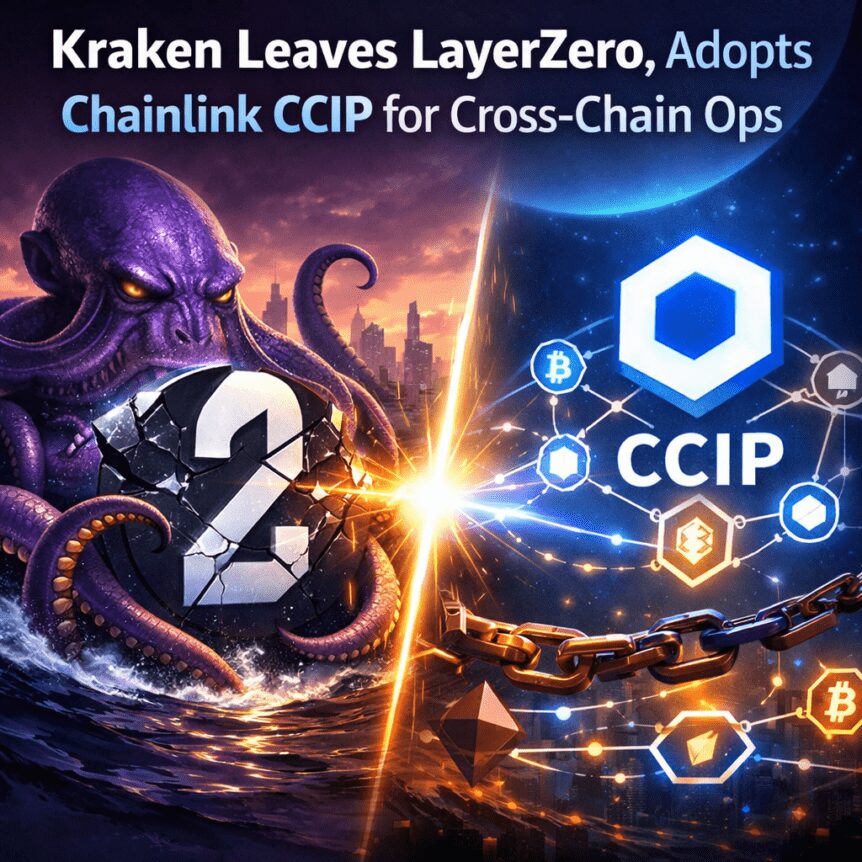
Kraken has decided to migrate its cross-chain infrastructure from LayerZero to Chainlink’s Cross-Chain Interoperability Protocol (CCIP), designating CCIP as the exclusive cross-chain backbone for Kraken Wrapped Bitcoin (kBTC) and all future wrapped assets. The move places Kraken among a growing group of protocols re-evaluating their cross-chain security posture in the wake of a major DeFi incident earlier this spring.
The exchange said the transition to CCIP reflects a preference for what it describes as enterprise-grade security and risk management. Kraken highlighted CCIP’s certifications, secure-by-default design, 16 independent nodes, and native rate limits as core advantages in reducing cross-chain risk for the firm’s wrapped assets.
The shift comes amid heightened scrutiny of LayerZero following the Kelp DAO exploit in April, in which roughly $292 million in liquid restaking tokens were siphoned by actors suspected to be linked to North Korea’s Lazarus Group. LayerZero subsequently issued an “overdue apology” on May 9, acknowledging communication failures in the weeks after the attack. The company attributed the breach to a combination of compromised internal RPCs—described as the “source of truth” being poisoned—and a targeted denial-of-service assault on external RPC providers, while noting that the vulnerability was tied in part to Kelp’s configuration of its single-DVN (decentralized verifier network). LayerZero maintained that the incident did not affect other applications and that more than $9 billion in bridged assets had been moved using the protocol since April 19.
Key takeaways
- Kraken commits to Chainlink CCIP as its exclusive cross-chain infrastructure for kBTC and future wrapped tokens, citing enterprise-grade security features and risk controls.
- The Kelp DAO exploit has accelerated a broader migration away from LayerZero, as multiple protocols reassess cross-chain infrastructure.
- Industry momentum toward CCIP is evident: Kelp DAO, Solv Protocol, and Re.xyz are migrating, with total cross-chain TVL migrating to CCIP rising into the billions of dollars.
- Chainlink CCIP’s adoption is accompanied by a price backdrop where major tokens have shown muted immediate reactions to the cross-chain shift, while LayerZero’s native token has faced notable declines.
LayerZero under pressure after the Kelp DAO incident
The April attack on Kelp DAO set off a wave of reconsiderations across the cross-chain landscape. In addition to the estimated $292 million stolen from liquid restaking tokens, LayerZero’s communications team issued an apology for a communications lag during the crisis, while officials described the breach as a consequence of compromised internal RPCs and a distributed denial-of-service attack on external RPC providers. LayerZero asserted that the problem did not spread beyond the targeted chain and that the rest of its ecosystem remained secure. The protocol has still faced heightened scrutiny as activity on bridges linked to LayerZero continues to be re-evaluated by projects across DeFi.
Despite the setback, LayerZero reported that more than $9 billion in assets had been bridged using its protocol since the April incident, underscoring the continued reliance on cross-chain liquidity even amid security concerns. The episode has prompted several protocols to consider or implement alternative cross-chain infrastructure to diversify risk and reduce single-vendor exposure.
CCIP adoption accelerates across DeFi
Kraken is not alone in shifting away from LayerZero in response to the incident. Kelp DAO has stated it is in the process of migrating to Chainlink CCIP and, as part of its recovery steps, burned 117,132 rsETH issued during the attack. The move to CCIP is part of a broader realignment as DeFi projects reassess cross-chain reliability and risk controls.
Other notable migrations include Solv Protocol, which announced on May 7 that it would move from LayerZero to CCIP as the official cross-chain infrastructure for about $700 million in tokenized Bitcoin. Re.xyz followed suit on May 8, signaling a transfer of its $475 million in total value locked from LayerZero to CCIP. Industry data compiled after the Kelp incident show more than $3 billion in total value locked (TVL) migrating to CCIP, as several protocols suspended bridging using LayerZero while the ecosystem reevaluated its options. In parallel, Lido, the world's largest Ethereum liquid staking protocol, has publicly endorsed CCIP, praising Chainlink’s defense-in-depth model as a guiding standard for cross-chain interoperability.
The rapid pace of migrations underscores a broader market shift toward multi-layer cross-chain safety, with CCIP emerging as a leading option for secure asset transfers across chains. This trend aligns with a growing emphasis on governance, reliability, and resilience in cross-chain infrastructure, as DeFi projects weigh the costs and benefits of single-vendor dependencies against the potential upside of diversified security models.
Market backdrop and what to watch next
In the wake of these developments, market prices for core cross-chain players painted a cautious picture. Chainlink’s native token, where available, remained around bear-market levels near ten dollars, with no clear, immediate price reaction tied to the CCIP migrations. LayerZero’s ZRO token has faced a pronounced drawdown since the April breach, down more than 30% and well below its 2024 highs, reflecting a broader risk-off sentiment toward cross-chain infrastructure bets during a period of heightened scrutiny.
As CCIP gains traction among major DeFi protocols, observers will be watching for any further migrations, new security measures, and potential regulatory or governance updates that could influence cross-chain interoperability. The coming weeks will likely clarify whether CCIP can sustain rapid adoption while delivering the security guarantees that investors and users increasingly demand.
For readers, the key question is whether this momentum signals a durable reconfiguration of cross-chain trust or if additional incidents could temper the pace of migration. The next steps—more protocol migrations, governance decisions on cross-chain risk, and tangible improvements in cross-chain security—will reveal how the market recalibrates in response to a rapidly evolving multi-chain landscape.
https://www.cryptobreaking.com/kraken-leaves-layerzero-adopts-chainlink/?utm_source=blogger%20&utm_medium=social_auto&utm_campaign=Kraken%20Leaves%20LayerZero,%20Adopts%20Chainlink%20CCIP%20for%20Cross-Chain%20Ops%20
Comments
Post a Comment