
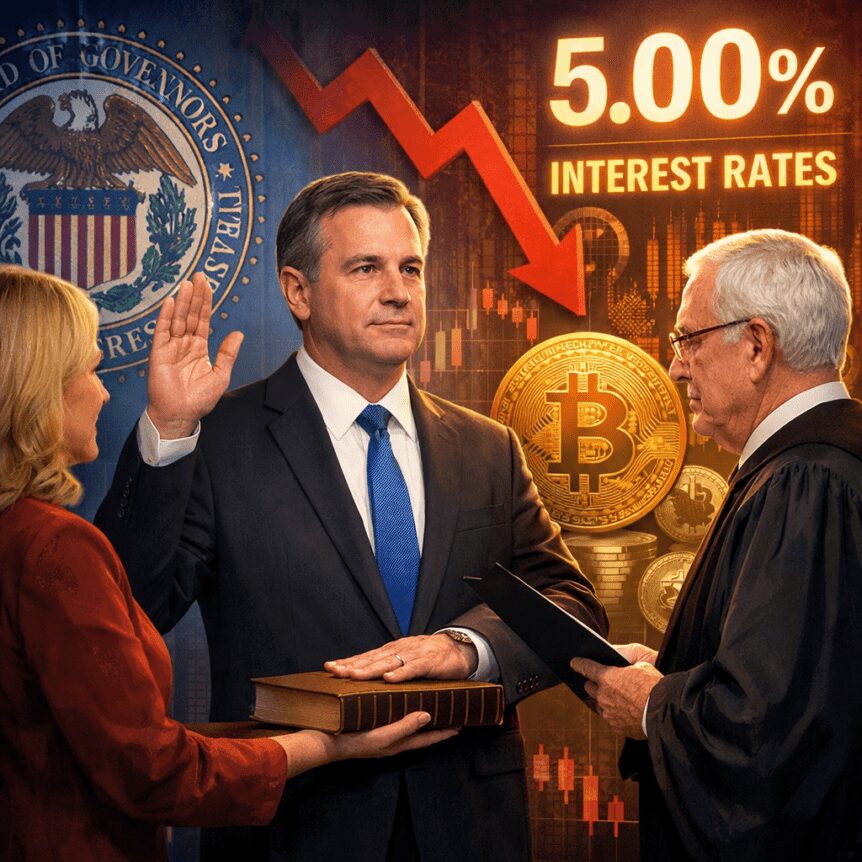
Kevin Warsh is poised to be sworn in as the next chair of the U.S. Federal Reserve Board of Governors this Friday, a pick that could tilt policy toward a more accommodative stance in the eyes of President Donald Trump. The Senate voted to confirm Warsh largely along party lines, setting the stage for a leadership change that has already sparked debate about whether the Fed will lower interest rates in the near term despite current market expectations for a hold.
Trump has repeatedly argued that the central bank should be cutting rates, a drumbeat that has shaped both political rhetoric and investor sentiment. As Warsh steps into the chair’s role, market watchers will be watching not only for formal policy signals but also for how the new leadership interprets the Fed’s mandate in a way that could influence borrowing costs and risk asset pricing in the months ahead. The next major policy decision point remains the Federal Open Market Committee’s (FOMC) meeting scheduled for June 16, when traders will scrutinize new guidance in the context of a potentially shifting rate path.
Key takeaways
- Warsh is set to take the helm of the Federal Reserve, with expectations that his leadership could influence the direction of U.S. monetary policy.
- Markets express a cautious split: prediction markets place the odds of a rate cut before 2027 at roughly 38.2%, down from near certainty earlier this year.
- In contrast, the CME FedWatch tool continues to signal a high likelihood that the policy rate, currently 3.50%–3.75%, remains unchanged through the summer, with expectations of little to no movement into July.
- During Warsh’s confirmation process, concerns were raised about potential conflicts of interest, highlighted by remarks from lawmakers about his proximity to crypto and tech interests, underscoring the broader scrutiny of top financial regulators’ disclosures.
- With Warsh’s swearing-in imminent, lawmakers are pressing for timely CFTC nominations as part of a broader push to clarify U.S. market structure for digital assets and to address regulatory questions around prediction markets and crypto platforms.
Warsh’s ascent and policy outlook
Warsh’s confirmation signals a transition at the helm of U.S. central banking. While the Fed has navigated a complex inflation and growth backdrop in recent years, the new chair’s approach will be closely watched for how aggressively policy levers could be adjusted in response to evolving economic data. The immediate policy question, however, remains whether the Fed will pivot toward rate relief in the near term or maintain a cautious stance while inflation and growth readings come into sharper focus. The FOMC’s next meeting on June 16 will be a critical moment for readers seeking to gauge how a Warsh-led Fed might balance price stability with the need to support a slowing economy.
Market sentiment ahead of the swearing-in reflects a tension between political expectations and monetary policy signals. The president’s public commentary has consistently urged rate cuts, creating a frame in which Warsh’s chairmanship could be interpreted as a commitment to more dovish policy. Yet investors must weigh this against the Fed’s broader objective of inflation containment and the possibility that a new leadership approach could still hinge on incoming data, not political timing alone. That cross-currents dynamic is why traders will be attuned not just to the Chair’s statements, but to the committee’s communicate-and-respond style as data evolves.
Markets, bets, and the rate-path debate
Two analytical channels offer contrasting pictures of where policy might head. On the one hand, prediction markets have priced in a materially lower probability of an imminent rate cut, reflecting a more cautious or data-driven outlook. Kalshi’s market for a rate cut before 2027 shows roughly 38.2% odds, a significant pullback from February’s near-certainty levels. This reflects a broader recalibration among traders who treat rate-path expectations as sensitive to the incoming data and the Fed’s evolving narrative under a new leadership regime. For context, Kalshi’s rate-cut market is publicly accessible and used by participants to hedge or speculate on policy moves as the cycle unfolds. Kalshi.
Meanwhile, the CME Group’s FedWatch tool remains more sanguine about the status quo in the near term. The current reading assigns a 98.8% probability that the Fed does not change policy rates through June, with a similar likelihood (>94%) continuing through July. In practical terms, traders are still largely expecting rates to hold at 3.50%–3.75% at the next few meetings, even as a new Fed chair takes the helm. The juxtaposition highlights how markets can price in different trajectories depending on whether they prioritize the idea of a policy pivot or the commitment to a patient, data-responsive approach. CME FedWatch.
What this means for investors in the crypto and broader risk-asset space is nuanced. A potential shift toward easier financial conditions could buoy sentiment for higher-beta assets, including crypto, but the trajectory will still be tethered to inflation data, employment trends, and the Fed’s confidence in its inflation framework. Traders should watch for how Warsh’stone in forthcoming communications aligns with the data flow from upcoming inflation readings and growth indicators.
Disclosures, conflicts, and regulatory tensions
Warsh’s confirmation hearing touched on questions of conflicts of interest and insider risk. Massachusetts Senator Elizabeth Warren voiced concern that confirming Warsh could lead to favorable regulatory accommodations if connections to crypto or Wall Street circles were construed as a risk to impartial policy. Warsh had disclosed assets exceeding $100 million ahead of the hearing, including holdings in AI and crypto-related ventures, underscoring the ongoing scrutiny surrounding regulators’ personal investments. The discussion underscores a broader theme in crypto governance: the delicate balance between expertise, independence, and the perceived risk of regulatory capture. Cointelegraph coverage of the disclosure outlines the context of such concerns.
The same moment also features a country-wide focus on the U.S. commodities regulator, the CFTC, and its stance on new market structures for crypto. Since December, the CFTC has been led by Michael Selig, Trump’s nominee, who has taken a relatively aggressive posture toward predicting-market platforms like Kalshi and Polymarket, even as state authorities challenge advances in sports betting regulation. The leadership gap at the CFTC has left lawmakers pressing for a broader panel to address urgent regulatory issues as the Digital Asset Market Clarity Act (CLARITY) moves through the legislative process. Lawmakers on the House Committee on Agriculture urged Trump to nominate a full slate of CFTC commissioners to provide clarity and a steady hand on rulemaking as the crypto and prediction-market ecosystems continue to evolve. Cointelegraph coverage.
The regulatory storyline matters for crypto users, developers, and investors not only because it shapes how digital-asset markets may be structured in the future, but also because it frames the risk and compliance environment in which innovative platforms operate. Kalshi and similar prediction-market venues have become flashpoints for regulatory debates, with questions about whether such markets fall under securities, commodities, or a bespoke category for digital-asset-based markets. The CLARITY act’s fate and any CFTC decisions will influence market design, listing standards, and the degree of federal oversight that crypto markets face in the coming years.
What readers should watch next
As Warsh steps into the chair, all eyes will be on how the Fed’s policy narrative evolves in the face of incoming data and political expectations. The June 16 FOMC meeting will be the immediate inflection point, but the longer arc will hinge on how the new leadership interprets inflation signals and growth momentum. On the regulatory front, the pace of CFTC nominations and any progress on the CLARITY framework will shape the structural context for crypto markets and prediction platforms alike. For market participants, the tension between rate-path expectations and the regulatory timetable will frame how crypto and other risk assets move in the weeks and months ahead. Investors should stay tuned to official communications from the Fed and to updates on CFTC leadership and CLARITY-related discussions as the regulatory landscape continues to tighten around the digital asset space.
https://www.cryptobreaking.com/new-fed-chair-swearing-in/?utm_source=blogger%20&utm_medium=social_auto&utm_campaign=New%20Fed%20Chair%20Swearing-In%20Dampens%20Rate-Cut%20Prospects%20for%20Crypto%20
Comments
Post a Comment