
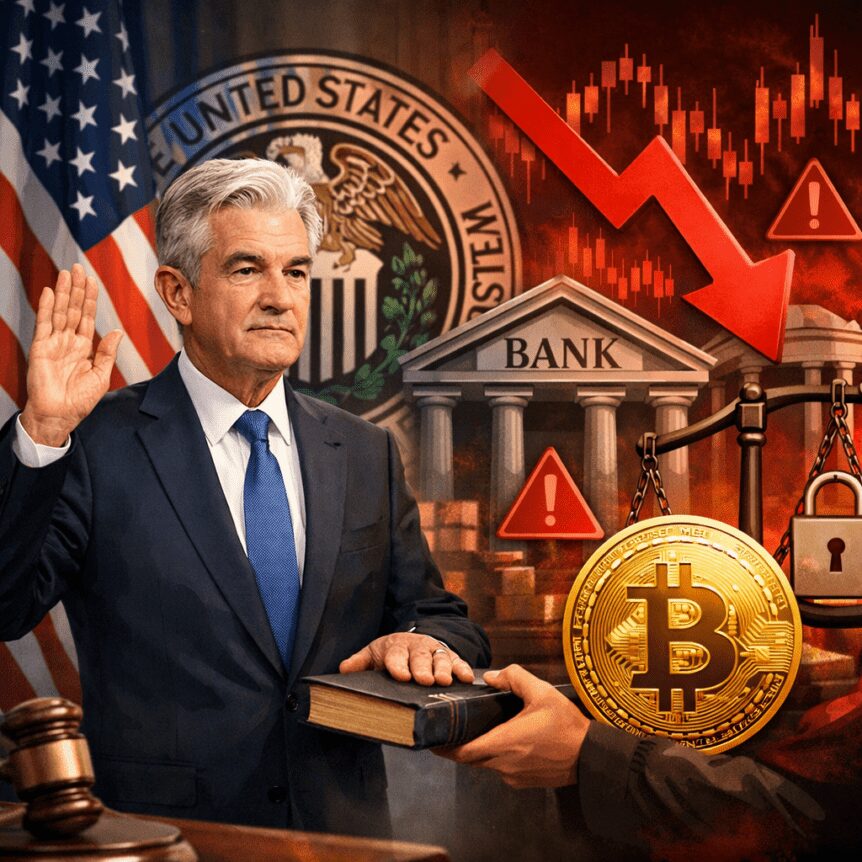
Kevin Warsh is poised to be sworn in as the next chair of the U.S. Federal Reserve Board of Governors this Friday, a transition that will place him at the center of monetary policy formation at a moment of heightened scrutiny over inflation, growth, and financial stability.
According to Cointelegraph, the Senate voted largely along party lines to confirm Warsh as the Fed’s new chair, succeeding Jerome Powell. The nomination comes as President Donald Trump has publicly pressed for a rate-cutting stance, a position that has fed ongoing debate about the Fed’s independence and its policy trajectory. In recent months, Trump publicly urged that the chair should be lowering interest rates, a stance that has intensified market and political discussion about looming shifts in policy direction.
With Warsh slated to assume the chair’s duties, synthetic market indicators have begun to price in divergent views on the policy path. Prediction-market platform Kalshi shows approximately 38.2% odds of the federal funds rate being lowered before 2027, a drop from roughly 96% observed in February. Meanwhile, CME Group’s FedWatch tool continues to signal a high probability that rates will remain at their current target of 3.50%–3.75% through the summer, with a 98.8% probability of no change through the end of June and more than 94% through July.
As the Fed chair, Warsh will wield substantial influence over policy deliberations and the setting of the federal funds rate, a task closely watched by financial markets, lenders, and institutions that rely on predictable policy signals. The next Federal Open Market Committee meeting is scheduled for June 16, providing a potential inflection point for policy if the new leadership signals a shift or confirms the status quo.
During Warsh’s confirmation hearing, concerns were raised about governance and potential conflicts of interest. Massachusetts Senator Elizabeth Warren argued that confirming Warsh could create opportunities for the Fed to direct favorable outcomes toward financial interests, citing the possibility of special accounts or bailouts tied to affiliations with private entities. Warsh disclosed assets exceeding $100 million ahead of the hearing, including holdings in AI and crypto-related ventures, a disclosure that has prompted ongoing discussions about independence, disclosure standards, and perception of risk within a central bank leadership role.
Key takeaways
- Kevin Warsh is set to be sworn in as the chair of the Federal Reserve Board, signaling a leadership transition with potential implications for monetary policy inference and regulatory posture.
- The confirmation vote in the Senate was described as largely along party lines, reflecting the broader political dynamics surrounding the central bank’s independence.
- Market expectations show a divide: Kalshi’s contract pricing indicates a 38.2% chance of a rate cut before 2027 (down from 96% in February), while CME FedWatch places a high probability on rate stability through mid-year and into summer.
- Warsh’s asset disclosure — reportedly more than $100 million, including investments in AI and crypto — has amplified discussions about governance, personal exposure, and conflict-of-interest risk for a central bank chair.
- Lawmakers are pressing for rapid CFTC nominations amid ongoing debates over crypto market structure, enforcement priorities, and the Digital Asset Market Clarity Act (CLARITY), underscoring the regulatory dimension of the evolving crypto landscape in parallel with traditional financial oversight.
Federal Reserve leadership and policy trajectory
The impending swearing-in of Warsh as Fed chair places him at the apex of a complex policy milieu that includes inflation dynamics, growth concerns, and financial stability considerations. While the Fed’s policy stance will ultimately be guided by the FOMC’s deliberations, leadership signals can shape the tempo of policy normalization or accommodation. The central bank operates with a mandate to maximize employment and price stability, and the appointment of a new chair often influences market interpretations of the committee’s appetite for rate adjustments or balance-sheet actions in the near term.
From a regulatory and compliance perspective, the transition underscores the importance of ensuring that chair-level commitments align with established institutional safeguards, independence norms, and robust governance practices. The ongoing dialogue around potential conflicts of interest and asset disclosures highlights the critical need for transparent governance frameworks within key U.S. financial authorities.
Market sentiment, risk assessment, and policy signaling
The divergence between prediction-market pricing and traditional probability tools reflects a broader ambiguity about the policy path under Warsh’s leadership. Kalshi’s pricing suggests a meaningful probability of a rate cut only beyond the near-term horizon, whereas the Fed’s own projections and futures markets continue to show a strong tilt toward policy stability in the coming months. This discrepancy matters in practice for institutions managing interest-rate risk, the pricing of secured funding, and risk-management frameworks that rely on forward-looking policy expectations.
Regulatory and institutional implications are evident in how market participants calibrate their capital planning, liquidity management, and lending practices. A shift toward a more aggressive rate-reduction stance could alter the pricing of risk across debt markets, impact leverage conditions for banks and nonbank lenders, and influence the valuation of income-oriented assets. Conversely, a confirmed stance of steady policy could reinforce the current macroeconomic assumptions underpinning credit markets and risk models.
Regulatory nominations, oversight, and the crypto-policy backdrop
Even as Warsh approaches the chair’s desk, lawmakers remain focused on the regulatory architecture governing financial markets, particularly the crypto sector. The CFTC’s leadership lineup has come under scrutiny amid debates about who should oversee innovative trading platforms and how rulemaking should evolve in tandem with digital asset market developments. Since December, the CFTC has been led by Michael Selig, with Acting Chair Caroline Pham replaced, and the regulator has taken a more assertive stance regarding platforms that host prediction markets and other digital-asset-related activity.
House lawmakers have urged the Trump administration to nominate a full slate of CFTC commissioners to address urgent regulatory issues and to provide clarity on rulemaking if the Digital Asset Market Clarity Act (CLARITY) were to become law. The evolving policy framework for crypto markets and the broader digital-asset ecosystem remains a dynamic area of federal regulation, with potential cross-border considerations and implications for licensing, enforcement, and market structure standardization.
According to Cointelegraph, these developments reflect a broader regulatory calibration: balancing innovation and investor protection, ensuring effective oversight of new trading venues, and aligning U.S. policy with a rapidly changing market landscape. The regulatory trajectory and the precise stance on crypto market infrastructure will be pivotal for exchanges, fintechs, and institutions seeking to operate within a coherent U.S. framework that can interface with international standards.
Institutional and compliance implications
The combination of a new Fed chair, ongoing questions about independence and disclosure, and the regulatory push around crypto markets creates a multifaceted environment for financial institutions. Banks and nonbank lenders alike must monitor policy signals that affect funding costs, capital adequacy planning, and risk governance. Compliance teams should prepare for potential shifts in disclosure requirements, governance expectations, and the regulatory posture toward digital assets, including how the CLARITY framework might influence licensing, reporting, and cross-border operations.
From a policy-history perspective, the Warsh appointment sits within a lineage of central-bank leadership where governance clarity and preemptive risk management are increasingly prioritized. The unfolding discussions about special accounts, bailouts, or other policy tools underscore the importance of maintaining a transparent framework that preserves independence while addressing public-interest concerns.
Closing perspective
As Warsh takes the helm, the key question is how quickly and in what direction monetary policy will respond to evolving macro forces and political considerations. Watch for signals from the Fed’s communications and the June 16 FOMC meeting, alongside ongoing Congressional and regulatory activity around crypto-market oversight. The coming weeks will illuminate how the new leadership balances independence, economic stability, and regulatory alignment in a rapidly changing financial landscape.
https://www.cryptobreaking.com/new-fed-chair-sworn-in/?utm_source=blogger%20&utm_medium=social_auto&utm_campaign=New%20Fed%20Chair%20Sworn%20In,%20Crypto%20Regulation%20Risk%20to%20Institutions%20Rises%20
Comments
Post a Comment