
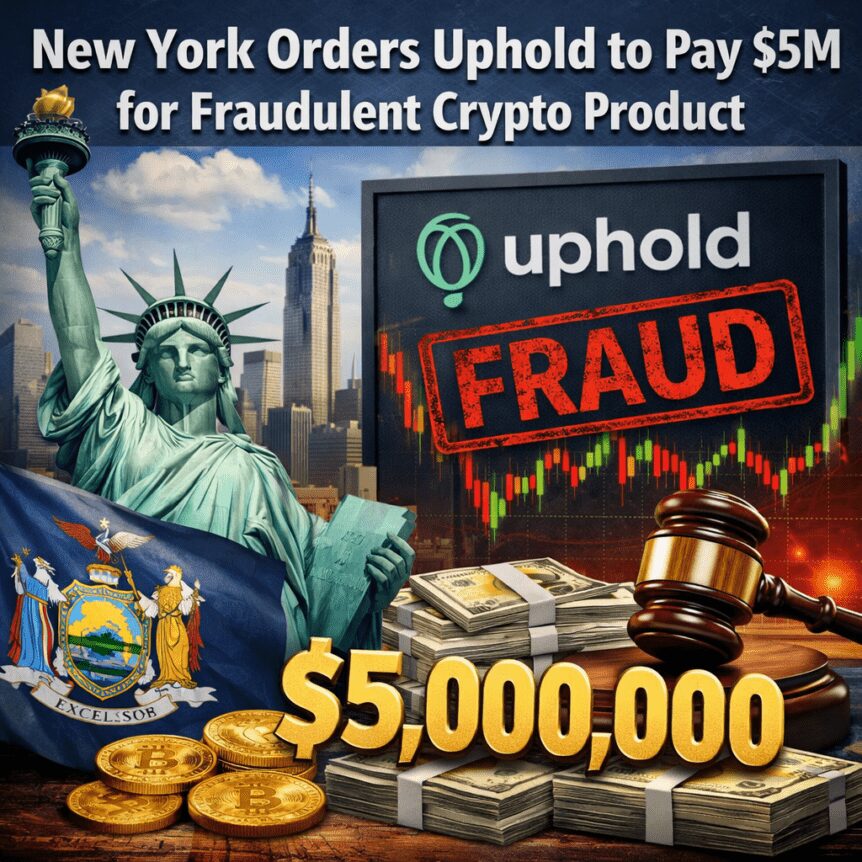
New York Attorney General Letitia James announced a settlement with Uphold, a cryptocurrency trading and wallet platform, over its promotion of CredEarn, a product offered by Cred, LLC and its CEO Daniel Schatt. The agreement secures more than $5 million in restitution to affected Uphold users and imposes ongoing compliance measures on the firm.
According to the Attorney General’s office, Uphold marketed CredEarn on its platform and mobile app between January 2019 and October 2020 as a safe, reliable savings product with attractive annual interest payments. Investigators found that Uphold did not disclose that CredEarn’s returns were generated by microloans to low-income video game players in China—borrowers typically lacking credit histories and access to traditional financial institutions. The office also determined that Uphold’s claim of “comprehensive insurance” protecting retail investors was false and not reflective of industry conditions at the time. In addition, Uphold operated without the required broker or commodity broker-dealer registration.
CredEarn’s marketing and the underlying product came under scrutiny as Cred began incurring losses from its lending practices in March 2020 and subsequently filed for bankruptcy eight months later, leaving thousands of Uphold customers affected, according to the attorney general’s announcement.
Key takeaways
- The New York attorney general secured more than $5 million in restitution for Uphold users connected to the CredEarn promotional program.
- The settlement centers on Uphold’s failure to disclose CredEarn’s risk profile and funding source, as well as a misrepresentation regarding insurance coverage and a lack of required broker-dealer registration.
- CredEarn’s returns were tied to microloans to Chinese gamers with little or no credit history, raising questions about cross-border lending and consumer protection in crypto products.
- Funds recovered from Cred’s bankruptcy estate, where Cred is owed a modest amount, will be redirected to harmed investors in addition to the direct restitution payment.
- The case illustrates ongoing regulatory focus on disclosures, licensing, and consumer protections in crypto platforms, with broader implications for enforcement trajectories in the sector.
Settlement details: Uphold, CredEarn, and the relief framework
Under the settlement, Uphold will issue $5 million directly to affected customers as restitution. The agreement also provides that any funds recovered by Cred’s bankruptcy estate— Cred is owed approximately $545,189 by the estate—will be allocated to harmed investors, where applicable. Affected Uphold users are slated to receive notice by email when the funds are deposited into their accounts.
“Investors should be able to trust the industry advice they receive,” said New York Attorney General Letitia James. “My office will always work to ensure bad actors are held accountable for endangering their customers’ financial security.”
Regulatory implications for crypto platforms and enforcement trends
The Uphold settlement adds to a widening pattern of state-level enforcement targeting misrepresentations and licensing gaps within crypto product offerings. The case reinforces expectations that platforms providing yield-generating products must clearly disclose risk factors, origin of returns, and any insurance or guarantee representations that could influence consumer decisions. It also underscores the necessity for proper registration where broker-dealer or other financial activity is involved, a point frequently cited by regulators in related proceedings.
Within a broader regulatory context, the action sits alongside a recent wave of U.S. regulatory activity. For example, New York has pursued actions against major exchanges over unregistered or allegedly inappropriate activities, and federal authorities have asserted jurisdiction in related areas of crypto markets, sometimes triggering jurisdictional tensions between state regulators and federal agencies such as the CFTC. The evolving framework contrasts with ongoing EU developments under the Markets in Crypto-Assets Regulation (MiCA), which seeks to harmonize licensing and consumer protections across member states, highlighting differing approaches to licensing, compliance, and cross-border supervision.
From a compliance perspective, the Uphold case reinforces ongoing scrutiny of advertising practices, disclosures, and insurance representations across crypto platforms. It also spotlights scrutiny of cross-border lending activities and the need for robust KYC/AML controls when platforms offer high-yield products funded by microloan-type portfolios. For institutions and exchanges, the decision signals heightened attention to registration status, permissible lending activities, and transparent risk communication in product marketing.
Legal and historical context: licensing, insurance claims, and cross-border considerations
The settlement draws a clear line on several fronts. First, Uphold’s lack of broker or commodity broker-dealer registration was a central factor in the enforcement action. Second, the assertion that CredEarn carried comprehensive insurance was deemed inaccurate, reflecting a broader industry reality in which retail investors did not have such protections at the time. Third, the cross-border element of CredEarn’s loan portfolio—financing microloans to borrowers in another country—highlights the regulatory complexities that arise when crypto platforms offer yield products tied to non-domestic lending markets.
In the larger policy context, the case illustrates how state authorities are blending consumer protection with securities-law considerations in crypto-for-investment products. It also underscores the importance for platforms to align their practices with evolving licensing regimes, cross-border compliance requirements, and rigorous disclosures aimed at safeguarding retail investors.
As enforcement posture continues to tighten, market participants should monitor developments in New York’s regulatory framework, parallel actions by other states, and the ongoing interplay between state and federal authorities in the United States, as well as the international regulatory landscape shaped by MiCA and related standards.
Closing perspective: The Uphold settlement demonstrates the growing emphasis on licensing compliance and transparent, substantiated marketing in crypto offerings, a trend likely to influence platform structuring, product design, and investor protection measures in the near term.
https://www.cryptobreaking.com/new-york-orders-uphold-to/?utm_source=blogger%20&utm_medium=social_auto&utm_campaign=New%20York%20Orders%20Uphold%20to%20Pay%20$5M%20for%20Fraudulent%20Crypto%20Product%20
Comments
Post a Comment