
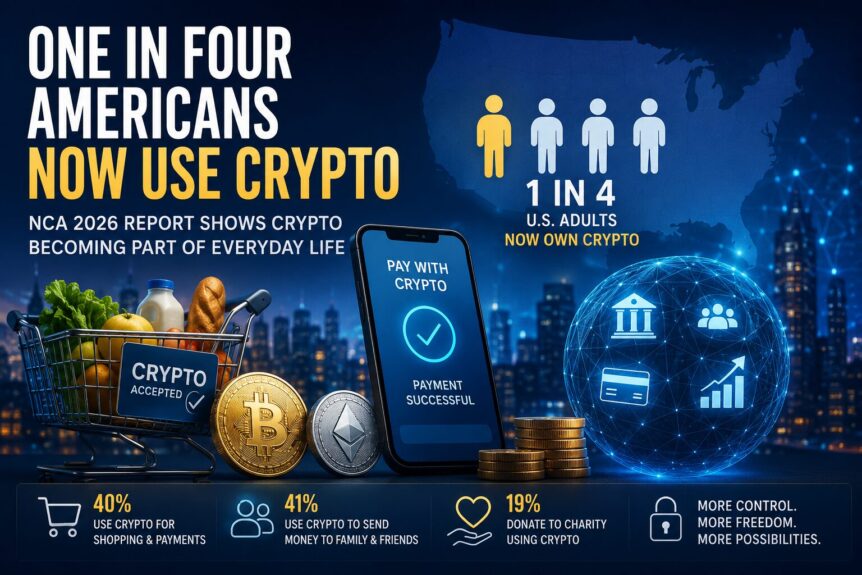
Crypto adoption in the United States is continuing to accelerate, with digital assets increasingly moving beyond speculation and becoming part of everyday financial life, according to the National Cryptocurrency Association’s newly released 2026 State of Crypto Holders Report.
The study, conducted with The Harris Poll among 10,000 U.S. cryptocurrency holders, found that more than 67 million Americans now own crypto, representing roughly one in four U.S. adults. That figure marks an increase of 12 million holders compared to 2025.
Beyond the growing number of holders, the report points to a broader transformation in how Americans are actually using crypto. While investing remains a major driver, usage is rapidly expanding into payments, peer-to-peer transfers, gaming, donations, and business activity.
Speaking with Crypto Breaking, Ali Tager, VP of External Affairs at the National Cryptocurrency Association (NCA), said the industry is entering what he describes as an “everyday utility” phase.
Crypto Usage Is Expanding Beyond Investing
One of the report’s standout findings is that 54% of crypto holders say digital assets have increased their financial independence.
According to Tager, this shift reflects a much deeper evolution in the relationship people have with money and financial systems.
“Crypto usage patterns are diversifying beyond investing and entering a phase of everyday utility,” Tager said.
The report found:
- 40% of holders now use crypto for shopping and payments
- 41% use it to send money to family and friends
- 19% have made charitable donations using crypto
Tager explained that many users are increasingly attracted to crypto because it offers:
- 24/7 access to assets
- faster transactions
- greater financial control
- alternative ways to participate in the economy
“Just like with any other innovation, from AI to smartphones to the internet, these tools become mainstream when we stop focusing on the technology itself and start using it because it solves our everyday problems more efficiently,” he added.
The “Everyday Utility” Era Has Arrived
According to the NCA, crypto’s evolution is no longer theoretical.
Tager shared several examples from the report showing how Americans across different states and professions are using blockchain technology in practical ways:
- ranchers in Wyoming using blockchain to verify humane livestock treatment claims
- artists in California earning royalties directly through blockchain marketplaces
- investors accessing tokenized real estate opportunities
- families using crypto to help manage everyday expenses and medical bills
“Crypto is benefitting people from all walks of life in all kinds of ways,” Tager said.
The report also revealed:
- 54% of holders use crypto in relation to groceries
- 41% connect crypto with travel-related spending
- 39% use it to help cover fuel costs
“When a technology stops feeling novel and starts feeling useful, you don't notice it crossing over, it just does,” Tager added.
At the same time, he acknowledged that challenges remain, including volatility, trust concerns, and friction around onboarding new users.
Female Participation in Crypto Continues Rising
The report also highlighted a major demographic shift among newer crypto adopters.
Female participation has increased significantly compared to previous years. Among people who entered crypto between 2025 and 2026, women represented 42% of new holders, compared to 34% among earlier adopters.
According to Tager, increasing accessibility and integration with familiar financial systems are helping reduce barriers to entry.
“As crypto becomes integrated into trusted platforms and financial services, it feels more familiar and less complex,” he explained.
The report found that trust tends to rise when crypto becomes connected to mainstream financial brands and platforms such as PayPal, Visa, and traditional banks.
The study also challenges several stereotypes around crypto ownership:
- 90% of holders earn less than $500,000 annually
- 23% earn less than $75,000 per year
- adoption is spreading across construction, manufacturing, retail, technology, and finance sectors
- ownership is growing across Gen Z, Gen X, Boomers, and older generations
Education Remains One of the Industry’s Biggest Challenges
Despite rising adoption, education remains one of crypto’s largest barriers.
According to the report, many Americans still avoid crypto because they simply do not understand how it works or how to use it safely.
Tager said this is one of the core reasons the NCA was created.
“The number one barrier to entry for non-crypto holders in America is that they don’t understand it,” he said.
The organization currently offers:
- free crypto education courses
- interactive beginner lessons
- wallet simulators
- educational podcasts focused on simplifying crypto concepts
Even among existing users, demand for education remains high. Roughly one-third of current crypto holders said they still want more learning resources and practical guidance.
“Accessible resources focused on real-world use cases is what moves the needle,” Tager added.
Regulation, Stablecoins and Payments Could Drive the Next Wave of Adoption
Looking ahead over the next several years, the report suggests mainstream adoption will likely be driven by a combination of:
- payments
- stablecoins
- clearer regulation
- institutional integration
- broader merchant adoption
According to the study:
- 84% of holders expect crypto payments to become common within five years
- 42% believe traditional finance integration would increase trust
- 39% say clearer regulation would strengthen confidence in crypto
Tager believes all of these factors are likely to work together rather than independently.
“Consumers are increasingly looking for practical, everyday ways to use their crypto,” he said.
The report also found that many large retailers in the United States are already accepting crypto payments at checkout.
At the same time, Tager warned that public perception remains heavily influenced by misinformation and sensationalized narratives online.
“When the loudest voices reduce crypto to a caricature, it becomes harder for people to separate fact from fiction,” he said.
“Some may jump in too quickly without understanding it. Others may dismiss the tool entirely without realizing the benefits.”
The National Cryptocurrency Association said it plans to continue expanding educational initiatives and partnerships designed to help Americans better understand how crypto works and how it can be used responsibly in everyday life.
https://www.cryptobreaking.com/one-in-four-americans-now/?utm_source=blogger%20&utm_medium=social_auto&utm_campaign=One%20in%20Four%20Americans%20Now%20Use%20Crypto%20as%20Everyday%20Utility%20Goes%20Mainstream,%20NCA%20Report%20Finds%20
Comments
Post a Comment