
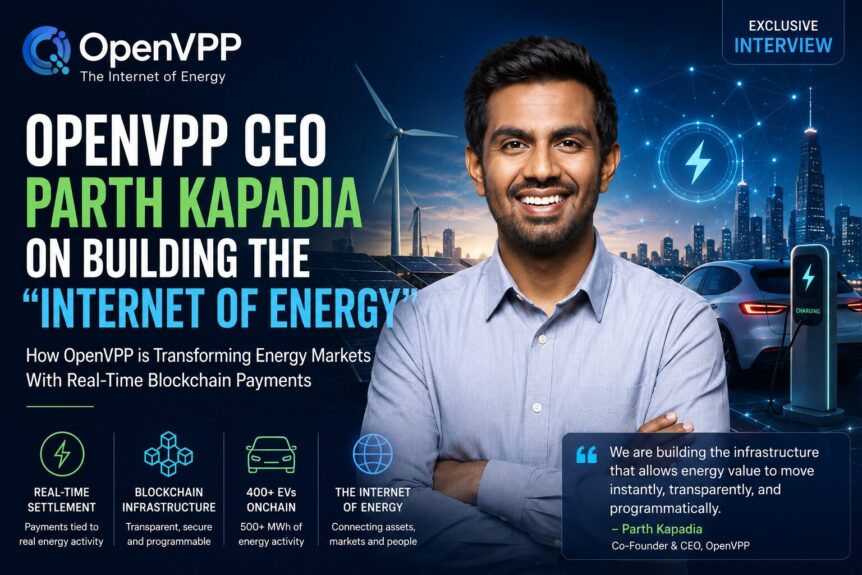
As global energy systems become increasingly decentralized, connected, and data-driven, a growing number of companies are exploring how blockchain infrastructure could modernize the way electricity markets operate.
One of the projects positioning itself at the center of this transformation is OpenVPP, a platform focused on bringing real-time programmable settlement and tokenized infrastructure into the energy sector.
The company describes its long-term vision as building the “Internet of Energy,” where electric vehicles, batteries, utilities, solar systems, and distributed energy resources can interact through automated, blockchain-powered financial infrastructure.
In this interview with Crypto Breaking News, OpenVPP Co-Founder and CEO Parth Kapadia discusses the future of tokenized energy infrastructure, real-world blockchain adoption, and how machine-to-machine payments could reshape the global utility sector.
“Energy Assets Need the Same Coordination the Internet Brought to Information”
According to Kapadia, the traditional utility sector still relies heavily on outdated financial systems that struggle to support increasingly decentralized energy networks.
“At its simplest, the Internet of Energy means giving energy assets the same level of connectivity, intelligence, and financial coordination that the internet brought to information,” Kapadia explained.
“EVs, batteries, solar systems, data centers, and distributed energy resources are all becoming active participants in the grid, but the systems used to track, reward, and settle their activity are still outdated.”
He believes the transition toward decentralized energy production, combined with growing global electricity demand, is creating the ideal environment for programmable settlement systems powered by blockchain infrastructure.
Bringing Real-Time Settlement to Energy Markets
One of OpenVPP’s primary goals is reducing the long settlement cycles that still dominate traditional energy markets.
“The infrastructure enables real-time settlement based on what actually happens at the device or asset level,” Kapadia said.
“If an EV, battery, or distributed asset contributes value to the grid, that activity can be measured, recorded, and settled automatically.”
The company says this approach can reduce administrative complexity while improving transparency and allowing consumers, businesses, and utilities to participate more efficiently in next-generation energy programs.
Building Consumer and Enterprise Infrastructure Simultaneously
OpenVPP operates through a dual-layer architecture composed of:
- Base, its consumer-focused layer
- Arc, its enterprise and utility-focused infrastructure layer
Kapadia says the structure was necessary because consumer energy participation and utility-grade infrastructure have fundamentally different operational requirements.
“Base allows us to create a more accessible consumer-facing layer where users, devices, and smaller assets can participate in energy programs and receive value from their activity,” he explained.
“Arc is built for utilities, enterprises, and larger-scale energy operations that require reliability, compliance, and integration with existing infrastructure.”
Real-World Adoption Already Emerging
While many blockchain projects continue searching for practical use cases, OpenVPP says it is already tracking live energy activity through connected devices.
Kapadia revealed that the platform has already brought:
- more than 400 EVs onchain
- over 500 MWh of energy activity onchain
through integrations using connected vehicle data.
“The key driver is that we started with real energy problems, not just a token or a Web3 narrative,” he said.
“The grid needs more flexibility, consumers need better incentives, and enterprises need better settlement infrastructure.”
The company believes the same infrastructure can eventually support batteries, solar systems, chargers, data centers, and distributed energy resources operating across increasingly digitized power grids.
Tokenization Could Reshape Utility Markets
Looking ahead, Kapadia sees tokenization and blockchain infrastructure becoming increasingly important for the modernization of utility markets worldwide.
“Over the next decade, tokenization will help energy markets become more liquid, transparent, and automated,” he said.
“Blockchain infrastructure can turn verified energy activity into a programmable asset, making it easier to track value, distribute payments, and build new market structures around flexibility.”
He argues that energy may ultimately become one of the most important real-world asset categories connected to blockchain infrastructure due to its role across transportation, AI infrastructure, industrial systems, and data centers.
Focus Shifts Toward Infrastructure and Enterprise Partnerships
According to Kapadia, OpenVPP’s next phase will focus heavily on scaling both its technology stack and institutional partnerships.
The company is currently targeting:
- utilities
- EV platforms
- enterprise energy providers
- data center operators
- distributed energy infrastructure
as it expands real-time settlement systems and tokenized metering capabilities.
“Our goal is to move OpenVPP from proof of concept into critical infrastructure for the next generation of energy markets,” Kapadia concluded.
The interview reflects a broader trend emerging across the blockchain sector, where infrastructure projects tied to real-world industries such as energy, payments, AI, and logistics are increasingly attracting attention as markets mature beyond purely speculative use cases.
https://www.cryptobreaking.com/openvpp-ceo-parth-kapadia-on/?utm_source=blogger%20&utm_medium=social_auto&utm_campaign=OpenVPP%20CEO%20Parth%20Kapadia%20on%20Building%20the%20"Internet%20of%20Energy"%20With%20Real-Time%20Blockchain%20Payments%20
Comments
Post a Comment