
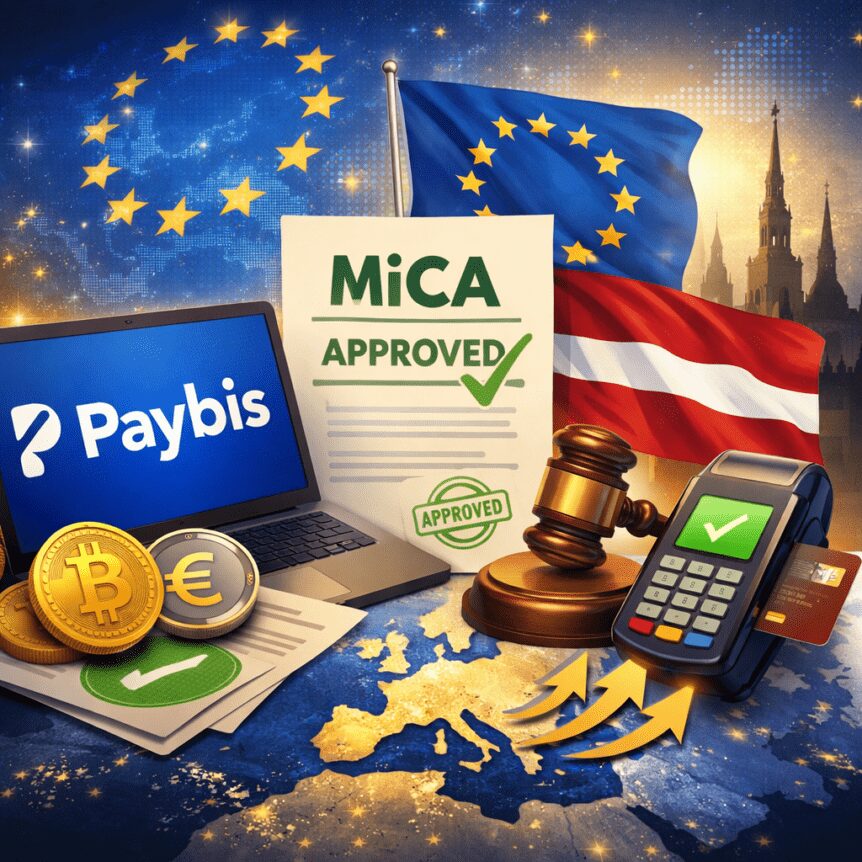
Latvia’s central bank granted Paybis Europe two regulatory licenses, marking a notable expansion of the crypto platform’s EU-regulated footprint. The approvals, issued on May 12 by the Supervision Committee of Latvijas Banka to SIA Paybis Europe, include a MiCA crypto asset service provider (CASP) license and a PSD2 payment institution license, expanding the firm’s ability to operate across the European Union.
The central bank noted that Paybis is the third Latvian company to receive a MiCA CASP license, underscoring a broader push by the Baltic state to support compliant crypto services within the EU regime. The MiCA license authorizes services such as custody and administration of client crypto assets, crypto-to-fiat and crypto-to-crypto exchanges, order execution, transfer services and crypto asset advisory. The PSD2 payment institution license enables Paybis’ EU entity to execute payments and transfers to payment accounts, integrating crypto activities with traditional rails.
Paybis’ leadership framed the dual licenses as a strategic enabler for broader, future-focused offerings. Innokenty Isers, Paybis’ CEO and co-founder, said the licenses position the company to pursue a wider range of services “including working with stablecoins.”
Key takeaways
- Latvia’s Latvijas Banka awards Paybis Europe both a MiCA CASP license and a PSD2 payment institution license, effective for operating complex crypto asset services and regulated payments within the EU.
- The MiCA CASP authorization covers custody, exchange, order execution, transfer services and advisory, while the PSD2 license enables payments to and from payment accounts, linking crypto services with regulated payment rails.
- Paybis is positioning itself as a B2B infrastructure provider, seeking to offer a white-label stack (on/off ramps, buy/sell/swap, payment acceptance, stablecoin payouts) through a single API for enterprise clients.
- The move aligns with Paybis’ broader footprint, which already includes money services licenses in the US and Canada and a user base spanning 90 cryptocurrencies, seven million users, and 180 countries.
- Regulatory context surrounding MiCA is evolving, with EU discussions anticipated on a potential “MiCA 2,” while industry voices push back on some thresholds and supervision debates.
Latvia’s license milestone and what it enables
Latvijas Banka announced the two licenses were issued to SIA Paybis Europe, the company’s EU entity, highlighting that the MiCA CASP authorization allows Paybis to custody and manage client crypto assets, facilitate crypto-asset exchanges for funds or other assets, execute orders, provide transfer services and offer crypto asset advisory. The PSD2 license enables the company to execute payments and move funds to payment accounts within the EU. The central bank’s announcement also notes Paybis is one of the few Latvian firms to secure a MiCA CASP license, signaling the country’s active role in shaping regulated crypto activity in Europe.
For Paybis, the dual licenses are more than regulatory milestones; they lay the groundwork for a seamless, compliant crypto service suite that can be accessed by business partners without each partner needing to build its own regulated framework. Konstantins Vasilenko, Paybis’ co-founder and chief business development officer, described a concrete product vision: a white-label crypto infrastructure stack that covers on/off-ramps, buy/sell/swap, payment acceptance and stablecoin payouts, all delivered through a single API. In his view, the combination of MiCA CASP authorization and PSD2 licensing is critical because it can “connect crypto asset services with regulated payment rails,” enabling smoother integration with traditional financial ecosystems for Paybis’ clients.
Paybis has a long-standing global footprint. Since its 2014 inception, the platform has supported around 90 cryptocurrencies, serving seven million users across 180 countries. The company also holds money services business licenses in the United States and Canada, positioning it as a cross-border crypto service provider with regulated credibility in multiple jurisdictions.
MiCA evolution and the regulatory backdrop
The Latvian licenses arrive as Europe’s crypto regulatory framework contends with ongoing scrutiny and potential evolution. In April, Peter Kerstens, an adviser to the European Commission, suggested that MiCA regulation is likely to evolve as the market matures, with a public consultation planned to assess how well the rules are functioning for participants. Speaking at Paris Blockchain Week 2026, Kerstens said it would be “rather unusual” if there were no a forthcoming MiCA 2, noting that EU financial legislation typically progresses in stages. This outlook comes as policymakers navigate competing priorities around stablecoins, custody, and the supervision of major crypto entities.
Industry voices have been pushing back on specific thresholds and regulatory approaches. For example, Circle has challenged euro stablecoin threshold discussions, while debates continue over whether supervisory authority for significant crypto firms should rest with the European Securities and Markets Authority (ESMA). These conversations underscore a broader question for market participants: how to reconcile rapid innovation with consistent, pragmatic oversight across a diverse member state landscape.
Within this context, Paybis’ newly minted licenses place the firm at a potentially advantageous position as Europe contemplates MiCA’s future shape. The ability to offer regulated custody, exchange services and direct payments to EU accounts could enable Paybis to attract enterprise clients looking for a single, compliant provider to power a broad array of crypto offerings, including stablecoins, in a cross-border setting.
For platforms and investors watching Europe’s crypto roadmap, the developments around MiCA’s evolution—and any formalized “MiCA 2” proposals—could have meaningful implications for how rapidly and broadly crypto assets are adopted in business-to-business environments. The ongoing regulatory dialogue, including EU consultations and industry feedback, will be a key determinant of how quickly B2B crypto rails scale across the region.
As Paybis accelerates its EU expansion with a regulated, API-driven infrastructure, market participants will want to monitor partner onboarding activity, the inclusion of stablecoins in its offerings, and how the company leverages its dual licensing to connect crypto services with established payment rails. The next steps from Brussels on MiCA’s potential revisions and on related supervisory approaches will also shape the pace and nature of Europe’s regulated crypto adoption in the months ahead.
Readers should watch for how Paybis articulates its partner program and whether it signs notable enterprise clients seeking white-label crypto rails. What remains uncertain is the exact path and timeline for any MiCA 2 framework, and how the EU’s evolving stance on stablecoins and cross-border payments will influence Paybis’ deployment strategy across its 180-country footprint.
https://www.cryptobreaking.com/paybis-gains-mica-approval-and/?utm_source=blogger%20&utm_medium=social_auto&utm_campaign=Paybis%20gains%20MiCA%20approval%20and%20Latvia%20payment%20licenses%20for%20EU%20growth%20
Comments
Post a Comment