
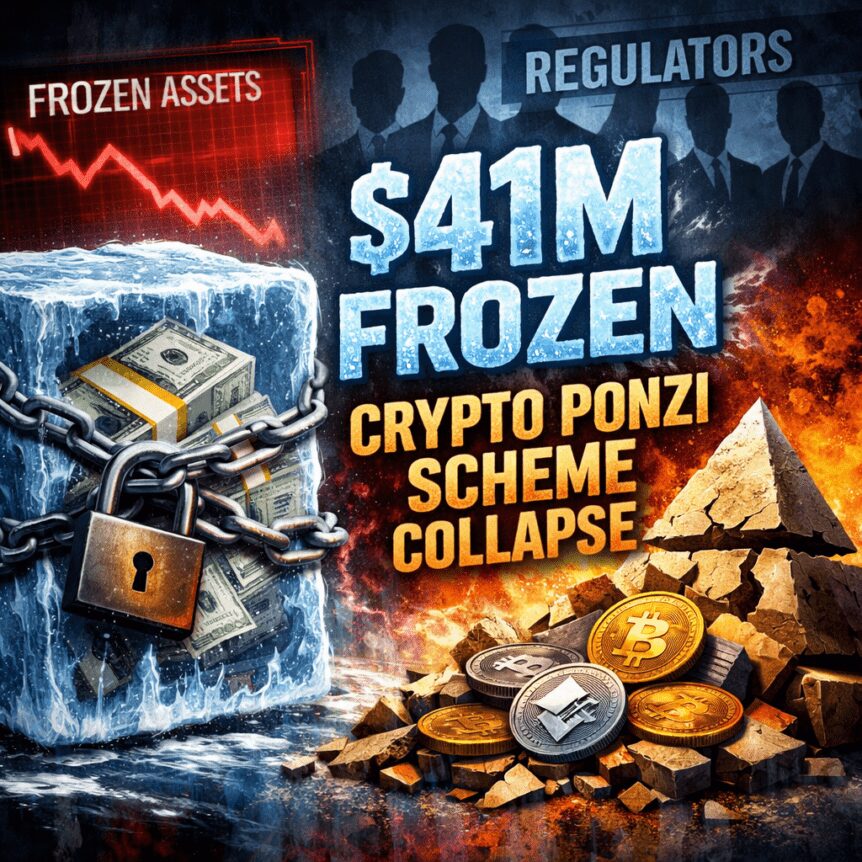
A suspected $150 million crypto Ponzi scheme centered on BG Wealth Sharing has seen its domain seized by U.S. law enforcement, following reports of a large-scale rug pull and mounting investor losses. The operation’s online presence was brought down as part of a joint initiative involving federal authorities and specialized task forces, underscoring ongoing efforts to disrupt scam networks that rely on social media to lure retail investors into high-yield promises.
On-chain sleuthing by ZachXBT indicated that illicit actors tied to BG Wealth Sharing attempted to launder more than $92 million in cryptocurrency between April 27 and this week. In a coordinated response, investigators managed to freeze more than $41 million of those assets, with cooperation from industry players including Tether, Binance and OKX, as well as U.S. law enforcement. The influencer’s update also framed the scheme as potentially responsible for losses well above the $150 million mark, based on activity since 2025 and the thousands of victim withdrawals identified to date.
“While these Chinese investment frauds are obvious to most, they purposely target unsophisticated retail investors via social media,” ZachXBT commented, noting the difficulty of convincing victims that they were scammed even after the fact.
Key takeaways
- Domain seized: BG Wealth Sharing’s website was taken down by U.S. authorities as part of a joint operation involving Level Up and the Scam Center Strike Force, signaling a broader crackdown on unlicensed crypto investment platforms.
- Asset recovery and laundering: investigators reported laundering attempts exceeding $92 million, with more than $41 million frozen in cooperation with major exchanges and law enforcement partners.
- Scale of impact: the scheme reportedly operated since 2025 and is linked to thousands of withdrawals, suggesting total losses could exceed $150 million.
- Regulatory warnings and cautions: regulators had long warned investors away from BG Wealth Sharing, including the FCA and the Central Bank of Samoa, highlighting the risks of unregistered crypto investment offers.
- Investor-facing red flags: descriptions of daily profits, referral schemes, and a claimed IPO for a related exchange were later tied to deceptions, culminating in a public rug pull narrative and warnings from state regulators.
Crackdown context: enforcement, warnings, and the scale of risk
The seizure of BG Wealth Sharing’s domain comes amid heightened vigilance from regulators and law enforcement against crypto investment platforms that promise high returns with minimal friction. In multiple jurisdictions, authorities have warned that BG Wealth Sharing presented itself as a crypto-trading advisor while peddling guaranteed yields and referral commissions—a combination commonly associated with sophisticated advance-fee scams and Ponzi-like structures.
Regulators’ warnings were not limited to one territory. The UK Financial Conduct Authority issued formal warnings about BG Wealth Sharing, while the Central Bank of Samoa cautioned investors that the group represented an investment scam. In the United States, the action aligns with broader joint efforts—Operation Level Up and the Scam Center Strike Force—designed to disrupt cross-border scams that rely on social media amplification to reach unsophisticated retail investors.
Investors have faced a difficult truth as authorities step up enforcement: schemes that promise regular, outsized returns often collapse once new inflows stall. The Washington State Department of Financial Institutions reiterated concerns by noting a pattern consistent with advance-fee fraud, a warning echoed in official statements that highlight how new funding is often required to access any withdrawn funds.
A company that requires an investor to deposit additional external funds in order to withdraw their investment is highly likely to be operating an advance fee scam.
Context for this crackdown is supported by broader crime data. The U.S. Federal Bureau of Investigation reported in April that Americans lost $21 billion to cyber-enabled crime last year, with crypto investment scams accounting for a substantial portion of those losses. The scale of the problem underscores why authorities continue to pursue operators like BG Wealth Sharing and why investors must scrutinize platform claims, licensing, and regulatory status before committing capital.
What BG Wealth Sharing advertised—and what regulators say happened
BG Wealth Sharing presented itself as a crypto-trading guidance service, heavily promoted on social media with promises of “daily profit opportunities” and a structured compensation plan featuring referral commissions and rank-based bonuses. It also advertised a daily yield range of about 1.3% to 2.6%, a promise that rarely survives the realities of a market where liquidity and withdrawal policies can hinge on the platform’s ability to attract new funds.
As the scheme unfolded, purported leadership and marketing claims around a related DSJ Exchange surfaced in a late-stage address to users. A video message from a figure identified as the company’s CEO suggested the exchange would be pursuing an initial public offering, with a requirement of a 12% tax on account balances as part of the regulatory process. When users began warning each other that a rug pull was in progress, regulators stepped in with formal alerts—reiterating that the platform’s claims did not align with licensed, compliant financial activity.
The grim arc of BG Wealth Sharing is consistent with other scams that leverage social-media reach to lure retail investors who may be drawn by the prospect of fast gains. ZachXBT’s reporting emphasizes the tension between the perceived legitimacy of online promotions and the reality that many participants may not realize they are dealing with an unregistered or fraudulent operation until well after losses mount.
Why this matters for the market and for participants
Criminal actions against BG Wealth Sharing illustrate the persistent threat of Ponzi-like crypto investment schemes that mix aggressive marketing with questionable licensing. For traders and investors, the case highlights several practical considerations: the importance of verifying licensing and regulatory status, the risks of platforms that offer unusually high yields with little transparent risk management, and the need to consider on-chain evidence and official cautions before committing funds.
For builders and infrastructure players, the episode underscores the ongoing need for clearer provenance and due diligence tools in the crypto ecosystem. Projects that emphasize transparent treasury management, auditable yield models, and verifiable investor protections are more likely to gain trust in a crowded market where scams can leave lasting reputational damage.
From a policy perspective, the BG Wealth Sharing case reinforces the imperative for coordinated enforcement across jurisdictions. The joint seizure and the public warnings from regulators in multiple regions may deter would-be scam operators and provide a blueprint for future takedowns, even as new schemes continue to adapt their narratives to evade detection.
Looking ahead, readers should monitor updates from U.S. law enforcement and regulatory agencies for any further recoveries, charges, or civil actions related to BG Wealth Sharing and similar entities. Investors should also remain vigilant for warning signs—unlicensed status, guaranteed returns, and sudden changes in withdrawal policies—especially when paired with aggressive social-media marketing and referral incentives.
As enforcement actions unfold, the broader market will likely see continued emphasis on vetting practices, more explicit disclosures around risk and compensation structures, and a push for faster cross-border information sharing among regulators and exchanges. The ongoing investigation and any subsequent asset recovery efforts will be crucial to understanding how effectively these networks can be disrupted and deterred in the future.
Readers should stay tuned for updates on the DSJ Exchange-related aspects of the saga, additional regulator statements, and any new data on the total scope of losses tied to BG Wealth Sharing. The case remains a salient reminder that high-yield promises on crypto platforms often conceal a higher likelihood of losses, and that vigilance—both by users and by the systems designed to protect them—remains essential.
Cointelegraph is committed to independent, transparent journalism. This news coverage adheres to established editorial standards, and readers are encouraged to verify details through official sources and ongoing reporting.
https://www.cryptobreaking.com/regulators-freeze-41m-tied-to/?utm_source=blogger%20&utm_medium=social_auto&utm_campaign=Regulators%20Freeze%20$41M%20Tied%20to%20$150M%20Crypto%20Ponzi%20Collapse%20
Comments
Post a Comment