
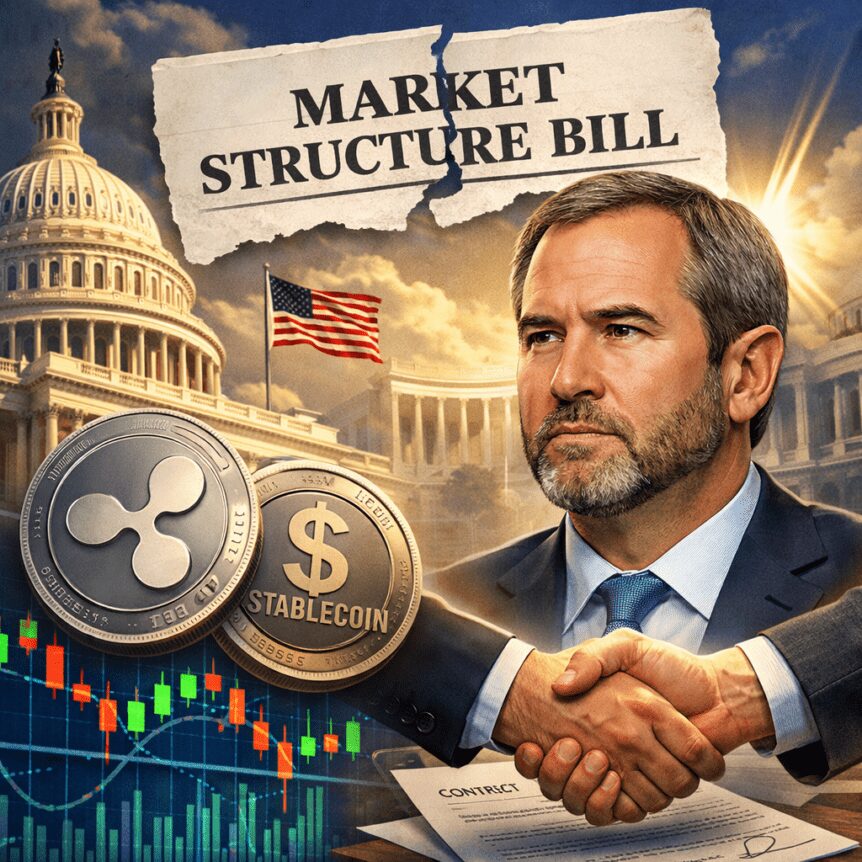
Brad Garlinghouse, chief executive of Ripple, warned that gains toward enacting the US Senate’s digital asset market structure framework may not translate into actual passage. Speaking at the Consensus crypto conference in Miami, Garlinghouse stressed that the next two weeks would be pivotal for the CLARITY Act, suggesting the political dynamics surrounding the measure could erode momentum during the calendar leading into the 2026 midterms.
Garlinghouse noted that while the CLARITY Act aims to bring regulatory clarity to the digital asset sector, no piece of legislation is without tradeoffs. He argued that clarity is preferable to chaos, even if the bill is not perfect, and underscored the broader objective of reducing uncertainty for market participants. According to Cointelegraph, his remarks reflect a broader industry push to finalize a comprehensive framework as lawmakers weigh competing concerns about stablecoins, tokenized assets, and ethics in the asset class.
Key takeaways
- The CLARITY Act’s prospects remain uncertain, with timing increasingly sensitive to political dynamics ahead of the 2026 midterm cycle.
- A compromise on stablecoin yield, announced by Senators Tillis and Alsobrooks, could influence momentum toward advancing CLARITY, though significant questions remain about broader market structure provisions.
- Regulatory oversight coordination between the SEC and CFTC persists as a parallel track, with officials signaling that legislation remains a prerequisite for a comprehensive enforcement framework.
- Ripple and other industry participants have engaged in informal negotiations involving the White House and financial regulators, highlighting the high-stakes negotiation environment surrounding crypto regulation.
Legislative trajectory for the CLARITY Act
At Consensus, Garlinghouse framed the CLARITY Act as a priority rather than a future consideration, aligning with ongoing parliamentary activity. The measure has already progressed through the Senate Agriculture Committee in a January markup and now requires action by the Senate Banking Committee before it can reach a full chamber vote. The evolving political calculus—particularly in the context of primary campaigns and the 2026 elections—raises the risk that the bill could lose momentum if not pushed decisively in the near term.
Senator Cynthia Lummis, a member of the banking committee, has publicly pressed for congressional action, emphasizing that the entire industry operates under a cloud of legal uncertainty that only Congress can dispel. While praise for the bill’s intent exists, critics point to the need to balance consumer protection, market integrity, and innovation incentives as part of any final package.
Beyond the legislative text itself, the negotiations have encompassed a broader set of policy questions—stablecoins, tokenized equities, and ethics—areas that have been sticking points delaying movement in the Senate since the House of Representatives passed the measure in July 2025. The latest signals indicate a potential path forward if adjacent provisions on yield and asset classification can be reconciled with a regulator-friendly framework that still preserves investor protections.
Regulatory coordination and oversight posture
Even as Congress contemplates the CLARITY Act, executive-branch and agency actions continue to shape the regulatory landscape. In March, the U.S. Securities and Exchange Commission (SEC) and the Commodity Futures Trading Commission (CFTC) signed a memorandum of understanding to coordinate their oversight of the evolving digital-asset market structure. Officials describe this interagency collaboration as a practical step in aligning approaches to market infrastructure, enforcement priorities, and investor protection, pending a broader legislative foundation.
As part of the stakeholder dialogue, SEC leadership has framed crypto regulation as an ongoing process rather than a finished product. The agency has signaled that approval of the CLARITY Act would inform and accelerate its rulemaking and enforcement posture, enabling a more predictable environment for regulated entities and registered market participants.
These developments underscore a critical point for institutions weighing regulatory risk: even with interagency coordination in place, a clear, enacted framework remains essential to reduce legal ambiguity for exchanges, banks engaging in crypto-related services, and other market infrastructure providers. The interagency momentum, while helpful, still leaves substantive questions about licensing, capital requirements, and customer due diligence unresolved in the absence of final congressional action.
Broader policy context and industry impact
The CLARITY Act sits at the intersection of innovation, investor protection, and financial stability. Its fate bears directly on how crypto firms structure licensing, compliance, and cross-border operations in a landscape where different jurisdictions pursue divergent approaches. For institutions involved in tokenized assets, stablecoins, or crypto-enabled banking services, the legislation could translate into clearer standards for registration, reporting, and customer verification, thereby aiding risk management and regulatory alignment.
From a compliance perspective, the bill’s trajectory matters for AML/KYC frameworks, know-your-customer regimes, and the governance of stablecoins tied to fiat or other reserve assets. Analysts and legal teams will be watching how the bill addresses collateral standards, reserve custody, and disclosure requirements, as well as how it interfaces with existing banking relationships and payment rails. The conversation also intersects with cross-border policy movements, including the European Union’s MiCA framework, which serves as a regional reference point for market structure and stablecoin oversight.
Within the political economy of regulation, industry stakeholders argue that timely clarity is essential to reduce the systemic risk that arises from fragmented supervision and inconsistent enforcement signals. Yet the practical path to a final bill remains constrained by competing sector interests and the broader electoral calendar. As negotiations continue, market participants should prepare for continued uncertainty and scenario planning around licensing timelines, regulatory approvals, and potential transitional rules.
In summary, the forthcoming weeks will test whether legislative action on the CLARITY Act can outpace political headwinds and regulatory tensions. While interagency coordination provides a supportive backdrop, the ultimate resolution will hinge on Congress delivering a comprehensive, workable regime that aligns with enforcement priorities, investor protections, and the evolving structure of the crypto markets.
Closing perspective: The path to a binding framework remains unsettled, and stakeholders should monitor congressional calendars, committee chair statements, and any new interagency guidance that could shape the timing and scope of a final bill. The balance between regulatory certainty and policy flexibility will define the next phase of the US digital asset regime.
https://www.cryptobreaking.com/ripple-ceo-market-structure-bill/?utm_source=blogger%20&utm_medium=social_auto&utm_campaign=Ripple%20CEO:%20Market%20Structure%20Bill%20Not%20Final%20Amid%20Stablecoin%20Deal%20
Comments
Post a Comment