
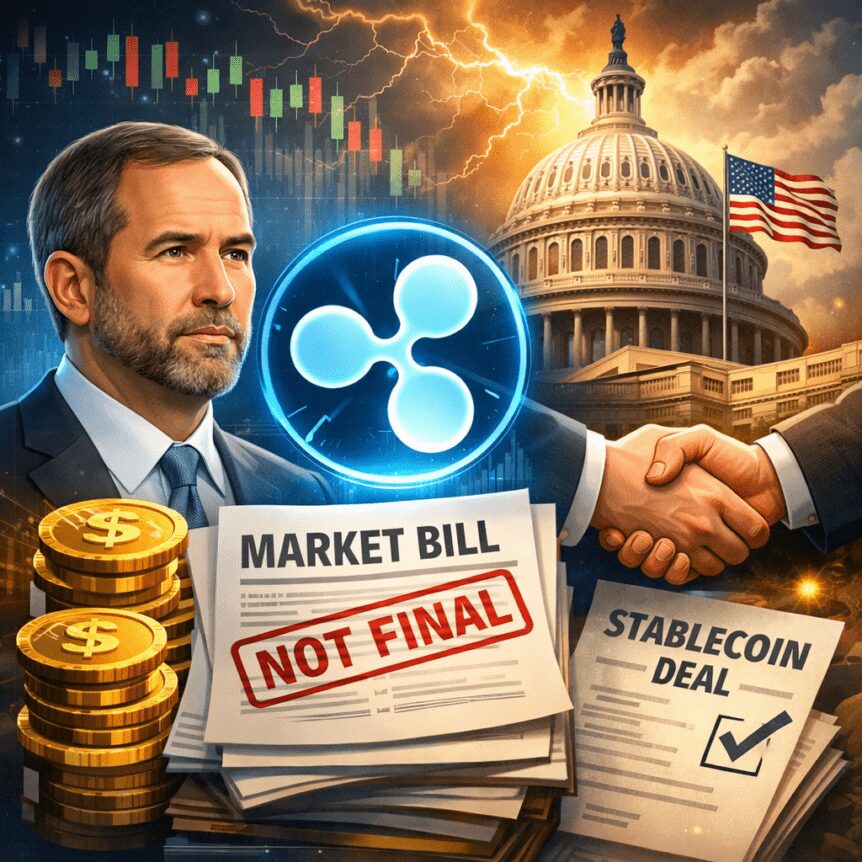
Brad Garlinghouse, the chief executive of Ripple Labs, warned that progress toward the US Senate’s market structure bill for digital assets, known as the CLARITY Act, does not guarantee a smooth ride to passage. Speaking at the Consensus crypto conference in Miami, Garlinghouse stressed that the next two weeks could prove decisive, with the fate of the bill hanging on how lawmakers navigate election-year dynamics and campaign priorities for the 2026 midterms.
Garlinghouse acknowledged that the CLARITY Act is not perfect, but argued that a clearer framework would be preferable to the current regulatory patchwork. “There's tradeoffs and compromises, but I do think clarity is better than chaos,” he said, signaling a pragmatic if cautious stance on a measure that would shape how digital assets are regulated in the near term. The two-week window emphasized by the Ripple CEO reflects the intensity of political negotiation as the legislation remains unfinished business in the Senate.
The latest twist comes as lawmakers on both sides of the aisle signal potential movement on a related front: a compromise over stablecoin yields. Last week, Senators Thom Tillis and Angela Alsobrooks announced a bipartisan agreement on stablecoin yield provisions that could unlock broader consideration of the CLARITY Act. The developing framework for stablecoins, tokenized equities, and broader market ethics has been one of the primary sticking points delaying action since the House passed the bill in July 2025. The renewed focus on stablecoins is seen as a potential pathway to clearing the way for the CLARITY Act to move through committee and toward a full Senate vote.
Among lawmakers rallying behind the bill, Senator Cynthia Lummis, a long-standing advocate for clear crypto regulation, underscored the urgency in a Tuesday post. “The Clarity Act is not a future priority; it is the priority,” Lummis wrote. “Every corner of the industry is operating under legal uncertainty that Congress has the power to fix. The Senate needs to act.” Her comments reflect the growing sense that a consensus framework could reduce ambiguity for market participants, issuers, and the broader ecosystem ahead of a politically charged cycle.
Key takeaways
- The CLARITY Act’s fate hinges on a brief, high-stakes window as the 2026 midterm cycle intensifies political calculations and campaigning.
- A bipartisan compromise on stablecoin yields, announced by Senators Tillis and Alsobrooks, could shift momentum in favor of advancing the bill.
- The CLARITY Act remains pending in the Senate after being advanced by the Senate Agriculture Committee in January; it would still need approval from the Senate Banking Committee before a full floor vote.
- Regulatory coordination between the SEC and CFTC is intensifying, with a March memorandum of understanding signaling closer oversight alignment as Congress weighs a broader market structure framework.
- Ripple’s leadership has been engaged in ongoing negotiations surrounding the legislation, highlighting industry participation in shaping the regulatory path.
The roadmap and the regulatory backdrop
The CLARITY Act represents a concerted attempt to codify a coherent market structure for digital assets in the United States. Its path to passage has been incremental: the bill was advanced by the Senate Agriculture Committee in a January markup, but still requires clearance from the Senate Banking Committee before it can reach the chamber floor for a vote. The House’s July 2025 passage marked a political milestone, but not a guarantee of cross-chamber consensus, especially given the multifaceted concerns about stablecoins, tokenized securities, and the broader ethics of the crypto economy.
In parallel with the legislative process, regulatory agencies have pursued closer coordination. In March, the U.S. Securities and Exchange Commission (SEC) and the Commodity Futures Trading Commission (CFTC) signed a memorandum of understanding to align their approaches to overseeing the evolving digital asset market structure. The SEC has framed its crypto enforcement and supervisory strategy as an ongoing, iterative process, describing the CLARITY Act as a potential accelerant that could clarify jurisdictional boundaries and reduce legal uncertainty for market participants. SEC Chair Paul Atkins framed the agency’s stance as a starting point rather than a final authority, signaling readiness to adjust as legislation progresses.
The collaboration between the two agencies comes at a time when industry participants have called for clearer rules. The MOU and related statements indicate a willingness to coordinate on registration, compliance, and market surveillance in a way that could provide longer-term certainty for developers, exchanges, and users. However, until Congress acts, the risk of a patchwork regulatory regime persists, underscoring Garlinghouse’s caution about the bill’s prospects and the broader market’s need for clarity.
Why this matters for investors and builders
From an investor and builder perspective, the CLARITY Act could mark a turning point in how digital assets are treated under U.S. law. A clear, codified framework would help institutions assess risk more accurately, potentially lowering the cost of capital for compliant projects and enabling more transparent product development. For traders, the bill could reduce regulatory ambiguity around token classifications and the permissibility of certain activities, such as staking, yield generation, and cross-border offerings.
That said, the process remains uncertain, particularly given the electoral calendar. If the coming two weeks do not yield meaningful movement on the CLARITY Act, activists and stakeholders may push for alternative legislative routes or rely more heavily on regulatory guidance and agency-level actions to shape market behavior in the near term. In this environment, even modest shifts in stablecoin policy or in the allocation of regulatory responsibilities could have outsized effects on market sentiment and project timelines.
What to watch next
The immediate signal to monitor is whether the Tillis–Alsobrooks yield framework gains traction in committee discussions and eventually in floor negotiations. Observers will also be watching how the Banking Committee handles the broader package and whether any compromise language can satisfy both pro-innovation voices and consumer-protection advocates. While Garlinghouse’s remarks emphasize urgency, the reality remains that congressional processes can be slow, especially when elections alter legislative calculus and committee assignment dynamics.
Beyond Congress, the ongoing SEC–CFTC coordination and the framing of crypto regulation in executive discussions suggest that a more predictable regulatory environment could emerge only with a formal bill’s passage. For now, the market should prepare for a period of high political exposure, with potential volatility tied to headlines about yields, stablecoins, and committee votes. Investors and builders alike should consider risk management strategies that assume regulatory clarity will evolve in stages rather than arrive in a single, definitive moment.
As the discourse continues, market participants should stay attentive to official committee agendas, White House outreach, and industry briefings that could signal whether a concrete path to CLARITY is emerging. The coming days will indicate whether the two-week window Garlinghouse highlighted translates into tangible movement or a continuation of the status quo—and what that implies for the timing and composition of any future regulatory framework.
https://www.cryptobreaking.com/ripple-ceo-market-structure-bill-2/?utm_source=blogger%20&utm_medium=social_auto&utm_campaign=Ripple%20CEO:%20Market-structure%20bill%20not%20final%20despite%20stablecoin%20deal%20
Comments
Post a Comment