
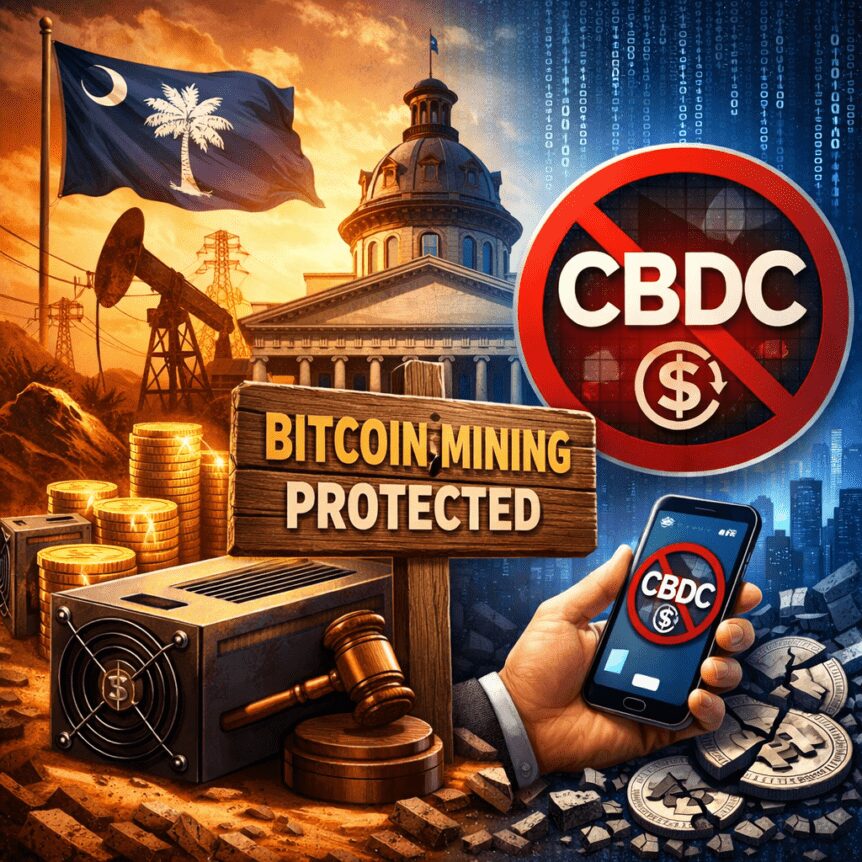
South Carolina Governor Henry McMaster signed Senate Bill 163 on Tuesday, advancing what observers describe as one of the most crypto-friendly state-level policy frameworks in the United States. The measure, which cleared strong impressions in the legislature, aims to curb state involvement with central bank digital currencies while advancing a clear path for crypto users, miners, and related businesses to operate with reduced regulatory friction.
According to Cointelegraph, the bill sailed through the Senate with a 38-1 vote and the House with a 110-1 margin before the governor’s signature. The enacted provisions include a prohibition on state agencies accepting or requiring payments in a Federal Reserve-led digital currency, including any federal pilot programs. The law also codifies protections for self-custody and hardware wallets, and it bars taxes on crypto transactions from being higher than those applied to comparable fiat payments.
Beyond individual rights and CBDC restrictions, the measure lays out specific protections for digital asset miners and related infrastructure, signaling a broader commitment to a conducive operating environment for blockchain activities within the state. The text emphasizes that crypto mining operations in designated industrial zones receive tailored assurances and that zoning actions affecting mining firms must follow standard notice-and-comment procedures, with avenues to appeal changes in zoning through the courts.
Key takeaways
- Senate Bill 163 becomes law, establishing a crypto-friendly framework and restricting state engagement with CBDCs and related federal pilots.
- The act protects self-custody rights, prohibits punitive tax treatment of crypto transactions relative to USD payments, and shields crypto users from government overreach in custody and usage.
- Mining operations receive zonal protections: local governments cannot impose mining-specific restrictions beyond general industrial rules, and zoning changes require proper notice and a legal appeal route.
- Money transmitter licensing exemptions apply to core crypto activities, including mining, node operation, blockchain software development, and crypto-to-crypto trading; mining-as-a-service and staking-as-a-service are not classified as securities.
- South Carolina joins a growing cohort of states adopting crypto-friendly policies, reflecting a broader shift in subnational regulation of digital assets.
Regulatory architecture: CBDCs, custody, and tax parity
The law sets clear boundaries around the use of central bank digital currencies at the state level. By barring state agencies and political subdivisions from accepting or requiring CBDCs, South Carolina signals a preference for jurisdictional control over how public payments and digital money interact with state operations. In tandem, the custody provisions reinforce a legal space for individuals to retain control of their private keys and hardware wallets, reducing the risk of compelled on-chain custody or asset concentration in custodial arrangements. The parity principle—preventing higher taxes on crypto transactions than those applied to fiat equivalents—aligns with a growing expectation that digital assets should not face an undue tax burden relative to traditional payment methods.
From a compliance perspective, these protections help delineate responsibilities for financial institutions and payment service providers operating in-state markets. While the CBDC ban is primarily a state-level posture, it interacts with ongoing national debates about the role of digital sovereign money and the regulatory perimeter for digital assets. The measure thus contributes to a trend whereby state legislatures seek to provide clarity and confidence for market participants while avoiding friction with federal monetary policy initiatives.
Mining safeguards and zoning clarity
Central to the bill is an explicit commitment to shield cryptocurrency mining activity from local regulatory overreach that would be inconsistent with other industrial operations. In practical terms, the text prohibits selective restrictions on mining sites that are not equally applicable to other industrial activities in the same zone. The policy is designed to prevent disparate treatment of mining operations and to ensure predictable, rule-based zoning outcomes.
The text includes a procedural safeguard for mining firms: a political subdivision shall not modify the zoning of a digital asset mining operation without following established notice and comment procedures. If a change is imposed, the mining entity may seek relief or challenge the decision in the appropriate court, safeguarding operators against abrupt, disproportionate regulatory shifts.
These provisions aim to reduce regulatory uncertainty for miners and data-center infrastructure operators, a sector that has drawn investment but also scrutiny in various jurisdictions. By tying zoning actions to standard processes, the bill reduces the risk of retroactive or ad hoc restrictions that could disrupt lawful business activity and investment timelines.
Supporting material from the South Carolina State House underscores the fiscal and governance considerations associated with the bill. See the official fiscal impact statement for S.163 for a formal accounting of costs and regulatory effects.
The broader licensing framework, meanwhile, clarifies that several core activities associated with digital assets fall outside traditional money transmitter regimes. Mining, node operation, blockchain software development, and crypto-to-crypto trading are exempt from certain licensing requirements, reducing duplication of regulatory requirements for in-state operators. Moreover, the bill explicitly excludes mining-as-a-service and staking-as-a-service offerings from being categorized as securities, which has important implications for how service providers structure product offerings and for the securities compliance posture of platform operators.
Broader policy context and regional implications
South Carolina’s move is part of a broader pattern among U.S. states that seek to establish clear, crypto-specific policy frameworks while avoiding unintended frictions with federal regulation. Kentucky already enacted a Bitcoin Rights bill in the prior year, with explicit protections for self-custody and mining operations against discriminatory local rules. Other states—including Oklahoma, Arkansas, Florida, Mississippi, Montana, North Dakota, Louisiana and Arizona—have advanced or enacted similar crypto-friendly measures in recent years. This regional movement appears aimed at providing predictability for market participants and signaling regulatory alignment with industry norms in a decentralized model of state governance.
The evolving state landscape presents both opportunities and enforcement considerations for firms operating across multiple jurisdictions. While these measures foster operational clarity and risk management, regulators at the federal level continue to assess how such state-level autonomy interacts with national anti-money-laundering, consumer protection, and securities frameworks. Observers will watch how the interplay between state rules and federal oversight shapes licensing decisions, cross-border activity, and the way banks engage with crypto businesses under evolving AML/KYC expectations.
For further context on how a similar policy trajectory is developing elsewhere, observers can reference related industry coverage and state-by-state analyses, including ongoing discussions around the balance between non-custodial DeFi innovation and regulatory guardrails.
Source: South Carolina State House
Closing perspective: The enactment of Senate Bill 163 positions South Carolina as a notable case study in how state governments can calibrate between facilitating innovation and maintaining regulatory clarity. As enforcement and practical implementation unfold, compliance teams and financial institutions will monitor for any regulatory updates, guidance interpretations, or potential challenges that could shape digital-asset activity within the state and beyond.
https://www.cryptobreaking.com/south-carolina-signs-law-protecting/?utm_source=blogger%20&utm_medium=social_auto&utm_campaign=South%20Carolina%20Signs%20Law%20Protecting%20Bitcoin%20Miners,%20Bans%20CBDC%20Payments%20
Comments
Post a Comment