
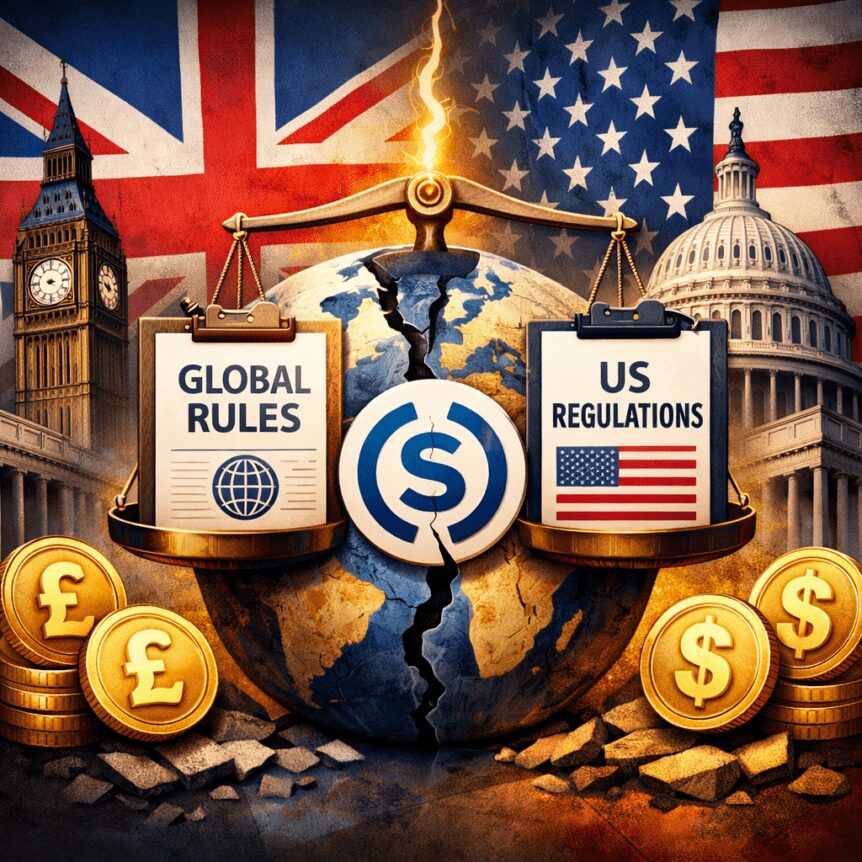
Global regulators are increasingly positioning stablecoins as a test case for cross-border payments, with Bank of England Governor Andrew Bailey saying any workable framework will require international standards. Speaking at a conference, Reuters reported, Bailey warned that the architecture around dollar-denominated stablecoins must be anchored in coordinated rules, or the financial system could face new forms of risk as these tokens scale globally. He also signaled that the regulatory tussle with the United States is likely to intensify as both sides shape how stablecoins are issued, used, and supervised.
Bailey, who chairs the Financial Stability Board, cautioned that stablecoins could threaten financial stability if their use expands beyond local markets without robust guardrails. He emphasized the risk that a sector-wide run on a stablecoin could disrupt liquidity and conversion pathways, particularly for tokens designed to be easily exchanged for cash. In his view, the lack of readily redeemable cash equivalents could complicate a rapid unwind during stressed market conditions, potentially drawing users and capital toward jurisdictions with stronger convertibility rules—such as the United Kingdom—while raising questions about where the dollars backing these tokens ultimately reside.
The conversation unfolds as the global stablecoin market remains dominated by tokens pegged to the U.S. dollar. CoinGecko estimates the sector’s total value at more than $317 billion, a figure that underscores the material stake regulators have in ensuring resilience and transparency behind these assets. The majority of USD-pegged stablecoins rely on Treasury securities and dollar-denominated assets to maintain their pegs, a structure that heightens the importance of stable and reliable settlement channels across borders.
Bailey’s remarks come amid broader regulatory debates about how to supervise stablecoins compared to the traditional banking system. He warned that if stablecoins are used extensively for cross-border payments, dollar tokens with limited convertibility could migrate to other markets, prompting domestic authorities to tighten conversion controls. “We know what would happen if there was a run on a stablecoin; they’d all turn up here,” Bailey said, highlighting a potential concentration of risk within the domestic financial system even as technology and digital liquidity routes expand globally.
Key takeaways
- International standards are seen as essential for stablecoins to function as part of a global payments architecture, setting up a potential regulatory fork with U.S. approaches.
- The stablecoin market sits at roughly $317 billion in value, with the bulk of USD-pegged tokens backed by U.S. Treasuries and dollars, anchoring confidence in their pegs but also tying them to U.S. monetary policy.
- Convertibility risk is a central concern: if some tokens cannot be redeemed for cash quickly, they may face heightened liquidity pressures in stressed market conditions.
- Regulatory momentum in the United States—via the GENIUS Act and ongoing debates around the Clarity Act and related bills—could shape how issuers operate internationally and how cross-border flows are managed.
- The UK signals it will pursue strict conversion rules for stablecoins, potentially creating friction with U.S.-led regulatory frameworks and influencing where stablecoins are used for cross-border settlements.
Global rules in the balance: Bailey’s warning and the US-UK dynamic
Bailey’s call for international standards reflects a broader tension in the crypto policy landscape. The Bank of England governor argued that stablecoins will only achieve widespread use in payments if there is a coherent set of global guidelines that govern reserve backing, liquidity, disclosure, and convertibility. The Reuters report quotes him as describing an inevitable “wrestle” with the U.S. administration over how these tokens should be regulated, especially given the United States’ own efforts to nurture the crypto sector while tightening oversight of stablecoins.
The rhetoric dovetails with recent U.S. policy signals. Former President Donald Trump has championed a pro-innovation agenda for crypto and has advocated for a regulatory pathway around stablecoins through the GENIUS Act, which is framed as giving issuers a structured framework. Supporters argue that clear rules can unlock legitimate use cases—ranging from cross-border remittances to on-chain settlement—while critics warn of regulatory metaphorical walls that could stifle innovation or push activities offshore. The divergence in policy philosophy between the U.S. and the U.K. underscores a broader question: will global stablecoin activity be steered by American market access ambitions or by a broader, harmonized regulatory regime?
Regulatory rails in motion: U.S. bills, hearings, and cross-border concerns
Beyond the GENIUS Act, U.S. policymakers are actively weighing additional measures to govern stablecoins. Banking groups have pressed Congress to advance a framework, including proposals to ban “yield-bearing” features on idle stablecoin balances, while permitting other forms of customer rewards. The debate centers on whether yield opportunities should be accessible on stablecoins, potentially altering the risk and return profile of these tokens and influencing how users deploy them in everyday payments and liquidity management.
On the legislative front, the U.S. Senate Banking Committee has been moving pieces of the regulatory puzzle forward. After delays earlier this year, the committee scheduled a markup on updates to the so-called Clarity Act, a draft bill aimed at clarifying the regulatory status of crypto assets, including stablecoins. The outcome of these proceedings will help determine whether stablecoins face stricter supervision, more explicit reserve requirements, or tighter restrictions on programmatic features like staking or rewards. The resulting policy mix will shape how issuers structure reserves, disclosures, and redemption mechanics across international markets.
In parallel, global regulators are watching the U.S. approach closely, mindful that a lighter regulatory touch in one jurisdiction can attract activity that undermines stability elsewhere. The BoE’s warning about convertibility risk echoes a larger concern: stablecoins that are easy to deploy across borders could accelerate capital flows, while gaps in convertibility could create de facto regional friction, complicating cross-border settlement and potentially amplifying shocks in periods of stress.
Market structure, adoption, and the path forward
The current scale of stablecoins—measured in hundreds of billions of dollars—means any shift in the regulatory regime carries real market consequences. If major jurisdictions converge on robust reserve standards, transparent disclosure, and enforceable redemption guarantees, stablecoins could become a more trusted complement to traditional settlement rails. Conversely, a fragmented regulatory environment or a stiffer U.S. stance could drive issuers to reconfigure their operations, potentially concentrating activity in markets with more favorable rules or prompting a quicker retreat from the cross-border use-case altogether.
For investors and builders, the implications are clear. Stablecoins remain a critical liquidity layer for DeFi, cross-border payments, and institutional settlement demonstrations. The outcome of policy debates—particularly around convertibility, reserve quality, and consumer protections—will influence how and where stablecoins are deployed, the cost of on-ramps and off-ramps, and the resilience of the broader crypto ecosystem in times of market stress.
As the regulatory horizon unfolds, market participants should watch two intertwined threads: first, how international coordination evolves to prevent regulatory arbitrage and preserve financial stability; second, how the U.S. and the U.K. implement concrete rules around conversion and redemption to ensure stablecoins remain reliable for everyday use. The balance between encouraging innovation and safeguarding systemic integrity will shape the next phase of stablecoin adoption and the willingness of institutions to participate in cross-border digital payments.
Source-linked context and ongoing coverage indicate that the dialogue around stablecoins will intensify through 2026, with regulatory bodies seeking practical benchmarks that can be implemented globally. For readers tracking policy risk, developments in the U.S. Senate markup, the GENIUS Act’s evolution, and the BoE’s stance on cross-border convertibility will be crucial signals of where the market is headed next. In the coming months, investors and users should expect sharper clarity around what constitutes an acceptable reserve, how quickly redemptions can be honored, and where the line is drawn between innovation and systemic risk.
What remains uncertain is how quickly international consensus can be achieved in a landscape marked by competing national interests. Bailey’s warnings suggest that, while the technology will continue to mature, the rules of the road for stablecoins—and the incentives for cross-border use—will be shaped as much by political negotiation as by technical evolution.
https://www.cryptobreaking.com/uk-central-banker-global-stablecoin/?utm_source=blogger%20&utm_medium=social_auto&utm_campaign=UK%20central%20banker:%20global%20stablecoin%20rules%20clash%20with%20US%20standards%20
Comments
Post a Comment