
Elon Musk is pushing forward with one of the most ambitious transformations of the financial ecosystem: turning X into a fully integrated banking and payments platform through X Money.
Early tests suggest that the platform could combine traditional banking features with fintech innovation, potentially reshaping how users interact with money on a global scale.
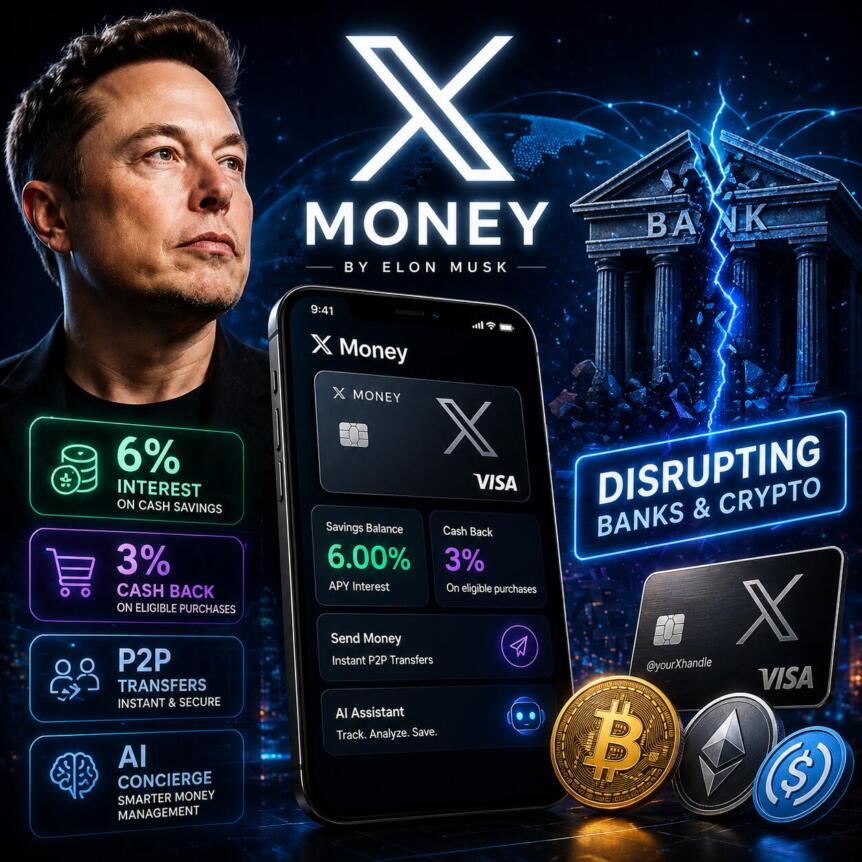
What X Money Is Offering So Far
According to early users cited by Bloomberg, X Money is already experimenting with a compelling set of features:
- Up to 3% cash back on eligible purchases
- Around 6% interest on cash savings, significantly higher than traditional bank averages
- Peer-to-peer (P2P) transfers directly within the app
- An AI-powered financial assistant tracking spending behavior
- A metal debit card powered by Visa, customized with users’ X handle
These offerings position X Money as a direct competitor to fintech companies like SoFi Technologies Inc., Block Inc., and LendingClub Corp.
Another key shift is that creators monetizing on X may soon receive payments directly through X Money instead of relying on external processors like Stripe, effectively internalizing the entire financial flow.
A Super App Vision Becoming Reality
This move aligns with Musk’s long-term ambition of turning X into a “super app”, similar to Asian platforms like WeChat, where messaging, payments, and financial services coexist seamlessly.
The integration of payments into chats and user profiles is particularly notable. It transforms social interaction into economic interaction, removing friction between communication and transactions.
If fully implemented, this could redefine digital identity itself. Your social profile would no longer just represent who you are, but also how you transact, save, and invest.
Regulatory Challenges and Political Scrutiny
Despite the promising features, X Money faces significant regulatory hurdles.
The platform has yet to secure payment licenses in key jurisdictions such as New York, which could delay or limit its rollout. Additionally, U.S. Senator Elizabeth Warren has raised concerns about:
- Potential stablecoin integrations
- Data privacy and financial surveillance
- Fraud prevention and compliance mechanisms
These concerns highlight a broader issue. When a tech platform becomes a financial institution, the regulatory expectations increase dramatically.
The Impact on Traditional Banking
If X Money scales successfully, it could challenge the traditional banking model in several ways:
1. Higher Yield Expectations
Offering 6% interest on savings sets a new benchmark. Traditional banks, often constrained by legacy systems and regulatory costs, may struggle to compete.
2. Disintermediation
By embedding payments directly into a social platform, X removes intermediaries. Users no longer need separate apps for banking, payments, and communication.
3. User Experience Advantage
Banks typically lag in UX innovation. X, on the other hand, is built as a digital-native ecosystem with AI at its core.
This could accelerate the ongoing shift from traditional banks to fintech and platform-based finance.
The Crypto Connection
While X Money is not officially a crypto product yet, the potential connection is hard to ignore.
Musk has historically supported digital assets, and there has been speculation around stablecoin integration within X’s ecosystem. If implemented, this could:
- Enable instant global transfers without banking friction
- Reduce dependency on fiat rails
- Open the door to hybrid financial systems combining fiat and crypto
In this context, X Money could act as a bridge between traditional finance and decentralized finance (DeFi).
A New Financial Paradigm?
X Money represents more than just another fintech product. It signals a broader transformation of the financial system:
- Finance is becoming embedded in everyday digital platforms
- AI is becoming a core layer of financial decision-making
- Social networks are evolving into economic ecosystems
If successful, X could become one of the first truly global, consumer-facing financial platforms operating at the intersection of technology, banking, and potentially crypto.
Final Thoughts
X Money is still in its early stages, and many uncertainties remain, particularly around regulation and execution.
However, the direction is clear. The convergence of social media, payments, and AI is no longer theoretical. It is happening now.
For users, this could mean more convenience and better returns. For banks, it represents a serious competitive threat. For the broader financial system, it may mark the beginning of a new era where money is no longer managed by institutions alone, but embedded directly into the platforms we use every day.
https://www.cryptobreaking.com/x-money-by-elon-musk/?utm_source=blogger%20&utm_medium=social_auto&utm_campaign=X%20Money%20by%20Elon%20Musk:%206%%20Interest%20Could%20Disrupt%20Banks%20and%20Crypto%20
Comments
Post a Comment