
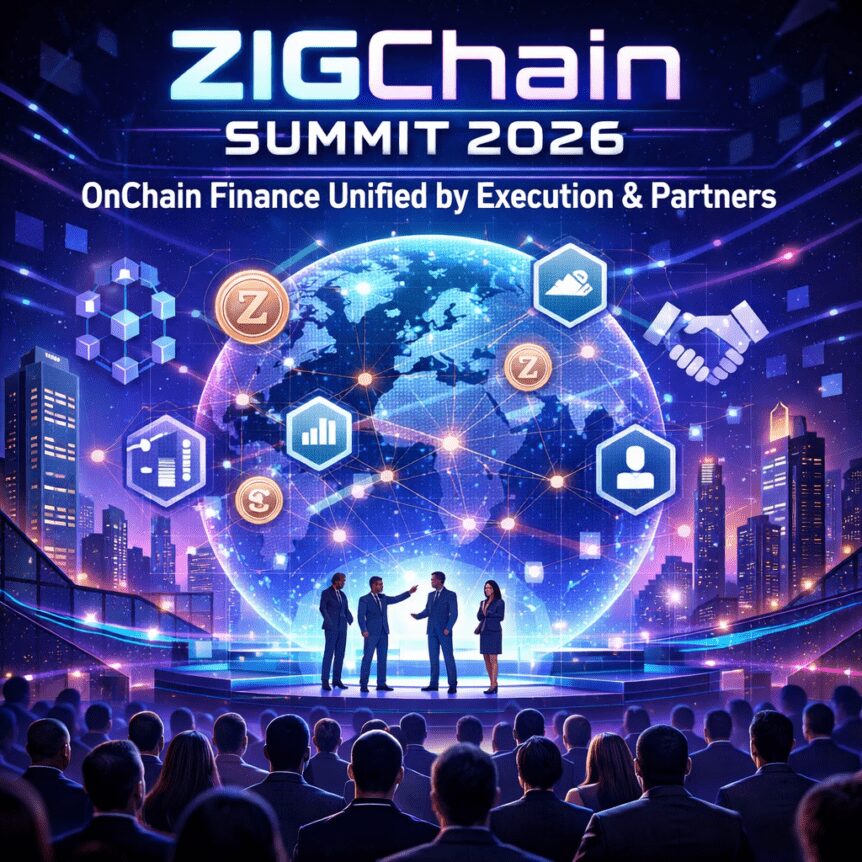
Dubai, UAE — ZIGChain hosted its second annual Summit on April 28 at The Meydan Hotel in Dubai, uniting regulators, institutional capital, and builders to push the adoption of regulated investment products onchain. The event, streamed live on Cointelegraph, illustrated a sector moving from exploration to execution as institutions and regulators converge around a practical framework for onchain finance in the GCC and beyond.
With the theme Nothing Compounds Alone, the program was designed not as a series of standalone talks but as an affirmative blueprint for coordinated progress. Organizers described the eight-session agenda as a mechanism to align capital, technology, and regulation in real time, aiming to accelerate decision-making and speed up the rollout of onchain financial products.
Key takeaways
- Regulatory clarity and multi-agency collaboration in the UAE create a conducive environment for institutional onchain adoption, with VARA, the DFSA, and FSRA cited as complementary pillars.
- Strategic partnerships and product rails on display, including aBeohive collaboration to tokenise UAE private credit and the deployment of Valdora Finance’s non-custodial liquid staking on ZIGChain, highlight tangible progress toward regulated onchain yields.
- The summit underscored a shift from pilot programs to scalable, institution-led deployments, signaling growing confidence in infrastructure and governance that can support large-scale capital allocation onchain.
- Participants from across the ecosystem—circles of capital allocators, custodians, and fintech builders—emphasized a shared objective: accelerate execution by synchronizing regulatory, technological, and financial flows on a common platform.
A milestone for regulated onchain finance in Dubai
The event’s framing around “Nothing Compounds Alone” captured a broader narrative: progress in onchain finance tends to accelerate when risk, governance, and capital are aligned in the same room. Sessions traced the ecosystem’s evolution from laying foundational infrastructure and leveraging the UAE’s regulatory edge to nurturing startup formation, fintech integration, and the tokenization of traditional assets into onchain formats. Attendees noted that policy clarity and interoperable infrastructure are now among the decisive factors that separate pilots from scale.
The UAE’s multi-regulator approach—anchored by VARA, the DFSA, and FSRA—emerged as a practical backbone for instituting governance that can accommodate regulated products onchain. In a market where institutional funds require verifiable compliance, the discussion at the Meydan Hotel reinforced a core takeaway: regulatory readiness is not a constraint but a growth lever for onchain offerings.
Concrete partnerships and product rails on display
One of the summit’s defining moments was the practical evidence of momentum beyond talk. A high-profile partnership with Beehive, the UAE’s regulator-facing SME funding platform, was highlighted as a path toward tokenizing private credit in the UAE. The collaboration, announced in the lead-up to the event, positions tokenized credit as a tangible entry point for institutions and retail participants to access regulated credit markets through onchain channels. For context, Beehive’s platform operates under the Middle East’s DFSA framework to enable regulated SME financing, making it a natural testbed for onchain credit products.
Additionally, Valdora Finance—an established non-custodial liquid staking protocol—announced deployment on ZIGChain. The deployment brings with it Liquid Real-World Asset Vaults, offering institutional-grade real-world yield strategies with liquid access. Together, these developments illustrate the architecture of an onchain ecosystem that is not only capable of handling regulated instruments but also designed to provide scalable, yield-generating access for institutions and informed retail participants alike.
The narrative around ecosystem momentum was reinforced by a roster of collaborations and product reveals throughout the day. The combination of tokenization initiatives, custody, asset management, and onchain yield infrastructure points to a broader strategy: build a regulation-ready, cross-chain ecosystem that can host a spectrum of regulated investment products—from private credit to other securitized assets—on a single, interoperable chain.
The UAE as the world’s onchain capital
A recurrent theme across sessions was the UAE’s positioning at the intersection of capital, policy, and digital asset infrastructure. The country’s regulatory architecture—framed as a multi-layered, cross-agency system—was cited as a critical factor enabling institutional capital to move onchain with confidence. Dubai, in particular, was highlighted as a hub where the convergence of advanced regulation, sophisticated financial players, and capable blockchain infrastructure is most visible and active.
Today’s gathering underscored that the onchain transition is not a distant prospect but a current reality being built through concrete collaborations and regulated deployments. By bringing together builders, allocators, and regulators in one room, ZIGChain demonstrated that the core infrastructure is not only ready but already being put into practice across the GCC and adjacent markets.
As the summit concluded, ZIGChain acknowledged the contributions of speakers, partners, attendees, and the broader ecosystem. The main-stage program, streamed to a global audience via Cointelegraph, signaled a growing appetite among institutional participants to engage with regulated onchain products in a manner consistent with traditional financial standards.
What comes next for onchain, regulated investment products
For investors and builders, the Dubai summit offered a clear implication: the onchain investment frontier is shifting from theory to practice. The Beehive partnership speaks to a concrete pathway for private credit tokenization, while Valdora’s integration illustrates how liquid staking and real-world asset yields can be made accessible to institutional portfolios. The UAE’s regulatory scaffolding provides a credible framework for scaling these products with appropriate oversight, potentially reducing the friction that has long constrained institutional entry into onchain markets.
Going forward, observers will want to watch the speed at which these partnerships convert into live products, the depth of capital that begins to flow through tokenized private credit and other onchain instruments, and how cross-chain interoperability evolves to support broader liquidity and custody solutions. The presence of diverse regulators and strong industry participation suggests a deliberate trajectory toward scalable, compliant onchain finance, rather than episodic pilots.
As the ecosystem matures, market participants will also be watching for additional formal announcements—new tokenized assets, custody arrangements, and further interoperability across chains—that could accelerate adoption. The question for investors remains whether the region’s regulatory clarity and infrastructure will translate into sustained capital formation and a wider array of accessible, regulated onchain products.
With ZIGChain positioning itself as an infrastructure layer for regulated, institutional-grade onchain opportunities, the coming months are poised to reveal how effectively such an ecosystem can scale. The summit’s emphasis on execution—paired with concrete partnerships and a governance-first framework—suggests that the era of practical, regulated onchain investment has begun to crystallize in the Gulf and beyond.
https://www.cryptobreaking.com/zigchain-summit-2026-onchain-finance/?utm_source=blogger%20&utm_medium=social_auto&utm_campaign=ZIGChain%20Summit%202026:%20OnChain%20Finance%20Unified%20by%20Execution%20&%20Partners%20
Comments
Post a Comment