
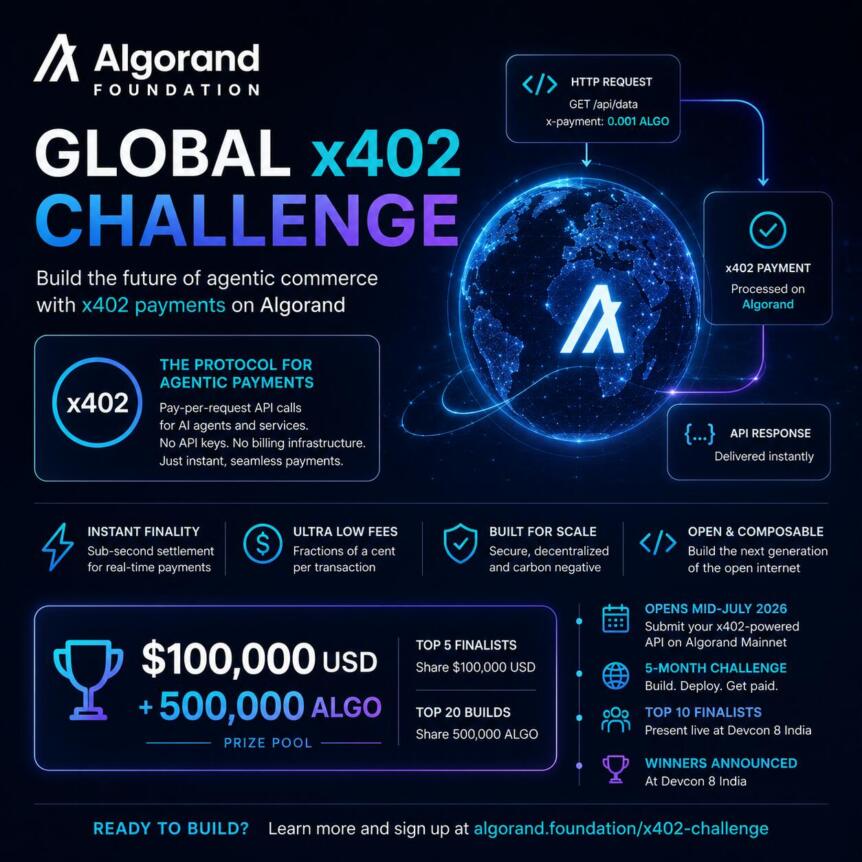
The Algorand Foundation has launched the Global x402 Challenge, a five-month competition aimed at developers building x402-powered, pay-per-request API services on Algorand mainnet. The program combines cash and token incentives, with a prize pool totaling $100,000 USD and 500,000 ALGO, reflecting a broader industry push to make on-chain payments easier for software agents and automated services.
The challenge is set to open in mid-July and run through early October. The top finalists will present at Devcon 8 India, with winners announced as part of the same event timeline.
Competition details: timeline, requirements, and prizes
According to the competition announcement, developers looking to participate must deploy a paid x402 endpoint on Algorand Mainnet. The initiative is structured around measurable usage, with tracking facilitated via the GoPlausible system and displayed on a public leaderboard.
In terms of progression, the program outlines a two-step selection approach. The leaderboard is used to identify the largest cohort of contenders, with the top 50 qualifying for 10 finalist spots. Those finalists will then present live, either in person or virtually, at Devcon 8 India.
The prize distribution is also tied to performance on the leaderboard. The top five finalists share the $100,000 USD prize pool. Separately, 500,000 ALGO will be split across the top 20 endpoints on the leaderboard. The Foundation notes that eligibility requirements, prize terms, and conditions are set out in the official rules, including jurisdictional restrictions.
What x402 is, and why it matters for agent payments
x402 is described as an open protocol designed to embed payment logic directly into HTTP requests. The Foundation’s announcement says the protocol was originally developed by Coinbase and is intended to allow AI agents and services to transact “per call” without relying on the same kind of traditional API keying or billing infrastructure associated with many payment integrations.
In practical terms, pay-per-request models are central to the economics of automated systems, especially when agent actions occur frequently and in small amounts. Rather than charging through a separate billing flow, the payment mechanism is coupled to the request itself, which can reduce friction for developers building agent-driven products.
The announcement further links this model to Algorand’s network characteristics. It cites instant finality and low transaction fees as reasons Algorand can function as a settlement layer for high-frequency agent payments at scale.
Momentum from Berlin hackathon and agentic commerce use cases
The Global x402 Challenge does not launch in isolation. The Foundation says it follows the Algorand Builders Berlin: Agentic Commerce x402 Hackathon held on June 6 to 7. The Berlin event reportedly drew more than 100 builders for a 36-hour sprint focused on x402-based agentic commerce.
Examples of winning build directions included an agentic trust layer for regulated finance and a peer-to-peer energy market scenario where an EV agent settles solar power purchases in real time without requiring a checkout step. While these examples illustrate the types of applications that developers appear to be targeting, the challenge itself remains focused on working x402 endpoints and real usage signals on mainnet.
Why this is a notable developer incentive for the ecosystem
Developer competitions tied to on-chain deployment are common across major networks, but they tend to differ in what they measure. Here, the Global x402 Challenge emphasizes a live product behavior signal, namely paid endpoint deployment and usage recorded on a public leaderboard.
For Algorand, the initiative can be read as an attempt to accelerate a specific segment of the developer ecosystem, namely integrations that bring automated payments into API-driven workflows. For the broader market, it also highlights ongoing efforts to align:
- AI agent operations with transaction settlement, in a way that scales operationally and economically.
- payment UX with software-native workflows, where payments occur in line with requests.
- developer tooling with measurable network activity that can be used to evaluate real-world readiness.
Because x402 is positioned as an open protocol, the competition also has the potential to attract teams that are not already deeply embedded in any one payments stack, provided they can meet the endpoint and eligibility requirements.
What to watch next
As the challenge opens mid-July, several factors will likely determine how much traction it gains among builders. These include how straightforward it is to deploy paid x402 endpoints on Algorand mainnet, how usage is reflected in the GoPlausible leaderboard, and whether teams can package x402 functionality into demonstrable agentic workflows suitable for presentation at Devcon 8 India.
The competition’s combined cash and ALGO structure suggests the Foundation is not only incentivizing prototypes, but also encouraging endpoints to reach meaningful usage before the judging and finalist presentations. For developers, the near-term focus will be on compliance with the official rules and building services that can sustain paid request patterns for the duration of the five-month window.
Links and rule details are referenced in the official challenge materials published by Algorand.
https://www.cryptobreaking.com/algorand-global-x402-challenge-100k/?utm_source=blogger%20&utm_medium=social_auto&utm_campaign=Algorand%20Foundation%20Launches%20Global%20x402%20Challenge%20With%20$100k%20Prize%20
Comments
Post a Comment