
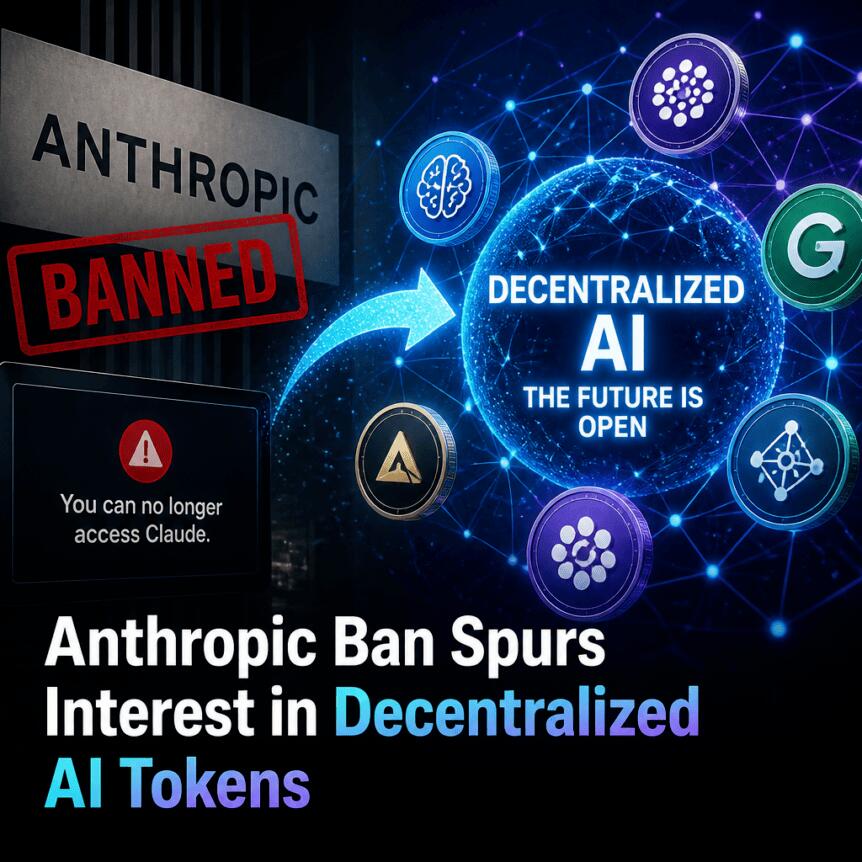
Grayscale researchers say Anthropic’s abrupt shutdown of access to its latest frontier AI models following a US government directive underscores the risks of centralized control over advanced AI systems. In a Monday note, Grayscale head of research Zach Pandl argued that the episode could accelerate interest in decentralized alternatives such as Bittensor.
According to the report, the US ordered Anthropic to suspend access to its models for foreign nationals on national security grounds. Anthropic then disabled access to Fable 5 and Mythos 5 for all users to comply with the directive, prompting a measurable shift in crypto market attention toward decentralized AI networks.
Key takeaways
- Grayscale’s Zach Pandl links Anthropic’s compliance move to the broader problem of centralized “frontier AI” access being controlled by a small number of entities.
- The US directive focused on foreign nationals, but Anthropic disabled access for all users, which Pandl called a warning sign for access risk.
- Grayscale reports that TAO rose sharply after the cut-off, climbing 30% within 12 hours and reaching a three-week high of $283 on Monday.
- Bittensor is positioned as an alternative network intended to provide AI access through decentralized infrastructure rather than a single lab.
- Industry observers cited by Cointelegraph argue the event sets a precedent for how governments can restrict commercial AI models quickly, potentially without standard procedural safeguards.
US directive prompts a wider shutdown
Cointelegraph reported that on Friday the US government directed Anthropic to suspend access to its AI models for foreign nationals, citing national security concerns. In response, Anthropic disabled access to Fable 5 and Mythos 5 for all users, not just those affected by the foreign-national requirement.
Pandl pointed to the speed and breadth of the change as evidence that centralized frontier AI access can be constrained overnight. He framed the episode as more than a policy dispute: it is a practical demonstration of how quickly access to cutting-edge capabilities can be revoked when decision power sits with a small set of institutions.
Grayscale: centralized control drives demand for decentralized AI
In his Monday note, Pandl said the US order “shows the centralized control of frontier AI technology and drives home the need for decentralized alternatives.” He argued that investors are likely to keep looking for different architectures that don’t rely on one company’s ability to grant or suspend access.
Grayscale expects that demand for decentralized AI—citing Bittensor specifically—will continue to rise as users search for options that are not subject to the same access chokepoints. Pandl linked this to the idea that governments and large AI labs increasingly influence “who can access these tools and under what conditions,” particularly as AI capabilities advance.
To illustrate the market reaction, Grayscale said that in the 12 hours after Anthropic cut access to its latest models, Bittensor’s TAO token climbed 30%. The note also claims TAO reached $283, a three-week high, on Monday—an indicator that traders were actively repricing decentralization narratives in response to the event. (TAO performance and the cited price level were attributed in the source to CoinGecko.)
“Think of it as Bitcoin for AI.”
Pandl described Bittensor as aiming to provide access to AI resources through an open, global, decentralized network—an “alternative vision” meant to reduce reliance on a single provider or centralized permissioning.
Why investors are watching decentralized networks
The debate here is not only technical; it’s about resilience. When a model vendor disables a service, users can lose access regardless of their location, and builders may have less certainty about continuity. Grayscale’s framing suggests that centralized AI deployment increases the probability of sudden disruptions tied to regulatory or security directives.
For market participants, the takeaway is that decentralized AI ecosystems are being evaluated not just on model quality or tooling, but on the structure of access itself. In other words, the episode became a live stress test of how quickly frontier AI access can change—and that test appears to have influenced attention toward networks positioned as alternatives.
However, important uncertainty remains: decentralized networks do not automatically guarantee immunity from regulation or other forms of restriction, and crypto token performance can reflect multiple factors besides the specific access event. Still, the timing described in Grayscale’s note suggests that traders and holders interpret the Anthropic directive as supportive of decentralization narratives.
Industry voices call it a precedent for AI governance
Beyond Grayscale, the source also includes comments from other participants in the AI-and-crypto space. Cointelegraph quoted EdgeRunner AI co-founder Colton Malkerson, who argued that the incident marks a “breaking point” for corporate data independence. He compared centralized AI access to “renting” intelligence from big labs, saying it is worse when access can be canceled and the provider can monitor the user’s activities as a condition of the service.
Tech entrepreneur and author Brett Hurt likewise described the US action as “a precedent,” arguing that if a government can silence a commercial AI model overnight without public hearing, technical disclosure, or an appeals process, then all labs may effectively operate under an unseen constraint.
These viewpoints align with Grayscale’s central message: access to advanced AI is increasingly treated as a policy lever. For crypto-native AI networks, that creates a motivating question for investors and users—whether decentralized systems can offer more continuity when centralized providers face sudden external directives.
Going forward, readers should watch how Anthropic’s compliance approach evolves—particularly whether access remains uniformly disabled—and whether additional policy moves target other frontier model providers. At the same time, market participants will likely continue tracking whether decentralized AI tokens capture sustained inflows, or whether the initial reaction fades as the situation clarifies.
https://www.cryptobreaking.com/anthropic-ban-spurs-interest-in/?utm_source=blogger%20&utm_medium=social_auto&utm_campaign=Anthropic%20Ban%20Spurs%20Interest%20in%20Decentralized%20AI%20Tokens%20
Comments
Post a Comment