
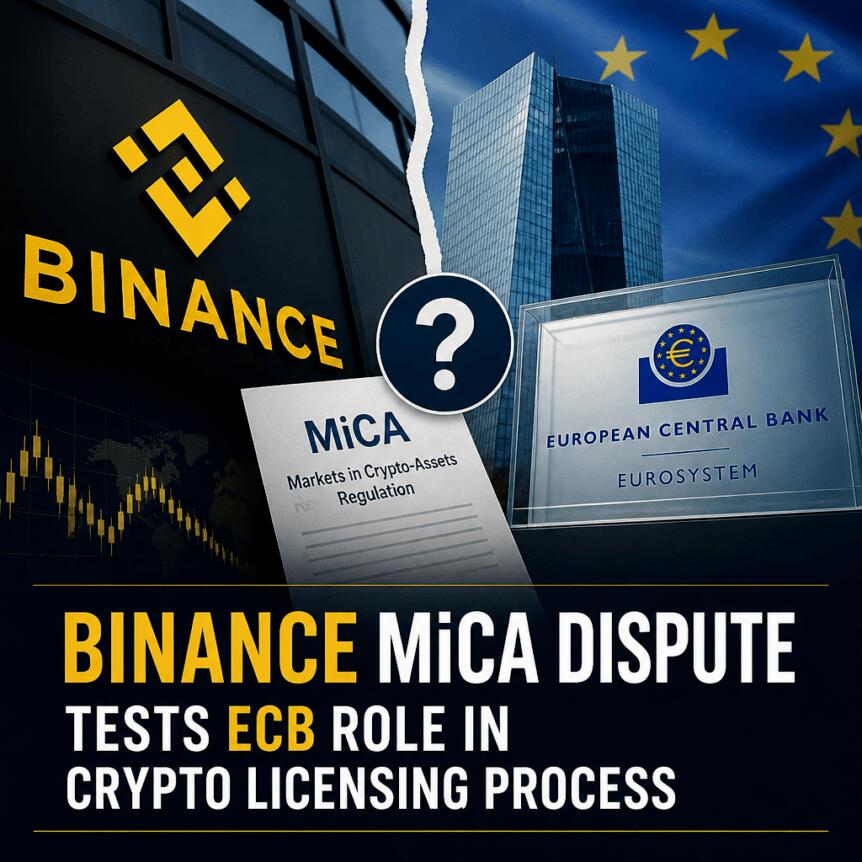
Binance’s troubled progress toward securing a MiCA license in Greece has sparked scrutiny over whether EU institutions beyond the formal licensing authorities could be influencing outcomes. The issue comes at a critical point in the MiCA rollout, with a hard transitional deadline approaching on July 1 that will determine which crypto-asset firms can continue operating across the EU under the new regulatory framework.
According to reports cited by Cointelegraph, speculation has grown that communication from European Central Bank (ECB) leadership may have affected political support for the exchange. Lawyers contacted by Cointelegraph, however, emphasized that MiCA’s design places the licensing decision with national competent authorities (NCAs), while also leaving room for other EU institutions to provide input.
Key takeaways
- Under MiCA, crypto-asset service provider (CASP) licenses are issued by national regulators, not directly by ECB or other EU-level bodies.
- Legal analysis suggests MiCA does not bar EU institutions such as the ECB from providing an opinion or sharing concerns with an NCA during a CASP review.
- In Binance’s reported Greece case, the relevant authority is the Hellenic Capital Market Commission (HCMC), while ESMA’s role is supervisory and not equivalent to granting the CASP license.
- ECB rhetoric on stablecoins has elevated the policy stakes, even though stablecoin-specific provisions in MiCA are distinct from the exchange licensing chapter.
- The situation highlights the compliance risk for EU market participants as the transitional period ends and licensing decisions become binding for continued operation.
MiCA licensing: national decisions with EU-level input
MiCA establishes a licensing regime for CASPs that is executed through national competent authorities. The regulation assigns authorization responsibilities to NCAs, meaning that an EU institution like the ECB does not, by itself, grant or deny an exchange license.
In Binance’s case, the licensing authority in Greece is the Hellenic Capital Market Commission (HCMC). Binance said in January that it had applied for a MiCA license in Greece. In the days that followed subsequent reporting about the application, Binance also indicated that the application had been reviewed for MiCA compliance and that it had been subject to an ESMA-level review as well, while maintaining that authorization would be decided at a future board meeting.
Legal practitioners contacted by Cointelegraph stressed that MiCA’s wording does not prevent other EU institutions from communicating with national regulators during the review. David Lesperance, founder at Lesperance & Associates, told Cointelegraph that “nothing in the MiCA framework would prevent a third party like the ECB from offering its opinion to that national authority on Binance’s application.”
Similarly, Yuriy Brisov of Digital & Analogue Partners noted that MiCA does not explicitly restrict the ECB from advising or sharing concerns with an NCA. At the same time, he pointed out an important structural detail: ECB involvement is expressly defined in specific parts of MiCA, especially regarding stablecoin issuance, rather than in the CASP licensing provisions that apply to exchanges.
In practice, this distinction matters for compliance and governance. Firms seeking MiCA authorization must address requirements assessed by the NCA, but they may also face broader regulatory scrutiny where EU institutions publicly or informally signal policy concerns that could affect how national regulators evaluate risk.
What the Greece reports suggest—and what remains unclear
Reports cited by Cointelegraph stated that Greece’s market regulator was preparing to reject Binance’s MiCA application. A subsequent report alleged that ECB President Christine Lagarde had signaled, through communication with Greece’s prime minister, that Binance should not be welcomed in Europe. These accounts were reported as the end of MiCA’s transitional period approached, increasing the practical importance of the final authorization outcome for firms’ continued EU operations.
However, public clarity around the exact decision status of the application has been limited. Brisov noted that the HCMC had not published a decision on Binance’s application. Cointelegraph also reported that ESMA does not itself authorize CASP licenses under MiCA, reinforcing that the decisive authority remains at the national level.
For institutional stakeholders, the unresolved question is not only whether an NCA will approve or reject a specific applicant, but also how cross-institutional signaling may shape the direction and tone of the licensing process. Even where legal authority is clearly assigned, the regulatory ecosystem often includes multi-layer interactions that can influence supervisory expectations, risk tolerance, and the evidentiary standards applied to applicant reviews.
ESMA and HCMC did not immediately respond to Cointelegraph’s requests for comment. The ECB and France’s securities regulator, Autorité des marchés financiers (AMF), also declined to comment.
Stablecoins and the ECB’s policy position: why it colors the debate
While the immediate dispute centers on a CASP license in Greece, the policy background is strongly linked to stablecoins. The ECB has repeatedly expressed concerns about privately issued stablecoins and has argued for payment and settlement infrastructure that is anchored in central bank money or otherwise tightly integrated with regulated financial systems.
According to reporting referenced by Cointelegraph, the alleged Lagarde intervention was tied, at least in part, to the stablecoin question. ECB officials have also argued in public remarks that Europe should prioritize regulated settlement systems rather than rely on private stablecoins. In separate commentary, ECB leadership has warned that stablecoins could reinforce the dominance of the US dollar.
This policy emphasis has compliance implications for exchanges and liquidity providers because stablecoin activity can affect how regulators assess systemic risk, market integrity, and the potential for regulatory arbitrage across jurisdictions.
Separately, market positioning is frequently cited in discussions of regulatory significance. Cointelegraph reported that CryptoQuant data indicated Binance held a large share of centralized-exchange stablecoin reserves, including USDT and USDC. The underlying point for institutional readers is not the particular figure itself, but the broader relevance: entities with large stablecoin footprints may become central to regulators’ expectations even when the formal decision concerns an exchange licensing application rather than stablecoin issuance permissions.
Cross-border compliance at the July 1 deadline
MiCA’s transitional period is designed to bring market participants into a harmonized regulatory regime. For exchanges and other CASPs, the July 1 deadline can determine whether continued EU operations require renewed authorization, restructuring, or cessation of certain activities under the new licensing framework.
This case illustrates a recurring compliance challenge across the EU: while legal responsibilities and licensing powers sit with NCAs, the regulatory environment is shaped by the priorities of EU-level institutions. Where institutions focus on stablecoins, payment settlement architecture, or financial stability, national regulators may adjust how they interpret MiCA’s risk-based requirements for CASPs—especially where an applicant’s business model intersects heavily with stablecoin liquidity and on- and off-ramp ecosystems.
Cointelegraph also reported that France could be another potential route for Binance, though it noted that no formal French application had been filed at the time of reporting. The broader compliance takeaway for firms operating across multiple EU jurisdictions is to avoid treating MiCA authorization as a purely jurisdiction-specific process; the effective evaluation can reflect an interplay of national supervision and EU policy priorities.
Closing perspective
As MiCA authorization outcomes tighten around the July 1 deadline, the Binance Greece situation underscores that the licensing process is not only a legal question of MiCA compliance checklists, but also a test of how EU regulatory institutions coordinate—formally and informally—around financial stability, stablecoin policy, and cross-border market integrity. Observers will likely focus next on whether the HCMC issues a decision and how other jurisdictions handle similar applications under the harmonized but politically charged MiCA landscape.
https://www.cryptobreaking.com/binance-mica-dispute-tests-ecb/?utm_source=blogger%20&utm_medium=social_auto&utm_campaign=Binance%20MiCA%20Dispute%20Tests%20ECB%20Role%20in%20Crypto%20Licensing%20Process%20
Comments
Post a Comment