
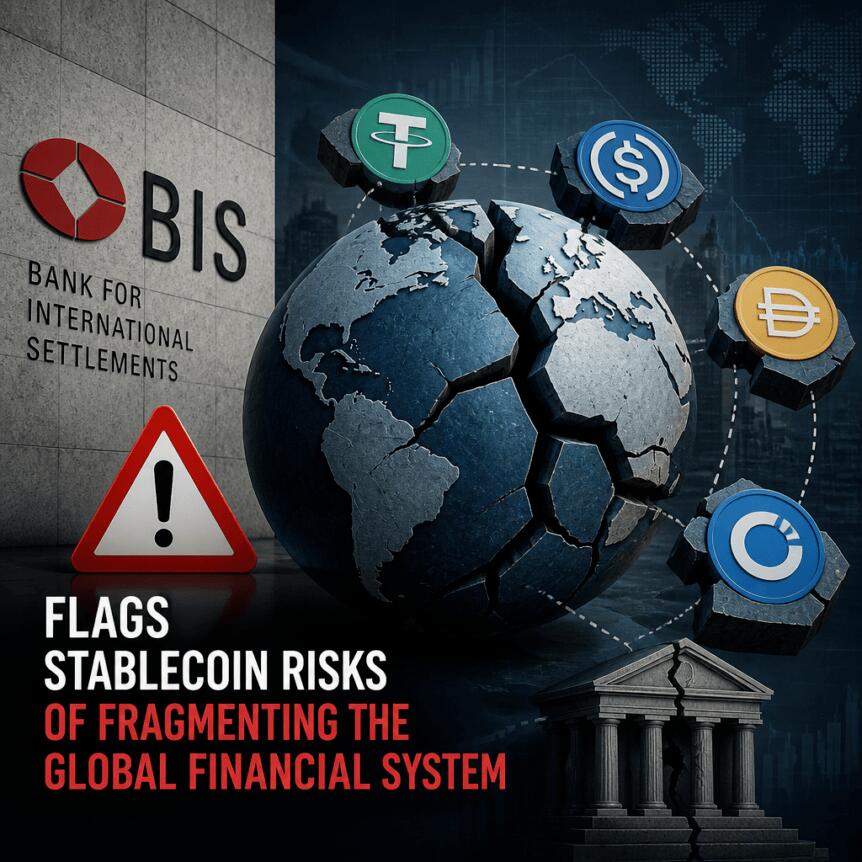
The Bank for International Settlements (BIS) has issued a warning that the fast-growing stablecoin market could destabilize the global monetary system—particularly by eroding central bank control and by pulling value away from bank deposits. In its Annual Economic Report published Sunday, the Basel-based institution says the scale of stablecoins has reached roughly $316 billion, and it argues that fiat-pegged tokens are not equipped with the institutional safeguards needed to function as “safe, reliable money” at system-wide levels.
Instead, BIS urges central banks and the broader financial sector to accelerate development of tokenized forms of central bank and commercial bank money on regulated infrastructures. The BIS message is not only a critique of today’s stablecoin structure, but also a policy signal that existing regulatory approaches may fall short as private digital currencies continue to expand.
Key takeaways
- BIS estimates the stablecoin market at about $316 billion and warns that its current design lacks features needed for large-scale “safe money.”
- Stablecoin growth could weaken banks and credit creation by enabling deposit migration into private digital tokens.
- BIS flags “stablecoin dollarization” as a risk to monetary sovereignty and domestic policy effectiveness, especially in emerging markets.
- Permissionless public chains face limits, in BIS’s view, due to scalability, legal accountability, and settlement finality requirements for systemic finance.
- BIS supports tokenization inside a regulated “unified ledger” model, combining tokenized central bank money and tokenized deposits.
Why BIS thinks stablecoins could strain the monetary system
In its report, BIS focuses on structural weaknesses it believes are inherent to stablecoins pegged to fiat currencies. The institution argues that these tokens do not carry the institutional features required to operate as trustworthy money at scale. A central part of BIS’s concern relates to how reserve assets are managed and governed.
BIS also highlights a potential macro-financial channel: if users shift value from commercial bank deposits into private digital tokens, banks could face reduced funding. In turn, that could constrain the credit banks provide to the real economy. The report frames this as a material risk created by stablecoins’ ability to transfer purchasing power outside the traditional deposit-based plumbing of the banking system.
For policymakers, BIS’s warning reads as a call for faster work on safer alternatives. Rather than aiming to position stablecoins as a lasting foundation for the monetary system, BIS says the more robust path is tokenized central bank and commercial bank money—supported by regulated infrastructures that preserve monetary stability and financial integrity.
Dollar-denominated stablecoins and the threat to sovereignty
BIS devotes particular attention to a trend it calls “stablecoin dollarization”—the increasing use of dollar-denominated stablecoins in jurisdictions with weaker domestic currencies. According to BIS, this pattern can have several second-order effects for countries that increasingly rely on external currency-linked digital products.
The report argues that stablecoin dollarization may undermine monetary sovereignty and reduce the effectiveness of domestic monetary policy. It also suggests the trend could decrease bank intermediation and heighten exposure to volatile cross-border capital flows, risks that BIS says are especially pronounced in emerging market economies.
For traders and market participants, this matters because stablecoin usage is not just a crypto-native phenomenon; it can reshape liquidity dynamics in foreign exchange-related channels by tying dollar value transfer more directly into the digital asset ecosystem.
BIS challenges permissionless networks as core monetary infrastructure
BIS goes beyond stablecoins themselves and delivers a sharply worded critique of the suitability of public permissionless blockchains—such as Bitcoin and Ethereum—as foundational layers for the monetary system. The report argues that decentralized networks that rely on distributed validation and lack central governance struggle to meet requirements that BIS believes systemically important financial infrastructure must satisfy, including scalability, legal accountability, and settlement finality.
A key part of BIS’s argument is that congestion and rising costs are not merely temporary bugs in permissionless systems, but rather are tied to their underlying economics. BIS contends that compensation for validators via transaction fees tends to increase with network activity, which can make congestion, slower confirmations, and higher costs persistent characteristics rather than solvable engineering limitations.
Just as importantly, BIS says permissionless networks generally lack the governance and accountability frameworks that institutional finance relies on. Without a clearly identifiable entity responsible for maintaining integrity, resolving disputes, or ensuring compliance with financial integrity standards, BIS argues that permissionless blockchains face major obstacles to supporting large-scale regulated financial activity.
Crucially, BIS is not rejecting tokenization outright. Instead, the BIS report argues for a different architecture—one where tokenized money and assets can be programmed for modern settlement benefits while remaining embedded in regulated, accountable institutional frameworks.
The “unified ledger” alternative BIS says can preserve stability
Rather than positioning tokenized assets to replace existing money mechanics, BIS proposes what it describes as a “unified ledger” approach. Under this model, tokenized central bank money, tokenized commercial bank deposits, and tokenized financial assets would be brought together on programmable platforms—within regulated legal and institutional boundaries.
In BIS’s framing, the objective is to keep the advantages that tokenization can bring—such as programmable transactions and faster settlement—while avoiding what it sees as the institutional risks associated with private fiat-pegged tokens operating outside traditional monetary controls.
This direction also signals an important policy tension: as private stablecoins expand, BIS suggests regulators and central banks may need to treat tokenized bank and central bank money as the more durable pathway for digital payments and settlement, not only a technological evolution but a governance one.
Going forward, investors, payment companies, and policymakers will likely watch whether jurisdictions move quickly toward regulated tokenized money pilots and whether new rules meaningfully address deposit-funding risks and dollarization dynamics—areas BIS singled out as central to its concerns.
https://www.cryptobreaking.com/bis-flags-stablecoin-risks-of/?utm_source=blogger%20&utm_medium=social_auto&utm_campaign=BIS%20Flags%20Stablecoin%20Risks%20of%20Fragmenting%20the%20Global%20Financial%20System%20
Comments
Post a Comment