
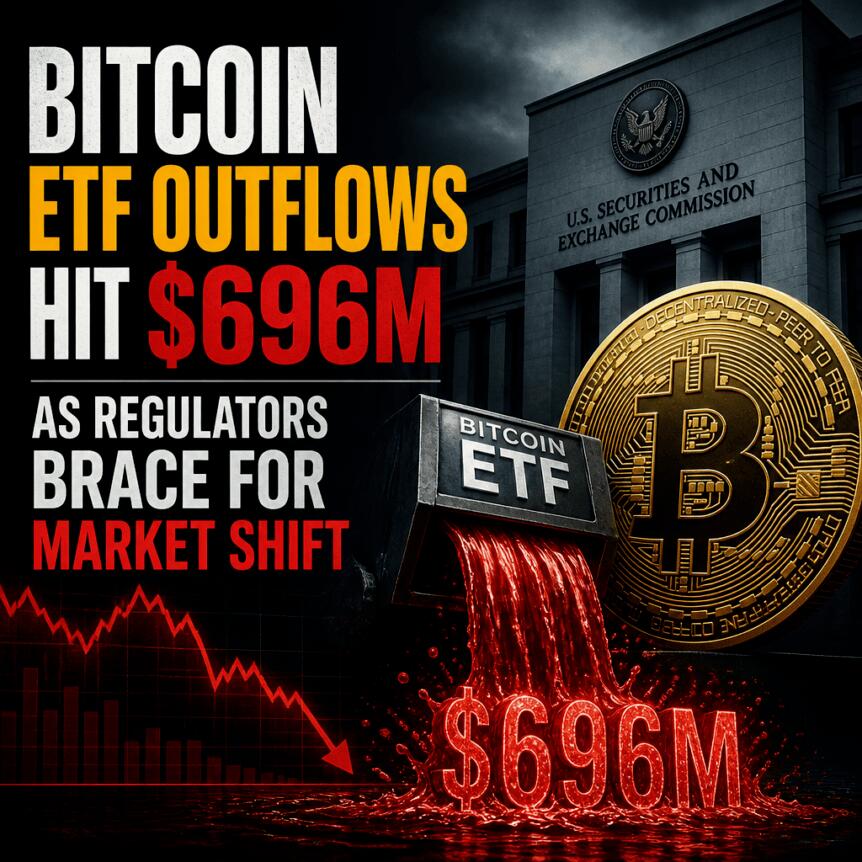
US-listed spot Bitcoin exchange-traded funds (ETFs) posted their largest June daily net outflows on Thursday, following renewed weakness in Bitcoin that pushed the asset below the $60,000 level. The withdrawals underscore a cooling in demand that many US-listed ETF investors previously relied on as a stabilizing institutional inflow channel.
SoSoValue data shows the outflows amounted to $696.3 million on the day, exceeding the prior monthly peak of $519.2 million recorded on June 2. As a result, total net outflows for June rose to $3.61 billion, lifting year-to-date net outflows to $4.6 billion, according to the same dataset.
Key takeaways
- US spot Bitcoin ETFs saw a $696.3 million net outflow on Thursday, the largest daily outflow in June.
- June net outflows reached $3.61 billion, bringing year-to-date net outflows to $4.6 billion (SoSoValue).
- Total net assets in US spot Bitcoin ETFs fell below $73 billion for the first time since late 2024, down roughly 57% from a reported October 2025 peak.
- Separate tracking data indicates ETF BTC holdings declined by about 63,500 BTC over the past 30 days.
- Strategy’s reported June buying pace slowed materially, prompting renewed scrutiny of institutional accumulation risk management and liquidity planning.
Spot Bitcoin ETF outflows accelerate in June
The Thursday withdrawals represent a material step-down in net inflows that had been supporting ETF balance sheets earlier in the year. According to SoSoValue, the $696.3 million net outflow surpassed the previous June high daily outflow recorded on June 2, signaling that the pullback is not confined to isolated days.
From a compliance and institutional risk perspective, sustained outflows can affect how ETF issuers and their service providers manage operational readiness and liquidity across custody, brokerage settlement, and fund administration. While ETFs remain structurally distinct from crypto spot custody models used by direct holders, the flow-through effect on the underlying Bitcoin exposure can become relevant to internal risk controls, including contingency planning for valuation, margining arrangements (where applicable), and concentration monitoring.
ETF net assets and holdings retrace from late-2025 highs
In addition to daily flows, broader balance-sheet data points to a sustained contraction in the ETF complex. SoSoValue reports that total net assets in US-listed spot Bitcoin ETFs have fallen below $73 billion for the first time since late 2024. The same source previously cited a record net assets level of $169.5 billion in October 2025; the latest figure is about $72.6 billion, representing a decline of roughly 57%.
WalletPilot data provides a view into the underlying Bitcoin holdings. It indicates that the funds held a combined 1.24 million BTC as of Tuesday, with approximately 63,500 BTC leaving the products over the prior 30 days. For institutions, the shift from flow-based indicators to holdings-based indicators is often critical: daily net flows can reverse quickly, but reductions in the total BTC held can influence longer-horizon risk assessments related to custody balances, redemption dynamics, and exposure to market-wide volatility.
Strategy’s slower accumulation draws renewed attention
ETF outflows are occurring alongside signs that other large sources of institutional Bitcoin demand are easing. Strategy, described as the world’s largest corporate Bitcoin holder, reportedly reduced its pace of Bitcoin accumulation during June.
Company filings indicate Strategy has bought roughly 3,600 Bitcoin so far in June, down from about 25,000 BTC in May and more than 50,000 BTC in April. The filings also show a net sale of 32 BTC earlier in the month—one of the few instances in which the company has sold Bitcoin during its accumulation period.
The change in behavior has prompted renewed debate about corporate treasury strategy, particularly whether liquidity preservation becomes a priority during market downturns. Critics have argued that Strategy should pause additional purchases and instead rebuild cash reserves, pointing to the importance of downside risk management for firms that rely on balance-sheet leverage and equity-linked financing structures.
In June’s context, institutional scrutiny is not limited to “buy or sell” decisions. It also extends to how capital is raised, how discount rates and equity market conditions influence treasury financing, and what liquidity buffers are maintained to support continued operations. These issues can indirectly affect how regulated counterparties—such as lenders, underwriters, and custodians—assess operational continuity.
Financing-market pressure and the preferred stock debate
Strategy’s perpetual preferred stock (STRC) has reportedly come under pressure. The stock has traded below its intended $100 benchmark level, with Thursday’s close reported at $75.69, down 6.37%.
The price movement has fueled discussion around whether the company’s preferred share financing approach is aligned with its long-term accumulation plan under stressed market conditions. CryptoQuant analysts raised concerns about timing and risk management, while Bitcoin advocate Samson Mow argued that STRC has a “self-repairing mechanism” that activates when the stock trades below its $100 benchmark. He also noted that Strategy pauses new share issuance through its ATM program at that level, limiting new supply.
For institutional stakeholders, this debate matters because financing mechanics can influence the predictability of future purchasing behavior. Where issuance programs and preferred-stock terms include triggers or constraints, equity-market volatility can propagate into accumulation schedules—creating uncertainty for counterparties that model corporate Bitcoin demand. It also raises questions for governance and disclosure oversight, particularly for firms subject to securities regulation and investor reporting obligations.
More broadly, policy compliance teams monitoring the crypto market may find it useful to connect these developments to regulatory context. US-listed spot Bitcoin ETFs operate under a mature set of investor protection expectations, including custody arrangements and securities-law compliance frameworks. At the same time, corporate treasuries and their financing instruments intersect with conventional financial regulation, making transparency and risk disclosures a recurring theme for oversight bodies.
What to watch next
Whether ETF outflows continue or reverse will likely remain the near-term indicator that shapes institutional exposure to Bitcoin via regulated wrappers. Separately, Strategy’s future acquisition cadence and any further changes in financing-market conditions could affect expectations for corporate demand, reinforcing the need for monitoring of disclosures, treasury liquidity posture, and the operational implications of sustained reductions in net asset growth.
https://www.cryptobreaking.com/bitcoin-etf-outflows-hit-696m/?utm_source=blogger%20&utm_medium=social_auto&utm_campaign=Bitcoin%20ETF%20Outflows%20Hit%20$696M%20as%20Regulators%20Brace%20for%20Market%20Shift%20
Comments
Post a Comment