
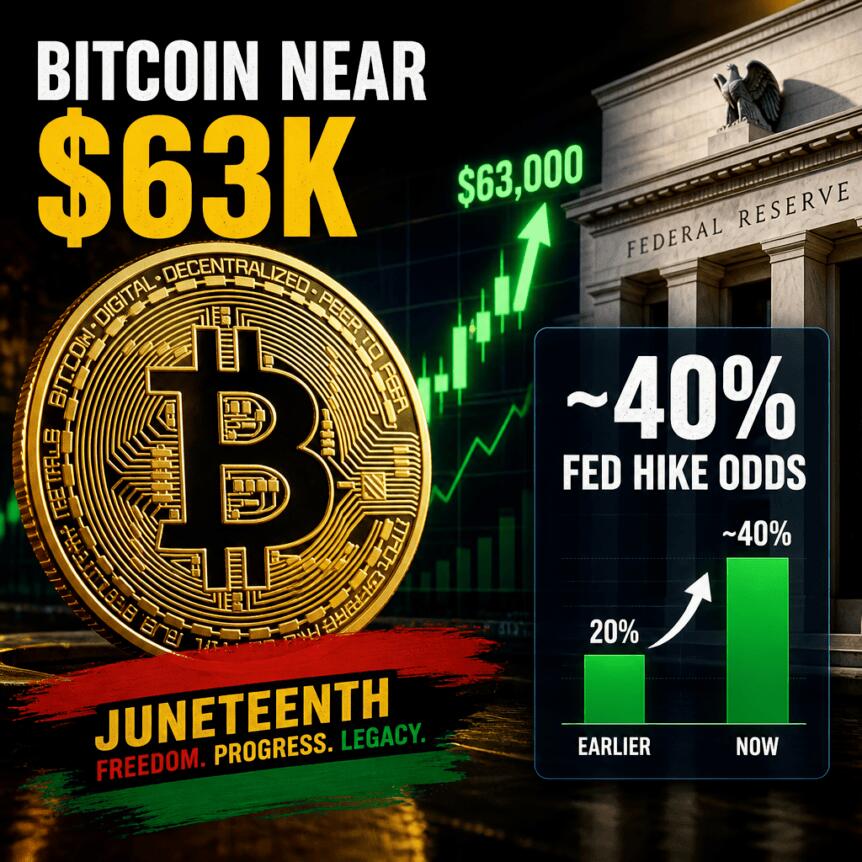
Bitcoin pushed back above $63,000 on Friday as traders digested a mix of macro policy signals and renewed attention on US-Iran tensions. The bounce came after BTC weakened into eight-day lows and then stalled near week-to-date support levels, suggesting the market was still searching for direction rather than building fresh momentum.
Alongside calmer volatility in crypto, attention drifted to the Strait of Hormuz and the implications of a recently signed US-Iran memorandum of understanding—developments that market participants typically treat as a tail-risk driver for risk assets, including Bitcoin.
Key takeaways
- Bitcoin’s rebound above $63,000 lacked follow-through, with BTC still confined to tight intraday ranges after falling to eight-day lows.
- The Federal Reserve’s latest decision was interpreted as broadly hawkish, with CME Group data pricing in close to a 40% chance of a hike at the next FOMC meeting.
- US-Iran tensions remain a live macro concern, with reporting highlighting that traffic through the Strait of Hormuz depends on Iran’s permission.
- One trader framed the current period as potentially leading to a “black swan” event later in the bear-market cycle.
Bitcoin stalls after the Fed’s more hawkish tone
BTC/USD trade activity remained range-bound on lower time frames following a move down to eight-day lows, according to TradingView data referenced by market coverage. Rather than accelerating higher, the market consolidated—an early sign that buyers were not yet confident enough to press beyond recent resistance.
The shift back toward tighter trading conditions followed the Federal Open Market Committee (FOMC) meeting, which was the first for new Fed chair Kevin Warsh. The Fed kept interest rates at current levels and, importantly, did not provide the kind of dovish cues traders had been looking for.
In the Fed’s post-meeting statement, Warsh emphasized that inflation remains above the committee’s 2% goal, noting that supply shocks have contributed to price increases in sectors such as energy. The statement also reiterated that the committee “will deliver price stability,” a message analysts interpreted as less accommodating than some market hopes.
Commentary from trading resource The Kobeissi Letter pointed to a change in how Fed communications may work going forward. The account argued Warsh’s approach was unusual compared with expectations that had him being more aligned with President Donald Trump’s calls for rate cuts, adding that the FOMC statement was also shortened and forward guidance appeared reduced.
In particular, the Kobeissi Letter highlighted a concern that communication could become less informative, arguing that this would increase uncertainty because fewer policy signals would be available to markets.
That uncertainty showed up in rate expectations. CME Group’s FedWatch Tool (as cited in the coverage) indicated markets were pricing in roughly a 40% probability of a rate hike at the next FOMC meeting in late July. In a market that often treats interest-rate direction as a key driver for liquidity and risk appetite, that pricing supports the idea that BTC’s recent weakness and hesitation may be more policy-linked than purely crypto-internal.
US-Iran developments keep geopolitical risk on the board
With US markets closed for the Juneteenth holiday, crypto remained more exposed to global headlines without the usual wall of liquidity from traditional markets. The renewed focus on the US-Iran conflict helped bring the Strait of Hormuz back into the discussion—specifically, whether transit through the narrow waterway will effectively remain controlled by Iran.
Earlier coverage noted that the US and Iran signed a memorandum of understanding (MoU). However, Friday’s commentary suggested the agreement does not remove deeper strategic disagreements. In reporting cited by Kobeissi, traffic through the Strait of Hormuz cannot cross without Iran’s permission.
Kobeissi’s account clarified that while the MoU suggests transit through the Strait of Hormuz would be “free” for the duration of its 60-day term, it does not resolve the broader question of long-term control. The post further concluded that Iran appears to be preparing for longer-term control of Hormuz.
Geopolitical risk typically matters for Bitcoin through a macro channel: tensions can translate into energy price pressure, inflation concerns, and shifts in market risk appetite—each of which can affect the pricing of risk assets.
Supporting that macro linkage, WTI crude oil continued to trade around $75 per barrel after posting its lowest levels since early March, according to the coverage. Even without a dramatic jump in oil at the time, the market’s willingness to track Hormuz-related developments underscores how quickly conditions can change.
Traders look for a “black swan” later in this bear market
As near-term volatility cooled, some market participants began framing what comes next rather than reacting only to today’s price action. Rekt Capital, a trader and analyst cited in the article, suggested that Bitcoin’s more decisive test may not arrive immediately.
In a post on X, Rekt Capital told followers that “there tends to be a Black Swan event in the second half of Bitcoin Bear Markets,” presenting it as a pattern-based lesson rather than a specific forecast of timing or magnitude.
While such commentary cannot be treated as a data-driven prediction, it reflects a broader reality of crypto cycles: markets often experience delayed shocks rather than smooth, linear declines or rebounds. For traders, the practical takeaway is that a quiet patch—especially one following a macro-driven selloff—can sometimes be a pause before a more consequential move.
What to watch from here
Bitcoin’s current range behavior above $63,000 appears closely tied to Fed-driven uncertainty and geopolitical headlines. Traders will likely keep an eye on evolving rate pricing ahead of the late-July FOMC meeting, as well as further developments around Strait of Hormuz transit and oil-market signaling—two factors that can quickly reintroduce volatility if the narrative shifts.
https://www.cryptobreaking.com/bitcoin-near-63k-as-juneteenth/?utm_source=blogger%20&utm_medium=social_auto&utm_campaign=Bitcoin%20Near%20$63K%20as%20Juneteenth%20Lift%20Coincides%20With%20~40%%20Fed%20Hike%20Odds%20
Comments
Post a Comment