
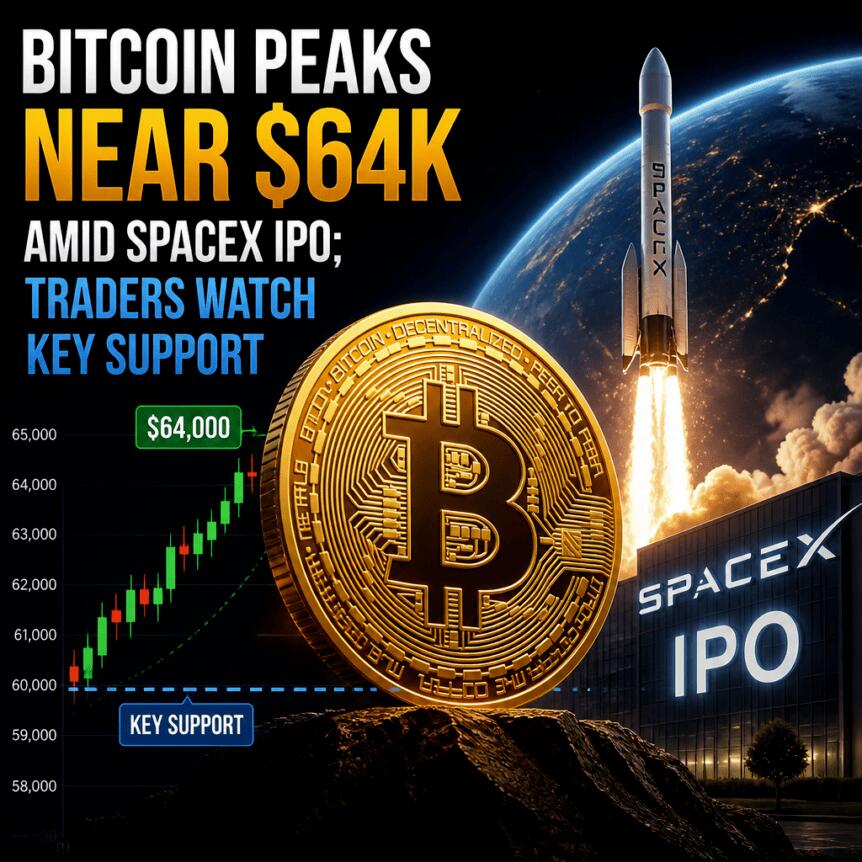
Bitcoin pushed into fresh local highs around $64,000 during the early US session on Friday, helped by a modest improvement in broader risk sentiment tied to hopes of a US–Iran de-escalation. Even so, analysts flagged that some widely watched technical levels may not be as dependable as they appear, keeping traders alert to the possibility of renewed volatility.
At the same time, equity markets appeared to “pause” at the open while attention turned to Wall Street’s calendar of major events, including SpaceX’s IPO preparation. Data from TradingView indicated BTC/USD holding gains through the move, but sentiment remained fragile as investors continued to weigh inflation-linked macro signals.
Key takeaways
- BTC/USD rallied toward $64,000 in US trading as risk-asset sentiment received a limited boost from US–Iran peace hopes.
- Macro backdrop remained mixed: inflation concerns and the strength of the labor market were both emphasized by market analysts.
- Rekt Capital cautioned that the 200-week SMA near $62,025 has historically failed to hold as reliable support.
- Bitcoin’s price action below prior 2021 all-time-high territory could still be working through a multi-month pattern, per Rekt Capital.
Risk assets steady while US–Iran headlines move the tape
TradingView data, as cited in Cointelegraph’s coverage, showed Bitcoin maintaining gains during the US session while crypto and risk-asset markets digested a stream of conflicting signals. The immediate catalyst was not a Bitcoin-specific development, but rather improving expectations around a potential US–Iran agreement.
However, the situation also carried uncertainty. At the time of writing, there was no definitive, official confirmation that negotiations would translate into a deal, and US President Donald Trump publicly disputed the Iranian side’s account. In a post on Truth Social, Trump wrote that the other side’s statements were “weak and pathetic” and said they “bears no relation to the truth.”
With headline-driven sentiment, BTC’s upside momentum appeared more like a reflection of broader positioning than the start of a durable trend shift. Traders often respond quickly to risk-on cues—yet when clarity is missing, those moves can reverse just as fast.
Inflation anxiety persists, but equities look for reasons to hold up
Beyond geopolitical headlines, market participants were also focused on the macro mix. Mosaic Asset Company, in its latest “Mosaic Chart Alerts” update, argued that equity markets seemed to “shrug off” inflation headwinds even as inflation and labor conditions remained central to the narrative for valuations and monetary policy.
According to Mosaic, strong economic data was giving stocks an additional reason to rally. The firm also pointed out that some of the air had been released from the outsized momentum in AI infrastructure stocks, while laggards that had fallen from late March lows appeared to be turning upward more recently.
This matters for Bitcoin because—despite crypto’s growing maturity—BTC still frequently trades as a high-beta asset during macro-driven sessions. If inflation fears intensify or policy expectations shift sharply, liquidity conditions can change quickly and affect how much risk investors are willing to allocate.
SpaceX IPO highlights how Wall Street event risk can shape market tone
US stock trading got underway as SpaceX moved closer to what’s described as the largest IPO in history. Cointelegraph previously reported the IPO’s setup, and in this session coverage noted that shares were slated to debut at $170, $45 above the initial IPO price.
While an IPO does not directly determine Bitcoin’s technicals, major Wall Street events can influence day-to-day sentiment and cross-asset flows—especially during sessions when inflation and geopolitics are already competing for attention. For traders, that backdrop can mean wider intraday swings and faster rotation between risk-on and risk-off positioning.
Technical scrutiny: $62,025 200-week SMA questioned
Even with BTC testing new local highs near $64,000, some market participants remained cautious. Trader and analyst Rekt Capital zeroed in on Bitcoin’s long-term 200-week simple moving average (SMA), which was cited near $62,025.
Rekt Capital’s view was straightforward: Bitcoin is treating that 200-week SMA as support, but the level has “historically proven to be an unreliable support,” with price breaking down from it over time. In other words, the fact that BTC is above or near a major moving average does not automatically guarantee a stable floor.
Rekt Capital also pointed to another potential friction point: BTC/USD has dropped below old all-time highs from 2021. He suggested that this deviation often takes months to “fully develop” into a bear-market bottom, implying that the current phase may not be finished.
In a subsequent comment, Rekt Capital quantified the distance from those prior highs, stating that Bitcoin had deviated about -14% below old all-time-high levels thus far and that the process is “still technically ongoing” and could continue for a while.
For investors, the practical takeaway is not that BTC is destined to decline, but that the market may be in a longer adjustment period where support levels—especially those defined by higher-timeframe averages—are more likely to be tested than to provide certainty.
Going forward, traders will likely watch two things closely: whether BTC can sustain strength as macro headlines evolve, and whether the 200-week SMA around $62,025 continues to hold better than it has in past cycles. With geopolitical clarity still incomplete and macro data capable of shifting quickly, the next confirmed moves may come from broader risk sentiment as much as from Bitcoin-specific catalysts.
https://www.cryptobreaking.com/bitcoin-peaks-near-64k-amid/?utm_source=blogger%20&utm_medium=social_auto&utm_campaign=Bitcoin%20Peaks%20Near%20$64K%20Amid%20SpaceX%20IPO;%20Traders%20Watch%20Key%20Support%20
Comments
Post a Comment