
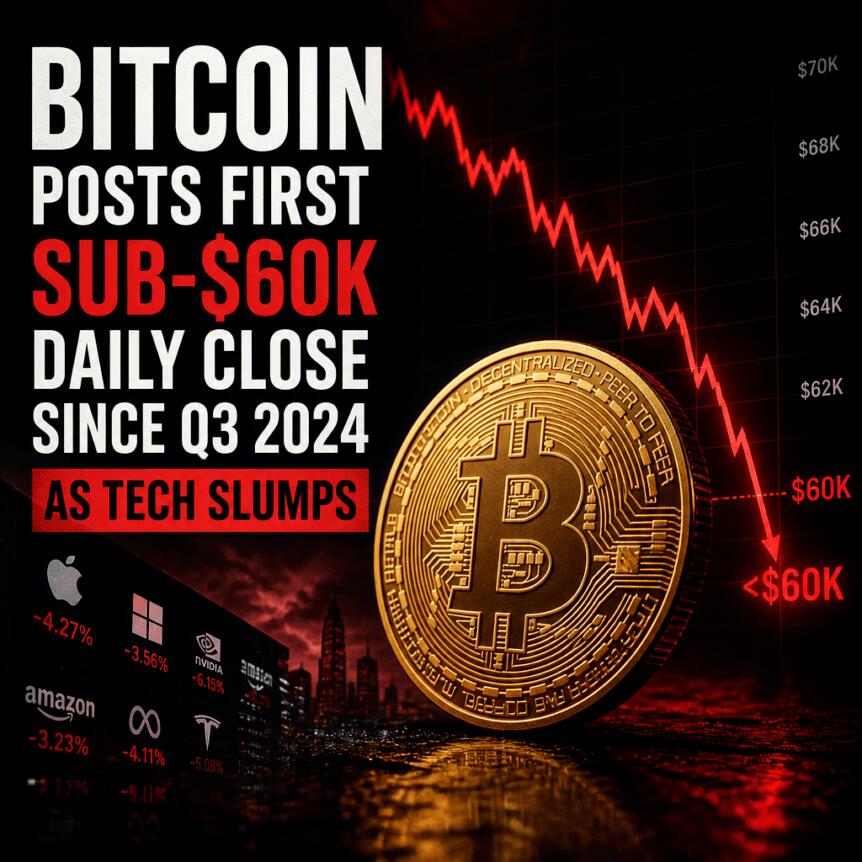
Bitcoin hovered under a key psychological level on Friday as broader risk sentiment stayed fragile. After failing to sustain momentum above $60,000, BTC slipped again and, on daily charts, closed below the $60,000 mark for the first time since September 2024—an important technical shift that traders will likely treat as a level to defend if a recovery is to hold.
Volatility in traditional markets added pressure. Asian equity markets recorded another session of heavy losses, particularly in technology stocks, while U.S. trading managed to avoid a broader contagion effect at the time of writing. Overlaying the price action, analysts pointed to macro drivers—especially the latest inflation reading—as well as a closely watched trend indicator: Bitcoin’s 200-week moving average.
Key takeaways
- BTC closed below $60,000 on daily time frames for the first time since September 2024, putting renewed focus on the level as potential resistance.
- Technology-stock weakness in Asia extended into the session, with risk conditions remaining sensitive to market headlines.
- QCP Capital highlighted that inflation dynamics—not economic growth—appear to be constraining risk assets, referencing higher PCE projections.
- Analysts are watching whether BTC can reclaim the 200-week simple moving average, which stood around $62,243 at the time of writing.
- Quarterly options expiry is on the radar, and traders are monitoring whether daily bullish divergence can develop into confirmation.
$60,000 turns into a “decision” level
According to TradingView data referenced in Cointelegraph’s market coverage, the first sub-$60,000 daily close since September 2024 marked a clear technical change. Prior support appears to be increasingly viewed as overhead resistance, a common pattern in market structure when price repeatedly fails to reclaim a level after breaking it.
Traders also noted that the move came alongside continued equity weakness. Asian markets saw additional downside, including a sharp move in South Korea where circuit-breakers were triggered on a new 8% crash. While the immediate U.S. session had pockets of strength—S&P 500 and Dow Jones both were in the green at the time of writing—crypto traders often watch cross-asset correlations during these periods of elevated macro uncertainty.
Tech sell-off and the question of whether it “spills over”
Technology performance remained central to the day’s narrative. While some developments provided short-term relief—Micron Technologies reported stronger-than-expected results—market participants largely continued to frame the session through the lens of tech-sector stress.
The Kobeissi Letter argued that part of the apparent resilience may be due to how many well-known technology names are already trading deep in bear territory relative to their own highs. In an X post cited by Cointelegraph, the account wrote that many major tech companies were already down more than 50% from all-time highs, adding that Coinbase led its group in drawdown at -69%. Kobeissi also warned that the S&P 500 may not fully reflect this underlying damage across individual stocks.
For Bitcoin traders, the practical implication is straightforward: if tech weakness persists, it can keep pressure on broader risk appetite, even when BTC holds around a major round-number level. On the other hand, if the market is able to stabilize in equities while crypto forms its own divergence signals, BTC may still have room to recover without requiring a full macro reversal.
Inflation remains the binding constraint
In a separate analysis highlighted by Cointelegraph, QCP Capital emphasized the continuing influence of U.S. inflation trends on risk assets. The firm pointed to the Personal Consumption Expenditures (PCE) index—described in the coverage as the Federal Reserve’s preferred inflation gauge.
Earlier reporting referenced by Cointelegraph noted that the May PCE print showed its highest year-on-year increase since mid-2023. In that context, QCP’s quoted view was that:
“Core PCE is nowcast at 3.30%, while headline PCE is nowcast at 3.82%, both still above target.”
QCP further added that the Fed’s 2026 inflation forecast had moved higher to 3.6% from 2.7%, reinforcing the view that inflation—more than growth—is the factor most likely to steer expectations for rates. With investors still pricing the path of monetary policy, that backdrop can translate into tighter conditions for assets that trade like risk-sensitive proxies, including BTC during periods of correlation.
For readers watching next, the key is not only whether inflation cools, but whether markets begin to interpret the data as less restrictive to liquidity. Until that interpretation shifts, BTC rallies may struggle to sustain above resistance zones such as $60,000.
200-week trend line reclaim in focus
Technical analysts also turned attention to Bitcoin’s longer-term trend. Crypto trader and analyst Michaël van de Poppe raised the question of whether BTC’s downward momentum would continue, describing Friday as an “interesting day for Bitcoin” in part due to an upcoming quarterly options expiry event.
In Cointelegraph’s cited discussion on X, van de Poppe noted that BTC had largely stalled near $60,000 while Strategy’s Bitcoin-related vehicle—Stretch (STRC)—saw a relatively larger drop in the prior day. He did not frame that as a definitive bearish signal, saying that the information alone is not “a weak signal,” but he also highlighted that a bullish divergence on the daily timeframe still remained unconfirmed.
“It can signal that we're bouncing back upwards, and, yes, the markets need to bounce back upwards in order to close above the 200-Week MA.”
The moving average in question is the 200-week simple moving average. Cointelegraph’s report put it at $62,243 at the time of writing—an explicit target level for bulls. If BTC can build a recovery that holds above $60,000 and then presses toward the mid-$62,000s area, it would suggest the market is trying to transition from break-down structure back toward a longer-term uptrend.
What remains uncertain is whether the bullish divergence will earn confirmation through subsequent closes, especially given the macro backdrop. Traders are likely to treat the path toward the 200-week line as a test: a quick push may attract buy interest, but if inflation-sensitive risk pressure returns, the move could fade before it reaches a decisive technical milestone.
For the next session and beyond, watch for two things: whether BTC can hold $60,000 as demand rather than supply, and whether daily follow-through supports a move toward the 200-week SMA near $62,243. Without improvement in those areas, the recent daily break could continue shaping downside expectations even if equities avoid outright contagion.
https://www.cryptobreaking.com/bitcoin-posts-first-sub-60k/?utm_source=blogger%20&utm_medium=social_auto&utm_campaign=Bitcoin%20Posts%20First%20Sub-$60K%20Daily%20Close%20Since%20Q3%202024%20as%20Tech%20Slumps%20
Comments
Post a Comment