
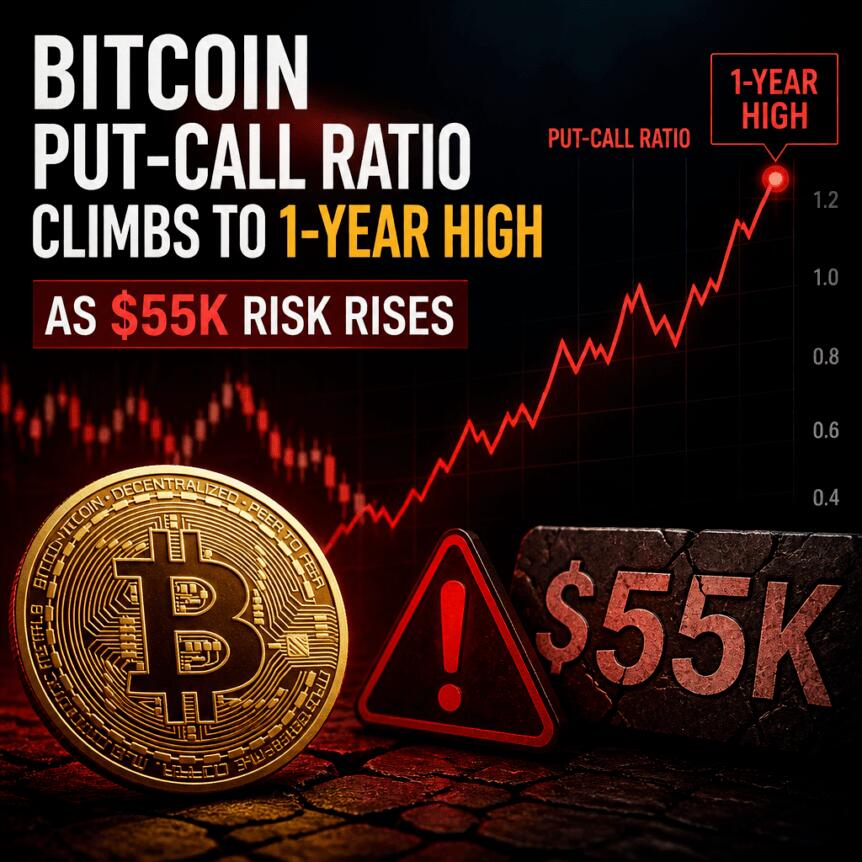
Bitcoin is struggling to regain the $61,000 level, and options markets are reflecting growing demand for downside protection. Traders are now openly debating whether $55,000 could become the next major support test as the market’s hedging behavior turns unusually aggressive.
At the same time, the broader backdrop for risk assets has improved—crude oil has fallen following a US–Iran 60-day ceasefire agreement—and capital appears to be rotating toward US tech, particularly semiconductors. For crypto investors, that divergence between traditional-market momentum and Bitcoin’s options-driven caution is becoming hard to ignore.
Key takeaways
- Deribit data shows put-option premiums are overwhelmingly higher than call premiums, with Friday’s put-to-call imbalance at the highest level in more than 12 months.
- A 19% 30-day delta skew suggests options market makers are not willing to carry downside exposure, implying persistent hedging demand over the past month.
- Strategy’s (formerly MicroStrategy) latest capital actions reduce some near-term dividend and debt concerns, but do not remove market uncertainty around Bitcoin supply dynamics.
- Outside crypto, Bloomberg-linked ETF flows point to heavy inflows into semiconductor funds, while US-listed Bitcoin spot ETFs have experienced seven consecutive weeks of net outflows.
Options traders lean into downside protection
Despite renewed optimism linked to lower crude oil prices after the US and Iran agreed to a 60-day ceasefire, Bitcoin has not been able to reclaim $61,000 since Thursday. The clearest sign of caution is visible in derivatives positioning.
On Deribit, the premium paid for Bitcoin put (sell) options totaled $115 million on Friday, compared with $16 million paid for call (buy) options. This put-call imbalance was reported as the most extreme in over 12 months, indicating unusually low appetite for bullish exposure.
However, the data does not automatically translate into coordinated bearish conviction. A surge in puts can also reflect risk management by investors who want protection without necessarily expecting an immediate collapse. Even so, the broader structure of the options curve reinforces the sense that hedging is in demand rather than speculative upside bets.
That structure is captured by the 30-day delta skew, which stood at 19% on Monday on Deribit. In practical terms, such a skew signals that market makers are unwilling to hold meaningful downside exposure. According to the analysis reflected in the article, this fear has effectively been “the norm” for roughly four weeks, lining up with Bitcoin’s difficulty holding above $60,000.
The market’s reaction matters because it can increase the cost of negative scenarios: more demand for protection typically means higher implied costs to insure positions. Traders watching the $55,000 level may therefore also watch whether the options skew starts to mean-revert—or whether demand for downside hedges continues to rise.
Strategy’s cash moves calm some fears—but don’t resolve supply questions
Another factor shaping sentiment is investor concern about Strategy’s ability to meet obligations. The company’s reaction provides some near-term comfort, even as it raises new questions for Bitcoin’s balance between potential selling and demand.
Earlier coverage noted discomfort around MicroStrategy (now Strategy) regarding dividends and debt maturities in 2027. On Monday, the company announced additional actions tied to liquidity: it disclosed an additional $1.2 billion in cash sourced from recent share sales, and it set aside $1.25 billion in Bitcoin for eventual sale.
From an investor’s perspective, the added cash helps address near-term funding anxiety. The reported logic also suggests bears may feel less pressure from forced issuance of MSTR shares—because, as the article states, the company does not have incentives to issue shares given its reported 17 months of dividend coverage.
Yet the same actions can introduce another layer of uncertainty: any reference to future Bitcoin sales keeps the market focused on supply/demand dynamics. Even if no sales occur in the “next couple of months,” the knowledge that a portion of holdings is earmarked for selling can continue to weigh on sentiment at the margin.
Capital rotation: semiconductors draw inflows while Bitcoin spot ETFs leak
While Bitcoin’s derivatives market shows caution, parts of traditional markets have leaned more constructive. The article points to easing inflationary pressure and the drop in crude oil to its lowest level in four months. It also highlights a Goldman Sachs report projecting 22% annual earnings growth for S&P 500 companies, which helped reduce worries about excessive valuations.
In that environment, retail investors appear to be reallocating toward semiconductors. The analysis cited by “The Kobeissi Letter,” using Bloomberg data, claims more than $20 billion in cumulative inflows into semiconductor exchange-traded funds (ETFs). That activity is said to have helped drive an 81% rally in the iShares Semiconductor ETF (SOXX) and 60% gains in the VanEck Semiconductor ETF (SMH).
Against this backdrop, Bitcoin is also facing persistent resistance from spot ETF flows. The article notes seven consecutive weeks of net outflows from US-listed Bitcoin spot ETFs, a pattern that has “shattered” hopes for a strong rebound from the reported $58,050 lows on June 25.
Even if some selling pressure is ultimately explained by sector rotation rather than a direct deterioration in Bitcoin fundamentals, the implication for near-term price action is straightforward: sentiment is unlikely to improve while flows remain consistently negative. Traders expecting a bounce may therefore need to see not only macro stabilization but also signs that ETF outflows are easing.
What to watch next as hedging and flows diverge
A retest of $55,000 should not be dismissed given the options market’s demand for downside protection. Still, the same skew that signals fear can also reflect investors hedging rather than betting against Bitcoin’s long-term prospects. The key variables moving forward are whether the options put-call imbalance and 30-day delta skew start to normalize—and whether US spot Bitcoin ETF flows begin to recover from their seven-week streak of net outflows.
https://www.cryptobreaking.com/bitcoin-put-call-ratio-climbs/?utm_source=blogger%20&utm_medium=social_auto&utm_campaign=Bitcoin%20Put-Call%20Ratio%20Climbs%20to%201-Year%20High%20as%20$55K%20Risk%20Rises%20
Comments
Post a Comment